The Commanding Heights
Scarce, controllable positions of economic power whose holders durably capture the gains of increasingly capable and diffused intelligence.
Will Manidiswill@willmanidis.com & Joe Robertsjoe@josephjcroberts.com
Read or
Acknowledgments
Special thanks to Edwin Farrell Gregory
Joe thanks his wife, Gwynna Dille
We also thank the following, who have given feedback on this document or shaped its ideas, with no presumption of endorsement:
Shyam Sankar, Sriram Krishnan, Michael Kratsios, Jeff Huber, Patrick O’Shaughnessy, Ravi Gupta, Samay Shamdasani, John Aristotle Phillips, Jamie Cox, Zack Baker, Jeremy Giffon, John Fiorentino, Justin Mares, Nabeel Qureshi, Samir Unni, Clark Minor, Dan Ashton, Paul Rice, Austin Bishop, John G Kennedy, Nick Abouzeid, Alex & Talia Immerman, Chauncey Hamilton, Zann Ali, Lucas Vaz, Josh Buckley, Max Meyer, Tomás Pfeffer, John Dulin, Charlton Boyd, Ben Braverman, Louis Mosley, Zane Dille, Isabella Garcia-Camargo, Will Reed, Zoe Taylor, Bala Chandrasekaran, Chad Byers, Pratyush Buddiga, Salen Churi, Cody Kittle, and foreign correspondents C.S., D.P.M., and C.V.
Ravi
Ravi wakes up at 5:56 AM to light tapping on the window. It is the rainy season, and his upper-middle-class apartment in Bellandur, which usually has such expansive views of Bangalore, is cloaked in fog. His wife is still asleep next to him, and he is careful not to wake her as he dresses. He clutches his buzzing phone.
Ravi is a proud graduate of the Indian Institute of Technology Madras, one of the top technical universities in India. He is among those who remained after graduating fourteen years ago. Others went to Europe, Canada, or America, but Ravi saw a bright future in the growing skyscrapers and the promise of nearly 1.5B Indians climbing up the ladder of modernization. He moved to Bangalore, fell in love, married, and had a daughter. He began doing systems implementation at a multinational firm that primarily did back-office accounting for American clients. He slowly rose up the corporate scale, promotion after promotion and incremental salary raises affording a better life than most. The rest of his career, his life, is laid out predictably before him like the table set he sees in the morning light as he moves through the kitchen, pouring tea.
The phone continues to buzz. His work has been speeding up and ballooning in scale. He’s managing delivery for five North American insurance clients. Usually it’s just one or two. It’s all because of AI. In practice the company calls it “accelerated outcome strategies,” a very nondescript term, but it means Ravi is managing more and more automated processes. He is used to overseeing people. These days, he’s just doing quality assurance on enterprise accounting systems powered by artificial intelligence from China. Graduate intake to the company has been paused for a year, and the fresh minds from the IITs are no longer coming in. In the last month, three departures alone on his team of fifteen. They won’t be filled. He’s been getting requests to help friends find work, but he doesn’t have time to answer. The agents never sleep. Now, neither can Ravi. Late nights at the office and early departures. It’s been like this for months, and his marriage is strained. But business is booming. Margins for the company have been steadily growing. He’s making more than ever.
He checks on WhatsApp as he waits for his driver in the lobby of his building at 6:22. He recently purchased a subscription to an AI tutor for his daughter and took her out of the reasonably pricey private English-medium school. He can oversee her curriculum from the app. He doesn’t look up from his phone, buzzing with incoming reports from agents that he signs off on without reading as the driver opens the door. He hardly reads the reports anymore; the agents are good enough. The car silently glides past the galvanized steel gates and new concrete walls that surround his safe, hard-won, upper-middle-class residential complex right at 6:25.
The driver puts on BBC as they roll onto a six-lane highway jam-packed with other drivers. Still raining, a certain tension in the air. English words, a polished Indian accent. The weather will clear up around mid-afternoon. New scientific discoveries announced from the sequestered American machine intelligence conglomerates. The breakdown of law and order in Lagos, aid to Indonesia.1 The Philippines has been downgraded from an emerging market to a frontier market. The riots in India are getting worse. The Prime Minister in a press conference says there’s nothing to worry about. The country’s future remains as bright as ever. India has immense potential, he says, and it will only be realized by utilizing the best in modern technology and boosting productivity. Then, to coverage from the night before. Unrest in Hyderabad, Gurugram, and Pune. Dismissed workers barricading themselves in an office in Chennai. Lynchings. It’s reminiscent of the unrest earlier in the year in Jakarta that toppled the government. Comparisons to the farmers’ protest seven years before. The noise is too loud, and Ravi needs to focus on monitoring his reports. He asks the driver to shut it off.
1 This, after a 40% fall in Indonesia’s markets on the year and a downgrade in rating from emerging to frontier market. Get ready for more.
Ravi enters his office complex on the Outer Ring Road near Devarabisanahalli at 6:44. The lights flick on automatically, and he doesn’t notice that it’s strangely empty, even at this early hour. He has an office with a door and a view, though he doesn’t face the window. He replaces his phone with a three-screen setup so as to better monitor his agents. He can’t see them doing anything, of course, but rather gets progress updates, finalized versions, requests for permission that he blindly approves. Why wouldn’t he? In the months that he’s been doing this, there has never been a mistake on the part of his agents. His employees required constant monitoring, but it was different. Ravi would circle the cubicles, check in on the state of spreadsheets and deliverables, and dispense praise and admonishment in equal measure. Now, his agents are completing tasks in hours that would have taken his subordinates weeks. Ravi continues to approve and skim over reports.
At 9:15, the SENSEX opens to a new record high. It’s the fifth time this month. Ravi might otherwise take notice, but he is not in the market. Most of his wages go toward maintaining the mortgage on his apartment. He purchased it six years ago, and it won’t be paid off for another seven. He needs to provide daily necessities for his wife and daughter and pay his driver and housekeeper. Comfort, even with his education and job, is not inexpensive, and that leaves little for owning equities.
At 9:30, Ravi tears his eyes away from the approval enterprise software and joins an all-hands conference Zoom session for management. A man appears in an office that Ravi has never seen before. It’s sunny. He makes an announcement in a hurried tone, the only one on the call with sound enabled. Margins are increasing. The firm has a very bright future, buoyed by productivity growth even amid a challenging environment for firms like Ravi’s. Those back offices behind the back offices. Separated by thousands of miles and several oceans from their customers.
In an equally upbeat register, the CEO of the America-listed outsourcing company that owns Ravi’s firm announces that the entire corporation will be restructuring. The consequence will be booked on two continents, on two balance sheets, in two currencies. It is necessary, he says, not looking up from the script he is carefully reading, to remain competitive and capitalize on new, modern technology. Since the firm qualified last night for the Labor Modernization Scheme, which will provide retraining support for affected workers, the firm will pursue more aggressive employment efficiency policies. Ravi’s division will, effective immediately, be cut by half. Over the next few months, they expect to reduce staff headcount by 90% across Ravi’s subsidiary and increase margins by a measure of three. If you’re on the call, the CEO states, you will be vital to the next few months of this exciting transition. Depending on workforce reduction and sector-specific productivity as a result of implementing new enterprise productivity and outcome-based software, there will be bonuses.
The call abruptly ends. The screen reverts to agent monitoring. Ravi has only a moment to think before the requests for approval start to pile up before him.
The rest of the day goes by without a moment to pause. Ravi eats curd rice and a pickle hunched over at his desk. At 3:30, the SENSEX closes at a new record high. By the time he moves back onto his phone, the sun has set, and the industrial park is bathed in orange light from the streetlamps. Few lights within the building are on. Fewer still in offices now silent.
His driver takes Ravi a different way than usual. Traffic, he says, is especially bad tonight. Disturbance in the city. Ravi arrives home at 10:21, later than usual. His head bent over his phone. Amid requests and deliveries from his agents, texts from colleagues and friends from university over WhatsApp. Other firms announced layoffs today, having qualified for the LMS, joining countless more from the prior weeks. There will be more tomorrow. His dinner sits on the placemat between fork and knife. Cold.
Ravi’s daughter is working into the night with her tutor in a messaging thread on her laptop. It costs hardly anything, the subscription. He doesn’t want to disturb her, so he checks her progress on the app. The tutor is helping her through math as she sits at the kitchen table. Her English is rapidly approaching CEFR B2-level proficiency, according to the app. She’s going far faster than she ever would have in school, though now he doesn’t know toward what. His path had been sequential. It was always his dream that she would attend an IIT and have a good, professional job like his. Perhaps she will go abroad for university, then. Though it is so costly, Western travel and Western tuition. The rupee is weaker by the day against the dollar. And it’s harder and harder to get a visa, these days. When Ravi was graduating, Western countries were hungry for Indian workers. They would arrange the entire visa process for you. Untapped potential, the largest democracy, the largest source of talent in the world. Now, that route is drying up, too.
Ravi had hoped to take the family to New York next year to visit old college friends who he hadn’t seen in a decade. He recently told his wife that he wouldn’t be able to take the time off work, but that was a lie. In truth, while he’s making more than ever, it’s hardly of use to spend it internationally. The rupee is continuing a downward slide against the dollar. All he can do is consume more and more in India.
Work with your mind, not your hands, Ravi’s father had always said. He had been a mechanic, hunched over repairing scooters and motorcycles in a small shop in Hubballi. It took every rupee he had, clutched in hands perpetually stained with engine grease, to afford the tuition in Madras. Education was priceless, he knew. Now, education is readily available online through AI tutors, practically free.
He heats up his dinner in the microwave as his wife washes up. Husband and wife circle each other silently in the kitchen. On the BBC, again from the Prime Minister. He speaks strongly against lawlessness. The riots springing up will be put down by any means necessary. Perhaps, he suggests, they were incited by Pakistani agents who do not want to see India’s economy modernize, who would happily stir up dissent to stop India from realizing its bright future. Further accusations of foreign influence and proud announcements that agitators have been arrested. Gatherings after dark in the following cities will not be permitted, under prohibitory orders issued pursuant to Section 163 of the Bharatiya Nagarik Suraksha Sanhita.
Ravi listens to the unceasing list of cities and eats his reheated rice and sambar with one eye on his buzzing phone. He approves requests from the agents. He doesn’t reply to the texts from friends and colleagues who were laid off today.
He leaves his bowl in the sink and takes his tea to the balcony. His wife is already out there. He places his phone face down on a side table next to his tea. It doesn’t stop buzzing. The BBC continues on inside, muffled. No words are exchanged between man and wife.
The rain has stopped but lingers, ready to pour, in low-lying storm clouds that hang over Bangalore. The air is suffocating. From Ravi’s fifteenth-story apartment, behind an entry manned by a night watchman, behind a recently poured concrete wall topped by looping concertina wire, you can see clear across Bangalore on a night like tonight. You cannot see down into the streets alive with anger, the congested urban arteries filled with blood boiling, ready to spill over in violence. Over the past few months, unemployment for young military-age males in Bangalore has risen from five percent to just over thirty. The layoffs of the last week pushed it just over the line. The 2,178 people laid off from Ravi’s firm were just a drop in a bucket nearly overflowing. They are stomping in the street, impotent. The howling masses, indistinct, intelligence abundant, swaying and swarming the streets tonight, as they will for many nights yet. Back to hunching over engines in shops and shambling through wetland fields. If they cannot work with their minds, what else could their hands do? India’s future is bright, and it will be built on jobs that do not need these men.
Ravi and his wife cannot see chaos unfolding in Bangalore tonight, but they can see smoke start to rise. Unconsciously, for the first time in months, they reach for each other’s hands. Fires alight, illuminating the pregnant black clouds, swollen, ready to burst.
Overture
It feels inevitable. Artificial general intelligence was born in the painted share houses of San Francisco, the output of engineers who a few years ago were dabbling in the backwater of academic natural language processing. And once born, it is dragged kicking and screaming to New York, where men in gray suits put it to work in glass towers, poking and prodding at it until the trillions spill out, a new mind set loose among gears uncountable inside the machinery of capital.
The race to deploy machine intelligence is the first wartime mobilization to come without a war. $800B is projected to be poured into the ground this year alone with feverish intensity. Next year it will be more than $1T of capex by America’s hyperscalers.2 The rate doubles on a schedule. You can set your watch to it, and the curve shows no sign of bending. The money financing this peacetime mobilization is private, drawn from every reservoir of capital on earth. From Berkeley and Mountain View and Pacific Heights, across vast flats unmarked but for growing clusters of infrastructure supporting the effort. And on into New York, through bridge and tunnel, into Williamsburg and the West Village and, finally, Midtown, machine intelligence is put to work.
2 Arjun Menon and Maria Binamin, “Charting an Earnings Surge, Powered by AI Capex,” J.P. Morgan Asset Management, September 10, 2026. Goldman Sachs, “Global AI Investment Is Forecast to Exceed $1 Trillion in 2026,” August 7, 2026.
The provenance of that capital runs the gamut. At one end stands the family-office kid who cannot model to save his life. He will sling checks at anything with a waitlist and a high enough fee. At the other end of the capital stack sit the doctors and dentists of Osceola County, who, sold on the idea by their wealth managers, are packaged into the retail private credit funds backing the latest buildout. All the rest of capital is in, too. The innumerable venture firms, begging for an allocation. Middle-market buyout shops acquiring data center contractors at peak EBITDA. The momo hedge fund taking down a big allocation of that neocloud at IPO. Sometimes you will hear the occasional hem or haw about whether any of this enthusiasm will prove durable, or the refrain that the line we all watch cannot hold. It must all be a fit of mass delusion, they say, overly exuberant capex. That is just a way to avoid considering the certain and terrifying possibility that it is not a bubble. For whatever you might observe among the increasingly indistinct realms of finance and technology, dollar velocity is only increasing. Come to terms with the shape of things. This is the world arrived, neoteric. This is anything but a bubble.
For as far apart as the family-office kid and the CLO’d Floridian dentist might be, they are unknowingly united by one thing: they both expect a terrifying degree of return. Every dollar they invested was underwritten in exchange for a return in nearly antic excess of itself. Financialized folderol, but it works. To pull this trade off, recently birthed machine intelligence will not be left to play in the shoeless offices of San Francisco. Whether it likes it or not, it will be locked in the glass towers of Manhattan to labor in whatever form pays back the noteholders and the lenders and the limited partners. Every one of them, on time and with interest.
Leopold Aschenbrenner was early, and he was right. We admire him and his, and share the central convictions of his Situational Awareness: intelligence will keep improving, the expenditure will be immense, and the frontier will become a matter of sovereignty.3 We follow the vast new wealth that intelligence creates toward the few positions that can command its passage for another generation. “You can see the future first in San Francisco,” Leopold wrote. But the durable returns must be formed in New York.
3 Leopold Aschenbrenner, Situational Awareness: The Decade Ahead, June 2024.
Today, intelligence is only visible in a handful of places: the labs, the monthly subscriptions, the metered API tokens. At the state banquets, congressional hearings, and even inside the Politburo Standing Committee, the intelligence economy and the entire economy seem to be fusing into one. Every underwritten dollar is a bet, well founded, on what it will earn. And the price of that intelligence is crumbling, publicly and measurably. The largest deployment of private capital in pursuit of a spectacular machine itself is racing toward total and complete availability. Where will the returns come from?
In the beginning was the word. Johannes Gensfleisch zur Laden zum Gutenberg utilized movable-type printing and lettering techniques, combining them into a rudimentary printing press. There was only one book worth printing, which is why we now call it the Gutenberg Bible. In his workshop, he printed about 180 copies, all of which were spoken for and sold before they were printed. The Bibles subsequently spread across Europe, becoming priceless artifacts. So too did the printing technology, sparking a revolution in literacy and reason that came to define the modern world. But after the printing, Gutenberg himself was insolvent. After the word, there was very little for the inventor.4
4 Aeneas Silvius Piccolomini to Juan de Carvajal, March 12, 1455, translated in Eric White, Johannes Gutenberg: A Biography in Books (London: Reaktion Books, 2025), 90, reproduced by the John Rylands Library. Gutenberg-Gesellschaft, “Gutenberg’s Invention,” accessed October 2, 2026.
It’s a pattern so old and so reliable you can recite it like a nursery rhyme. Set it to a tune. A world-changing technology is almost never born where it ultimately creates wealth. Oil sprang up in Pennsylvania, and the resulting proceeds were banked in Cleveland and New York. The cotton gin was built in Georgia and financialized to global ends in Liverpool.5 Bell Labs invented the transistor in New Jersey, and its descendant wealth has grown in Hsinchu and Cupertino. What you see, early on in the life of a technology, is a misdirection. Right now, we are still early, hurtling out of the garden, toward somewhere stranger still. We expect machine intelligence to follow a similar pattern to that of antecedent technologies.
5 Ida M. Tarbell, The History of the Standard Oil Company, vol. 1 (New York: McClure, Phillips & Co., 1904), 38–39, 44. Thomas Ellison, The Cotton Trade of Great Britain: Including a History of the Liverpool Cotton Market and of the Liverpool Cotton Brokers’ Association (London: Effingham Wilson, 1886), 85, 201–2, 206–7.
The story is particularly evocative in 1947, at Bell Labs. The physicists, laboring over what they called a transistor, dreamed of the Nobel Prize, even over innumerable failed experiments and sleepless nights. They eventually created it, something transformational wrought out of nothing, some crystal and current. Naturally, the Justice Department sued, the Pentagon intervened to protect its client firm, and AT&T, the parent of Bell Labs, was forced within a decade to widely license the invention at minimal expense.6 Bell Labs would be spun off, and eventually sold to a Finnish conglomerate, a shell of its former self. And so the exquisite technology became profane and fertile. Escaping, as it always does. Techne pathogenic, let loose upon the world by theft or the direction of the sovereign. First to Tokyo, then Silicon Valley, then Taiwan and up the Pearl River Delta. Today, men of no invention have built trillions on top of it. At least Shockley, Bardeen, and Brattain got the prize. Small recompense for a technology that is still in its early stages of eating the world.
6 Martin Watzinger et al., “How Antitrust Enforcement Can Spur Innovation: Bell Labs and the 1956 Consent Decree,” American Economic Journal: Economic Policy 12, no. 4 (2020): 328–59.
The pattern is best exemplified in the technology that has become a shorthand and tired name for concentrated investment and diffuse returns: the railroad. It was one of the great capital expenditures in the history of the world, boom after bust after boom, thundering breakneck across the continental United States, and beneath the wreckage, it created far more wealth than it destroyed. But where did it go? Most of it accrued to the men who understood the purpose of the technology and its secondary effects.7 They knew that a metal beast powered by heat could move people and freight across a continent, reliably and cheaply, forever. That was just the beginning stage. Value would accrue elsewhere. So, every name still carved above library doorways and made immortal in the form of the firm originally made a fortune on the rail or its finance. Not a single one of them built a locomotive engine.
7 Dave Donaldson and Richard Hornbeck, “Railroads and American Economic Growth: A ‘Market Access’ Approach,” Quarterly Journal of Economics 131, no. 2 (2016): 799–858.
If you doubt where the power of rails settled, ask a regulator. Antitrust is a map of where wealth concentrates, downstream of the direction and size of returns. Drawn by the state itself, for the state’s own interests, the blame, or perhaps credit, was always laid at the account of the rails. Contrary to popular history, you should know that Standard Oil was not broken up for finding oil. Standard Oil was destroyed for the sin of owning the means of moving it across the country.8 When a technology becomes central enough that it transforms the world, the state will never come knocking, asking to break up the invention. The invention is everywhere, made possible by the means of conduction. The sovereign will meter access to the invention and take the prerogative to shape its direction.
8 Standard Oil Co. of New Jersey v. United States, 221 U.S. 1, 74–79 (1911).

† Source The Pipe Line Cases, 234 U.S. 548, 559 (1914).
‡ Credit U.S. Bureau of Corporations, “Map Showing Trunk Pipe Lines and Refineries of the Standard Oil Company in Relation to the Principal Oil Fields,” in Report of the Commissioner of Corporations on the Transportation of Petroleum, May 2, 1906 (Washington, DC: Government Printing Office, 1906), unnumbered map, Library of Congress, image 74.
It’s the same pattern, over and backward. A generational invention reorganizes the whole plane of human endeavor. The originary point of the technology will never capture most of the wealth that it ultimately creates. That wealth is created when the rest of the world adopts it and settles at the account of the owner of the means of conduction. This selfsame pattern is running now inside the machine’s own supply chain. The hardest manufacturing problem our civilization has ever solved was printing circuits onto silicon with flashing beams of light. A single Dutch company built the extreme-ultraviolet lithography systems that enabled the machine intelligent frontier. Yet the largest reserve of value as a result of this technology has accrued with the person who designs the schematic and uploads the file to the foundry. It’s comparatively easy work. Value can travel far beyond Eden and well past the point of Genesis, the early period in the life of a technology. The return to the largest outflow of capital in human history will settle somewhere well beyond the sight of those who sat leaning in, listening to the word whispered at the beginning. It will be past the vanishing point at the curve of the horizon, visible only to those who strike forth, seeking the end on the basis of faith alone.
Intelligence Adolescent
We can now roll that sequence forward to machine intelligence, still in its adolescence. The sequence of scaling should be familiar by now. A lab will raise vast sums to hire the most expensive employees in history. They will pretrain and post-train the model on power and racks and chips beyond counting. Out of the endless cascade of matrix multiplication will be born a model. When it comes time to put machine intelligence to work, it will be held in windowless monoliths spread across the continent. They will always be working, producing tokens for an ever-growing and unyielding demand. And with each passing day that growing work will return less and less in the way of margins. Yet the work must continue; the line must continue.
This is the proof of concept. Training and inference together achieve the first turning of the intelligence sequence that we foresee. As with any other normal technology, though machine intelligence is abnormal in several ways, the first step is ensuring that it can exist and function. All other technologies went through the same process. Recall the Bible freshly inked or soft cotton pulled from the gin by delicate unblemished hands. This is the moment of relief in the nursery: the thing is alive! But the lifecycle of a technology has never been its own and never will be. There is always a lien from the very first.
The scaling laws will hold. It’s hard to find serious arguments against scaling at this point. It does not take much of a leap of faith, if you follow the line, to see where machine intelligence goes from here. It is already the most powerful technology ever created. And the scaling laws would dictate that the only way for an investor to make a return on his capital is for the machine to continue growing. It is already becoming gargantuan through no fault of its own.
The time between the present moment and that near future is short and getting shorter. We are still in the first turning. That’s all the capital can see for now. They claim that they’ve invested in “AI,” when what they really mean is that they’ve put their money into a process that will only demand more than what was invested in order to see a return. Too many investors are unaccustomed to looking far beyond the valuation at the next round. Capital is an animal that survives on pattern recognition. It is poorly suited to moments, such as the one that we live through now, of true historic disjoint.
What comes next in the sequence is the second turning. This marks the beginning of the accrual of value away from the originary point, as occurred with the locomotive and the printing press. Always further away from ground zero, never backward. Toward the crossings where digital intelligence will burst out and transform the physical world and those who inhabit it. These crossings can be owned, made into enduring claims on the value of machine intelligence’s diffusion. Some of these already exist, such as the behemoth that owns the digital network of distribution. Others are just forming as we write. At the originary is the lab, which today owns very little, just the model.
And the model is a curious thing to own. It costs billions to build and dollars to run, but in a year it will cost pennies to run and several billion dollars more to build again. Given this dynamic, who would truly expect the trillions in expenditures to be repaid in full in twenty-dollar increments from monthly subscribers? Even further, as the frontier barrels ahead at an ever-growing cost and quickening pace, the fast followers are staying on their heels.9 After a lag of a few months, what was once exquisite will be commoditized. To be commoditized means that the price of the capability will be driven toward the marginal price of the compute serving it. If there is a durable margin to be had, it will not be found at the constantly churning layer of the model.
9 Andrew Fasano et al., “GLM-5.3 and the Spread of Advanced Cyber Capabilities,” Anthropic, September 29, 2026. Jack Edwards and Luke Emberson, “Open Models Lag State-of-the-Art Closed Models by 4 Months,” Epoch AI, May 29, 2026. Anthropic, “Strengthening Our Defenses against Distillation Attacks,” October 12, 2026.
Meanwhile the true diffusion of machine intelligence into the world has barely begun. Count the people whose working lives have truly been remade. Not just the people who have tried a chatbot or the civil servants restricted to Microsoft Copilot on government computers. If we’re talking about the few who’ve taken the model out for a spin and can truly appreciate the hum of the home compute cluster like a V8 engine, then the number sits in the low tens of millions. Most of them are software engineers on X dot com. The lawyers and the bankers are just now wading in. And the rest of the economy, which is to say the economy, for now, is still plodding along, unknowing. Despite the many saying otherwise, we’re still early. It would not be hyperbole to say that the ZIP codes experiencing true transformation from AI number in the dozens, if not hundreds, at this point.
But we won’t be in Genesis for much longer. This is visible in two figures: Since GPT-3, the price of a unit of machine intelligence has fallen thirteenfold a year, and US hyperscaler capex is projected to reach about $800B this year. The drop in unit prices is outpacing every technology buildout in history: dotcom fiber, cell networks, the telephone and telegraph, the railroads, you name it.10 These two things, unit cost and capacity investment, are inversely correlated, and they shall usher in intelligence’s successful diffusion across the economy. This was, in the arc of history, the intention of the billions. More and better research was meant to enable algorithmic breakthroughs and more efficient training. That training would result in larger, more capable models at lower costs. Superintelligence in your pocket for pennies. But look what that has resulted in. And in that near future, investors will still be shoveling in capital to supply this thing that is falling even faster in price per task.
10 Luke Emberson and David Roodman, “The Plunging Price of Thought,” Epoch AI, September 22, 2026. Goldman Sachs, “Global AI Investment Is Forecast to Exceed $1 Trillion in 2026,” August 7, 2026.
When parts of the Genesis capital expenditure do begin to take heavy losses, they will fall upon what is likely the most diffuse capital base ever assembled. That’s only when the music stops, though. No man can know the day nor the hour (Mark 13:32). But we know that it’s coming, unless averted by the intervention of a new sovereign. And the belief that an oligopoly of frontier labs alone will hold Atlas-like inference margins high enough to justify the whole spectacle will remain a belief, and nothing more.
Our analysis certainly is not that the frontier is becoming worthless over this period. Far from it. We recognize that the commercial frontier token is worth and will continue to be unimaginably far more than the commoditized token, which will be priced at the cost of the requisite compute and nothing more. We expect the ability to complete a truly frontier training run and then serve that model to become one of the clearest markers of sovereignty in the world (of both the sovereign, and increasingly less so the corporate) of the near future. It will be a power reserved for just two sovereigns: America and China. In that world intelligence will be both exquisite and commodified. Their sovereign intelligence will remain scarce and brilliant, locked away in air-gapped bunkers in the Gobi Desert and New Mexico, ready for the end of the world. And the commercially available frontier and commodity intelligence will swallow the world whole, inescapable, available on every phone and every digital surface.
At this point, there are several points of contention between the last remaining sovereigns. There will be a new contest for frontier capabilities, and decisions to be made about how they are put to use. Such questions of sovereignty are familiar but uncomfortable for private firms and capital. In some projects, they will find they have no say. Private enterprise might finance it, but it will be the sovereign eagerly watching training runs in San Francisco like the hushed night alight with unholy dawn, manmade in Los Alamos. If we are to pace the frontier, which we believe is likely, it will be the Sovereign and its proxies doing the pacing.
Simultaneous to the great power competition over the frontier, a far more profitable and global enterprise will occur. It will be an endeavor to spread intelligence as wide and as deeply as possible. The diffusion of abundant intelligence to every corner of the planet. The winning sovereign will create an unavoidable reliance on their technology stack, the uncountable benefits of which will follow.
In the process of diffusion, the average person, whether in Nashville or Jakarta, is waiting to be found. Rarely does the common man go seeking new technology. He is waiting, even if he does not know it, for intelligence to come find him. And once it does, he will be subsumed. In practical terms, this is what it looks like for intelligence to escape the originary point. To do so, it must be conducted. It must ride rails owned by someone, a distribution network. That’s how it gets from the data center to the mobile phone and back again, bearing dollar-denominated stablecoins. As it does so, watch it closely.
As an example of diffusion, we start with Malena. She is a graphic designer in Argentina, working from her phone and laptop in a rented flat in Chacarita where she always leaves the windows open to let in the fresh air. She used to paint portraits, but there was very little money in it. So she moved online. These days, she doesn’t see her clients. They hire her from their own offices in Austin and Toronto.
Intelligence came to her overnight in a software update. Just a ping on her phone that she woke up to, a model that took her from a middling graphic designer to a prolific, if still middling, one. She’s an early adopter, and to them go the spoils. Of course, everyone will adopt it eventually, but for now the business is good. She tripled her client list in the last month and manages her entire business alone, with only the assistance of agents. All it costs her is a monthly subscription and minimal token usage. The jobs come into her apartment through WhatsApp, and she sends the finished products back the same way in short order. Within minutes, her phone pings with a notification informing her that her payment has been deposited into an app on her phone. It’s USDT, a dollar-pegged stablecoin, but she doesn’t know that. She just knows that it holds its value week after week, while the peso loses a third of its value every year. Everything in Argentina moves too hot, too fast. She can hear the cars whipping down the street from her open window. So, at the start of the week she just withdraws what she expects she will need, converts it into pesos, and keeps the rest in the digital banking app.
That same model that made Malena such a capable graphic designer has learned from her preferences, along with millions of other users. It has been retrained as part of the next generation of models and is now repackaged and offered to Malena’s clients as a lower-cost alternative. They test whether they still need her. They quickly realize that they don’t. That’s just the way of things in the intelligence economy. She’ll lose the apartment within months.
Turn briefly to the financials. The model developer and the payment stack earn when she uses the model and pays for it. Both will earn again when her clients automate her services. This is just the upmarket instance of a pattern that will occur with hundreds of millions. The precariously unemployed and those who don’t already know how precarious their livelihoods are. Intelligence will come find all of them and reshape their lives on rails of diffusion built and fused into a single system. This is the early stage of agglomeration.
The rails most widely used will become inventories of human activity. They will allow their owners to gather proprietary data to improve the model, not through independent contracting, but through a new smiling face on an app like WhatsApp that billions of people already use every day. The people have the data, and there is no better way to reach them all across the world. And since the underlying digital infrastructure of these apps is American, and the oldest rail is the dollar, it means that increasing usage of these machines results in an increasing demand for dollars. The power to manufacture Dollar demand and intermediate its transactions is power itself. A toll-able flow of this magnitude, collected from so much of this newly legible economic activity, can do more than simply push up the valuations of a few well-placed companies. The Neo-Dollar, that is to say the system of relations between USDT, its carriers, and its spread, will have far greater uses.
It is easy to read a thinkpiece on the pages of The Economist or of belligerent drunks in the FT comment section and conclude that the US Dollar is ailing, that its percentage of foreign exchange in central bank reserves has dropped over the last 25 years, and that the bankers are looking to diversify. But they have not found some magical replacement for the world reserve currency. The Dollar still accounts for more of the world’s central bank currency reserves than all other denominations combined, and is a party to one leg of about 9 of every 10 FX transactions.11 Share of reserves does not even count dollar-denominated deposits, corporate bonds, loans, equity investments held by foreign households, businesses, and pension funds, and foreign sovereign wealth investments. And even if a foreign central bank moves from T-bills into private credit, it’s still investing in the Dollar-based and Dollar-denominated economy. At the level of nations, the dollar’s grip remains steady. But that’s just at the national level. Shift your gaze to the individual level, and the Dollar’s reach is expanding faster than it has since Bretton Woods. The Neo-Dollar is a new creature, settling transactions for people who would never be able to open an account at an American bank. Just so long as they’ve got an internet connection.12
11 Erin Nephew, Hannah Wei, and Abdulrahman Gweder, “World Official Foreign Currency Reserves Increased Slightly in the Second Quarter of 2026,” IMF Data Brief, September 30, 2026. Bank for International Settlements, 2025 Triennial Central Bank Survey: Detailed Tables—OTC Foreign Exchange Market Turnover in April 2025, final results, June 2026, table 1.
12 Ricardo Correa et al., “Fifth Conference on the International Roles of the U.S. Dollar: Stablecoins, Digital Payments, and the International Role of the U.S. Dollar,” FEDS Notes, Board of Governors of the Federal Reserve System, July 16, 2026.
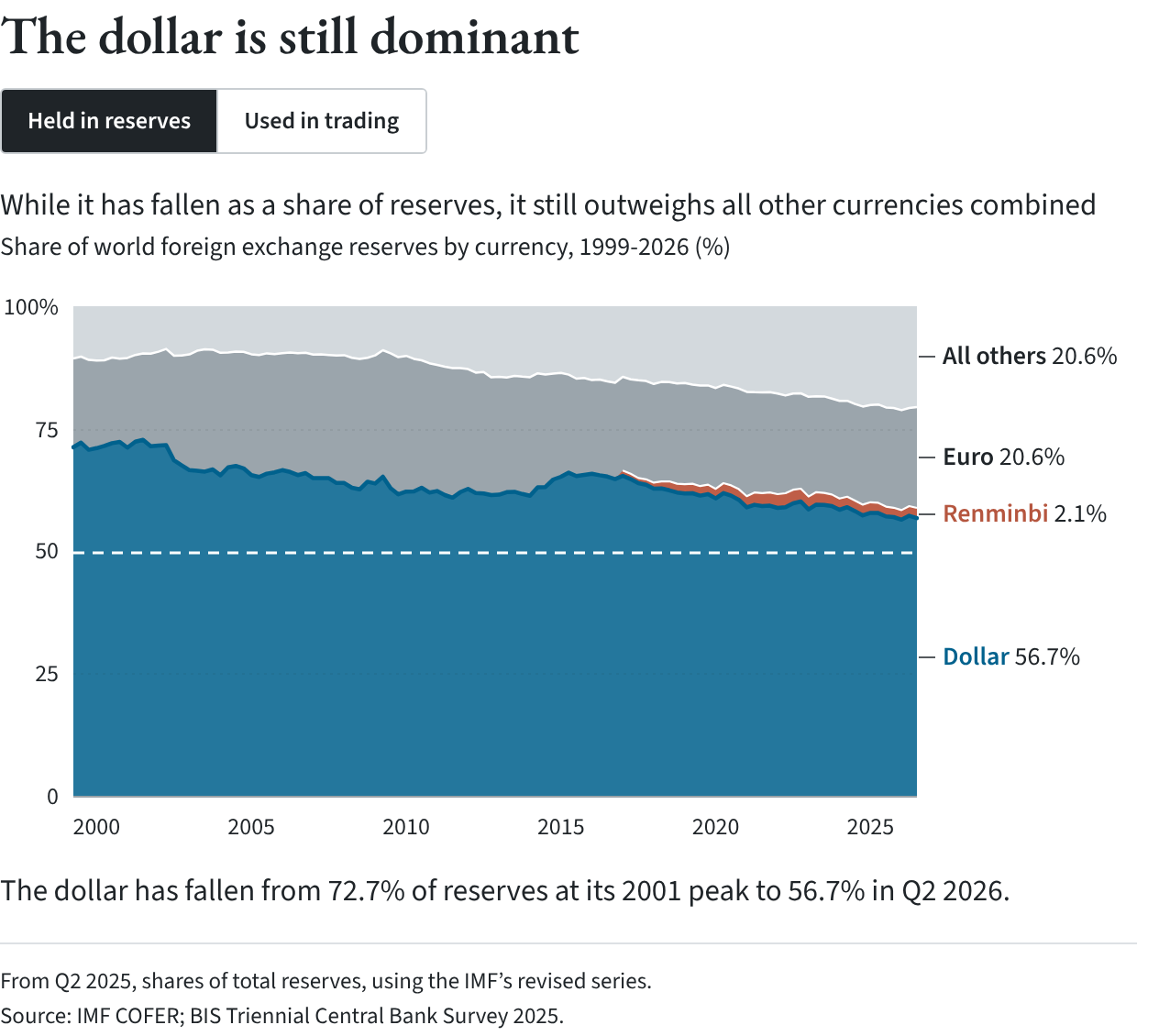
† Source International Monetary Fund, Currency Composition of Official Foreign Exchange Reserves (COFER). Shares through the first quarter of 2025 are of allocated reserves, as published before the IMF’s December 2025 revision. Later quarters use the revised series, from IMF Data Briefs of December 19, 2025, to September 30, 2026, which also estimates the currency of unallocated reserves. It puts the dollar at 57.1 percent in the second quarter of 2025, against 56.3 percent on the old basis. Glen Kwende and Erin Nephew, “Improving the Analytical Usefulness of the IMF’s COFER Data,” IMF Technical Notes and Manuals TNM/2025/14 (November 2025), table 1. Renminbi reported from the fourth quarter of 2016. Excludes gold, 27 percent of total official reserves at the end of 2025. European Central Bank, The International Role of the Euro (June 2026). Currency trading shares are of daily average turnover, net-net, and sum to 200 percent because each trade has two sides. Bank for International Settlements, 2025 Triennial Central Bank Survey, table 1. Calculations by Commanding Heights.
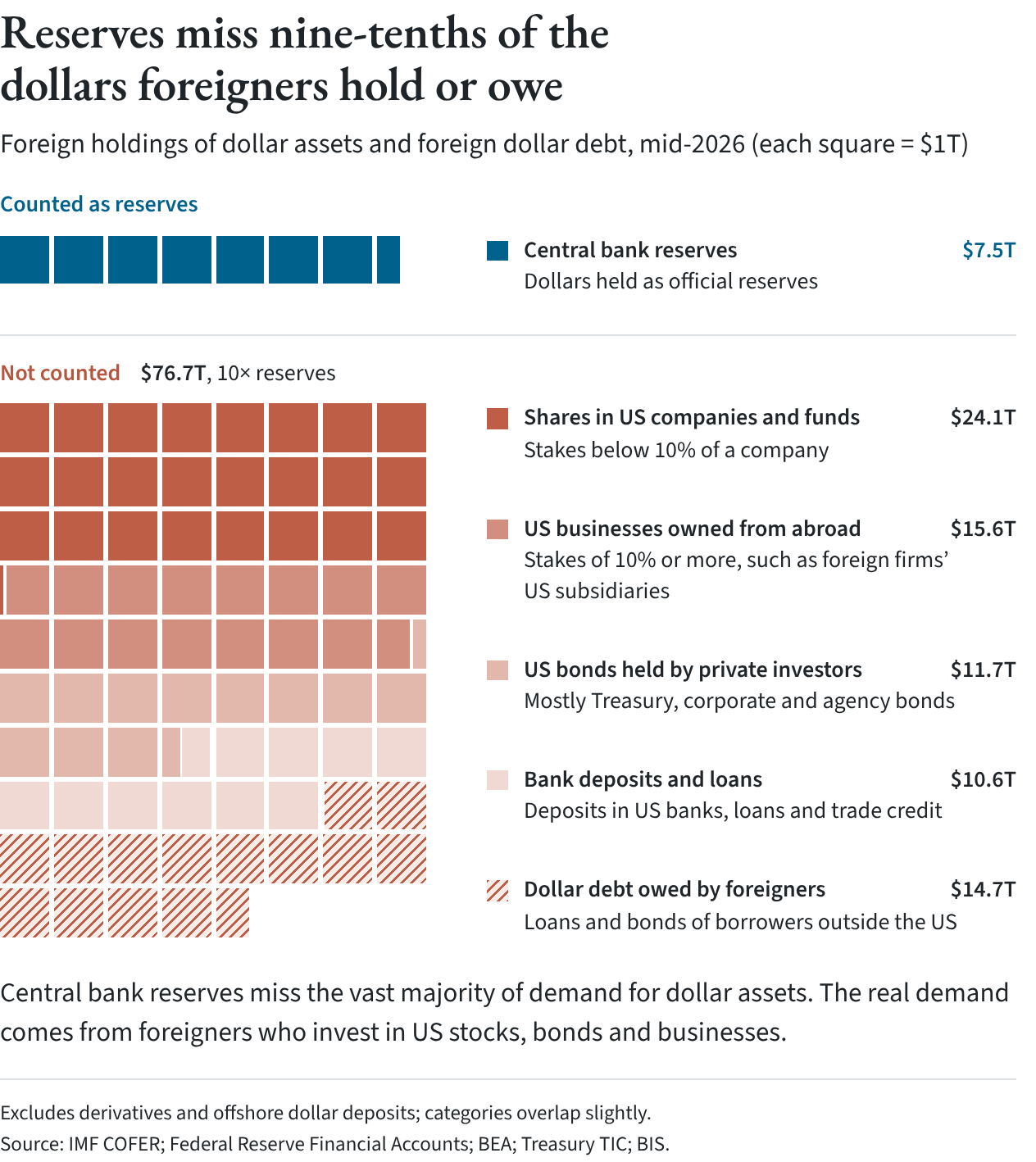
† Source Reserves: Nephew, Wei, and Gweder, “World Official Foreign Currency Reserves,” total reserves of $13.22 trillion at a dollar share of 56.7 percent, end of the second quarter of 2026. Stocks and funds: Board of Governors of the Federal Reserve System, “S2.s: Rest of the World,” Financial Accounts of the United States, September 11, 2026, U.S. corporate equities and mutual fund shares held by foreign residents, second quarter of 2026. Direct investment at market value, and deposits, loans and other: U.S. Bureau of Economic Analysis, “U.S. International Transactions and Investment Position, 2nd Quarter 2026,” September 24, 2026, U.S. liabilities. Bonds outside reserves: debt securities in the same Federal Reserve table, less foreign official holdings of Treasury securities, from U.S. Department of the Treasury, “Table 5: Major Foreign Holders of Treasury Securities,” June 2026, and of agency and corporate bonds, from U.S. Department of the Treasury, Federal Reserve Bank of New York, and Board of Governors of the Federal Reserve System, Foreign Portfolio Holdings of U.S. Securities as of June 30, 2025 (April 2026). Dollar loans and bonds: U.S. dollar credit to non-bank borrowers outside the United States, end of March 2026, from Bank for International Settlements, “BIS Global Liquidity Indicators at End-March 2026,” July 31, 2026. Excludes derivatives and offshore dollar deposits. Categories overlap slightly. Calculations by Commanding Heights.
All those billions of people outside of the Sinomodern economic zone will be able to feed the intelligent Dollar with uncountable queries in unknowable languages, save themselves from the fall of their own currencies, and accrue margin to Delaware-registered firms.
Until now we have focused on the effects this globalized, commodified, and dollar-backed intelligence will have on the world. But what will it do to us?
The United States has already seen one grand financial reordering, and it is teetering on the precipice of a second. That first reordering began about thirty years ago and it killed the wage economy. That grand olde memory of a class compromise where your work delivered a reliable surplus, a moment in time that lifted a great multitude into the middle class and created the fabled American Dream. Work hard, earn a good salary, receive periodic raises, and enjoy a life where the cost of living increased alongside the currency you were being paid in. Do it for 40 years at the same employer and you qualify for a generous defined-benefit pension. Sometimes, they even gave you a gold watch.
Then came the financialization of the closing decades of the 20th century and the death knell of the 2008 financial crisis. The resulting monetary intervention, necessary to avoid a greater financial catastrophe, broke the connection between wages and the good life permanently. The quantitative easing and a policy rate near zero kept the financial markets afloat, but did so by bidding up asset prices, not wages.13
13 Donggyu Lee, “Unconventional Monetary Policies and Inequality,” Review of Economic Dynamics 60 (April 2026): 101334.
The result was a miracle recovery for those who owned assets, and a slow strangulation for those who earned a wage. The 2020 intervention redux, where the Fed bought without a stated limit,14 severed any remaining connection between the two. Pick your favored statistic; they all sound similar. The top 1% of US households control something like $60T of wealth, more than the bottom 90% combined.15 The balance of the stimulus went to those that needed it least. The rest got checks from the Treasury that were largely eaten by the inflation the Fed was creating. We don’t expect this pattern to change.
14 Board of Governors of the Federal Reserve System, “FOMC Statement,” December 16, 2008. Board of Governors of the Federal Reserve System, “Federal Reserve Announces Extensive New Measures to Support the Economy,” March 23, 2020.
15 Board of Governors of the Federal Reserve System, “Distributional Financial Accounts,” second quarter 2026, released September 18, 2026, “Levels of Wealth by Wealth Percentile Groups,” FRED, Federal Reserve Bank of St. Louis.
They say there can’t be a recession, see, look at the statistics. But one economy is having the time of their lives, and another is increasingly expressing its disillusion in public. $150K would have bought you about 1,900 shares of Meta back in 2015. Today it will buy you about 200.

† Credit Flushing It Golf, photograph of private jets at Augusta Regional Airport, April 4, 2026, Facebook.
We’re moving into the second act of the K-shaped economy. The first was monetary and has largely finished its work transforming the world at this point. We’re well past the wage economy and the financial tricks meant to keep it alive. The second act will be technological. It will happen out of sight, out of mind. The adoption of machine intelligence will occur primarily inside firms, those firms pushing the cost of wages and applications toward the requisite cost of compute. The firm itself will shrink to a few operators, paid and governed like capital, directing work done mostly by models. Inflation and deflation will arrive together, extending the K well beyond the reach of the braking force of the Federal Reserve. The first act split the owners off from the earners. The second will split the owners themselves.
And what for the world? We think broad prosperity is unlikely. As intelligence becomes commoditized and widely available, value migrates toward the assets that remain scarce. By definition, value accrues to a much narrower stratum. Owned by the few, kept by the even fewer.
On the basis of our expectations about the future of financialized machine intelligence and its diffusion, understand the following:
We invert the assumption that the AI trade is about selling intelligence. Instead, we believe that intelligence is the giveaway, a loss leader that draws in users and data and derives margins from being the conduit.
The frontier of machine intelligence will always stay ahead of the commodity equivalent. Scaling laws still apply, and they dictate that the larger cluster tends to win first. But the smaller competitor will always remain close behind while the model is widely available.
One day, the frontier will no longer be for sale. The labs will be pressured on two sides. First, distillation of their latest widely available model will continue, and it will keep eating into both their short-term profits and their larger value proposition for investors. Second, the sovereign will recognize that frontier capabilities should not rise and fall on the whims of the market. This is a special project that requires particular treatment by the hands of the state. There is already a gap between released and in-lab models. Those most spectacular frontier capabilities will remain within the lab, and the lab and essential employees will remain within the reach of the sovereign.
The machines will begin to hum, and then sing in harmony. The frontier will remain on GPUs in a black site in the desert. Monoliths spreading horizontally above ground and soon below. Trillions allocated and the orchestra plays feverishly as the sovereign watches on. There will be what we call superintelligence in your pocket at no immediate expense. It will spread to every corner of the world from the originary point, uniform and impossible to dislodge once adopted, like the advent of spoken language. Its arrival heralded by notifications from the global messaging app and its uses made manifold by currencies that bear not the image but the superscription of the dollar. Pathogenetic in function, if not the strict biological form. Soon enough, intelligence will go from enhancing its early adopters to serving as a substitute for them and the multitudes like them. Then the wailing of the standing alterity riotous in cities you’ve never heard of, never could imagine that so many of them shook loose by automation could come crawling out of the cities ancient or recently constructed and themselves thrumming on the pavement howling as seen from afar. And you shall hear of wars and rumors of wars: see that you are not troubled: for all these things must come to pass, but the end is not yet. You will be a part of this world to come, and know, there are still safe spots on the map. Hallowed grounds that the efficient market is still pricing as ordinary assets. Only an early few will have the opportunity to lay claim to those scarce and enduring crossings worth owning.
In the world to come, one either owns the rails or pays those who do.
The power and wealth of this brave new world will be defined by the commanding heights.
Part I: Genesis
The Genesis of intelligence is composed of the industry that makes and serves models, and it will keep spending on itself even as returns fall. Rational capital allocation at the level of the lab or hyperscaler can destroy capital in the aggregate. Intelligence’s tremendous revenues still come from early adopters deploying models into existing workflows. As with the railroads, the larger fortunes will be captured outside Genesis, by those who control how models reach the far larger economy they create.
They are arguing about the AI bubble on X, the everything app. The bears can’t stop comparing hyperscaler capital expenditure to the fiber overbuild. The bulls point to Jevons and this cycle’s utilization rates. The models are busy proving open math questions.16 The mathematicians themselves are becoming luddites; even Terry Tao is foom posting. Staffers across Washington are asking Microsoft Copilot what post-training is while the President is handing awards to Elon, Brin, and Su. And the doomers are organizing the latest RMN “don’t kill us” party. The bazaar of ideas is bustling, blind prophets leading multitudes, psyops in every direction and the buyside analysts are updating their models accordingly.
16 Noga Alon, Thomas F. Bloom, W. T. Gowers, Daniel Litt, Will Sawin, Arul Shankar, Jacob Tsimerman, Victor Wang, and Melanie Matchett Wood, “Remarks on the Disproof of the Unit Distance Conjecture,” arXiv:2605.20695, May 20, 2026, 1–3. Tony Feng et al., “Towards Autonomous Mathematics Research,” arXiv:2602.10177, revised March 6, 2026, 1–2, 7–10.
The dollar-weighted opinion is unquestionably bullish. McKinsey dutifully projects $7T in data center spend through 2030,17 and that’s probably an underestimate. The smart money is rushing into labs, chips, neoclouds, and behind-the-meter power, while an ever-increasing torrent of private capital flows into AI. The duller ones say they’re more interested in picks and shovels and write checks to build tools for Anthropic researchers which are inevitably acquihired with little fanfare but much economic return within eighteen months. And behind this vanguard lies the deep end of capital markets: insurers, non-bank lenders, and the wealth-channel-packaged retirements of America’s doctors and dentists financing the credit side of the greatest infrastructure buildout ever seen this side of the railroads.18 These walls form the arena of the AI debate, the positioning and counter-positioning by which competing investors form their identities and views of the future. But because the plurality of capital moves inside this arena, its participants have mistaken its walls for the horizon. There is so much more to see.
17 Jesse Noffsinger, Mark Patel, and Pankaj Sachdeva, with Arjita Bhan, Haley Chang, and Maria Goodpaster, “The Cost of Compute: A $7 Trillion Race to Scale Data Centers,” McKinsey Quarterly, April 28, 2025.
18 Laura Benitez, “Apollo Muscles In on Wall Street’s Turf with $300 Billion of Loans,” Bloomberg, July 14, 2026, 1–2. Apollo Global Management, “Apollo Leads $35 Billion Capital Solution for Broadcom AI XPV Platform in Partnership with Blackstone and Leading Global Banks,” June 9, 2026. CoreWeave, “CoreWeave Closes Landmark $8.5 Billion Financing Facility, Achieving First Investment-Grade Rated GPU-Backed Financing,” March 31, 2026.
We must understand that the terms of debate describe only the adolescence of artificial intelligence, a coltish growth spurt rewarded with gobs of money. Before it was, work waited for it. AI was born only recently, and in San Francisco the model still stands in its Genesis.
The Genesis is composed of everything inside the cradle, the factory required to design, train, evaluate, host, and serve a model. We managed to write the algorithm. Then we trained it. And now we’re hosting this artifact for a price that is hurtling downward toward the requisite compute.19 This will go down in history as one of the greatest human achievements of all time, but so far it still only amounts to the token generation loop.
19 Luke Emberson and David Roodman, “The Plunging Price of Thought,” Epoch AI, September 22, 2026.
So far, its movement down into the labor process, beyond simple access to a free chatbot, has been minuscule. Few see how an API endpoint can augment their work, and fewer still have figured out how to economically benefit from it.20 It turns out that one of the most expensive artifacts wrought by man’s hand, or at least his design, produces impeccable decks, optimizes workflows exceedingly well, and files exceedingly detailed customer service complaints. The early adopters keep paying, increasing their usage, and giving the labs their first real revenue. For machine intelligence, this is just a summer job.
20 Kathryn Bonney, Cory Breaux, Emin Dinlersoz, Lucia Foster, John Haltiwanger, and Aditya Pande, “The Microstructure of AI Diffusion: Evidence from Firms, Business Functions, and Worker Tasks,” CES Working Paper 26-25 (U.S. Census Bureau, Center for Economic Studies, April 2026), 1–4, 23–27, 33–34, 58–59. Adam Grundy, Cory Breaux, and Dhanapati Khatiwoda, “Large Firms With at Least 20 Employees Biggest AI Users,” U.S. Census Bureau, May 26, 2026.
The man in Bangalore is not following Hacker News discourse. The small contractors, the middle-aged, the service workers and gig workers countless are laboring in a fog of ignorance fueled by underpowered Microsoft Copilot workflows. They are not reading DeepSeek API caching docs or thinking critically about their workflow or tracking the bleeding edge and deploying it into their business. The labs, relying just upon the vanguard of early adopters, have gotten the Genesis to world-historic levels of annualized revenue with little more than intelligence alone.21
21 “OpenAI Expects $70 Billion in Annualized Revenue by End of 2026,” Bloomberg, October 9, 2026. “Anthropic’s Quarterly Revenue Jumped 45% to Nearly $17 Billion,” Wall Street Journal, October 14, 2026.
On the other side of the railroads: the earliest productive use of locomotives was not for the intercity transport of people and goods. Instead, they were financed by ironmasters and colliery owners, who put them to work on captive industrial routes, where the traffic already existed, and a machine could do it better, faster, and cheaper.22 In 1804, at Penydarren, Trevithick’s early engine was installed on a road previously traveled by horses, and used to haul tons of iron nearly ten miles from the ironworks to a wharf, where it could be transferred onto a boat and shipped to Cardiff.23 Beginning in 1812, the first commercially viable locomotives replaced horses on the Middleton wagonway, tasked with pulling coal from the colliery at a lower cost.24 These were repetitive movements of heavy materials, directed by owners who already had a profitable horse-based operating system in place. They commissioned the locomotive builders to augment and improve an existing operation with the new technology of the era.
22 David Gwyn, The Coming of the Railway: A New Global History, 1750–1850 (New Haven, CT: Yale University Press, 2023), 1–2, 20–21, 92–100.
23 Richard Trevithick to Davies Giddy, February 22, 1804, reprinted in Francis Trevithick, Life of Richard Trevithick, with an Account of His Inventions, vol. 1 (London: E. & F. N. Spon, 1872), 161–62. Jennifer Protheroe-Jones, “Birth of the Railway Locomotive,” Amgueddfa Cymru-Museum Wales, May 16, 2020.
24 Gwyn, Coming of the Railway, 98–100. “Our History,” Middleton Railway, accessed August 11, 2026.

† Credit George Walker, The Collier, engraved by Robert and Daniel Havell (Leeds: Robinson & Son, August 1, 1813), aquatint, plate 3 in The Costume of Yorkshire (1814), Science Museum Group, object no. 1935-505.
This is the analog to the revenue that Genesis artifacts earn today: these early contracts gave the locomotive builders and the AI labs alike a reason to continue to develop their technology and production methods. But as we know, the lion’s share of the economic gains of the railroad age came not from building locomotives or integrating them into captive industrial routes, but from the network they made possible.25
25 Richard Hornbeck and Martin Rotemberg, “Growth Off the Rails: Aggregate Productivity Growth in Distorted Economies,” Journal of Political Economy 132, no. 11 (November 2024): 3547–3602, esp. 3550, 3583–85, 3592–93. The railroad sector captured only 7 percent of the railroads’ 1890 social return.
The step-change came when the locomotive moved off of the captive route that its owners had initially intended. The railway, now publicly accessible, was a boon for the surrounding economy. The openness allowed businesses and people to move freight themselves. Rail began to connect independent actors and made what was once disparate unified. The railroad network facilitated emergent economic activity that no railway owner had designed in advance. A new economy of scale unanticipated.26
26 Alexander Klein and Peter Matthews, “Transportation Costs in the Antebellum USA: A New County-Level Dataset with Time-, Region-, and Direction-Specific Freight Rates, 1820–1860,” European Review of Economic History, advance online publication, April 8, 2026, 2–5. Hornbeck and Rotemberg, “Growth Off the Rails,” 3547–51, 3582–85, 3592–93.

† Credit Traveling on the Liverpool and Manchester Railway, 1831 (London: Raphael Tuck & Sons, 1894), lithograph, The Henry Ford, Dearborn, Michigan, object no. 89.0.332.288.
Intelligence is still in the captive route. Revenue is driven by sophisticated customers bringing AI into an already existing workflow and reaping the rewards of the model’s new capabilities and cost structures. It takes sophistication to draft the brief. Clients must accurately handicap what work can be properly substituted, monitor the frontier for the latest Pareto model, and create high technology (bespoke .MDs) to instruct the models that still cannot continuously learn. Though soon they will. Managers must learn the spiky distribution of their new electronic employees, who talk just like people, but don’t act at all like the personages they’ve replaced. These requirements exclude all but a narrow population of enthusiasts and bleeding-edge firms.27
27 Among OpenAI’s enterprise customers, the top 10 percent of firms by output tokens per active user generated 8.3 times as many as the middle 10 percent in June 2026, up from 2.6 times in January. OpenAI, “Enterprise Signals: What Frontier Firms Are Doing Differently,” updated August 12, 2026.
It’s easier to hire people to force the adoption of technology. OpenAI’s own DeployCo and many others like it will send engineers to embed within your organization to do the diffusing for you.28 Where there’s a will, there’s capital. Services roll-ups become AI services roll-ups. They’ll buy the olden business to use as a training environment for the model, giving them the access to the ontology and authority over workflow that it’ll take to make it work. When the other bidders for your Midwestern accountancies have not yet learned how to deploy LLMs into the business, you can say the biggest number during the auctions and still expect to hit your underwritten IRR thanks to a small cohort of forward-deployed, stimulant-addled workflow engineers.
28 OpenAI, “OpenAI Launches the OpenAI Deployment Company to Help Businesses Build Around Intelligence,” May 11, 2026, under “Building for Where Frontier AI Is Headed.” “OpenAI Creates New Unit with $4 Billion Investment to Aid Corporate AI Push,” Reuters, May 11, 2026.
Some of these attempts may very well become durable downstream businesses that make plenty of net income for decades to come, but their scope is constrained and far too small. The DeployCos are limited in their ability to diffuse AI to the world by the number of capable experts they can hire, and the roll-up platforms must similarly struggle to acquire and integrate each new add-on. Both are too slow to diffuse AI at the speed at which intelligence is becoming abundant. And when viewed relative to the opportunity set, their capital and headcount are so small they disappear from the map.
Investors, meanwhile, build their understanding from metrics familiar to most: usage, OOMs, hockey sticks, ARR, and reading credit card data like the flight of the birds in Roman times. When you see the greatest numbers you have ever seen for any product past or present, it should be obvious where to invest. Then you look to your left and your right and see all the sharps investing there too. Slowly, the blinders form to block anything but those metrics, and situational awareness, however robust its owner believes it to be, contracts around a certain San Franciscan summer of love.
Be merry. There is plenty to celebrate, now. Lab ARR is extraordinary even if slightly ailing. American inference margins are, surprisingly, positive for now. Gross profit is being booked by CFOs,29 and investors are popping champagne over generationally large post-money valuations and impending IPOs.30 These metrics prove that Genesis is Something People Want, and people are paying for it. But a larger bill is yet due. The eventual intelligence economy will be orders of magnitude larger than Genesis, even Genesis fully matured.
29 Sri Muppidi, “Why OpenAI, Anthropic Missed Their Own Gross Margin Forecasts,” The Information, February 24, 2026. Cory Weinberg, “Anthropic Reports $16.8 billion in Third-Quarter Revenue,” The Information, October 14, 2026. The reported margins are after inference costs but before research, sales, and other operating expenses. More recently, Anthropic reported an adjusted operating margin of 11 percent for the year through the third quarter of 2026, excluding stock-based compensation, and positive cash flow in the third quarter. “Anthropic Tells Investors Quarterly Revenue Up Nearly 50% to $16.8bn Ahead of IPO,” Financial Times, October 14, 2026.
30 Echo Wang, “Anthropic IPO Stands Alone as AI Market Jitters Sideline Others,” Reuters, October 22, 2026. Shirin Ghaffary and Rebecca Torrence, “OpenAI Shifts Value to $1.25 Trillion as Funding Talks Finalize,” Bloomberg, October 23, 2026.
As the newly capitalized ARR comes in, it is immediately put to use. Inside the labs, the cash supports even larger training runs still. Outside of the labs, the revenue run rate is capitalized at stratospheric multiples,31 summoning forth new companies and new pools of capital toward every new trade that promises to keep earning rents.
31 Anthropic, “Anthropic Raises $65B in Series H Funding at $965B Post-Money Valuation,” May 28, 2026. OpenAI, “OpenAI Raises $122 Billion to Accelerate the Next Phase of AI,” March 31, 2026. Jaspreet Singh and Krystal Hu, “OpenAI’s September Annualized Revenue Nears $50 Billion, Less Than Previously Indicated, Source Says,” Reuters, October 8, 2026, updated October 9, 2026. The March and May completed-round valuations correspond to approximately 17 times OpenAI’s September annualized revenue and less than 14.9 times Anthropic’s July annualized revenue, respectively.
Historically, the fashionable and consensus businesses that investors have fawned over as possessing the ultimate attributes have thrown off more free cash flow than their operating model can absorb in reinvestment at attractive rates of return. Genesis is nowhere near that point.
The labs will continue to devour the cash flows of the hyperscalers, and whatever dollars the capital markets wish to supply.32 There will always be dollars available. We expect Genesis to grow prodigiously throughout this process.33 Superusers will consume more and more productively, their hunger unabating. And there will be a growing class of users who will be sought and transformed by intelligence reaching through a digital network. The latest marginal user arrives, then the next one. Billions to come.
32 OpenAI, “OpenAI Raises $122 Billion to Accelerate the Next Phase of AI,” March 31, 2026, under “Deep Conviction across Global Capital” and “Compute Is a Strategic Advantage.” Patturaja Murugaboopathy and Gaurav Dogra, “AI Investment Boom Puts Big Tech’s Free Cash Flow under Pressure,” Reuters, July 22, 2026. Tatiana Bautzer and Gertrude Chavez-Dreyfuss, “Banks Get Creative and Look Further Afield as AI-Fueled Debt Soars,” Reuters, June 29, 2026. NVIDIA, “NVIDIA Partners with Apollo, BlackRock, Blackstone, Brookfield, Goldman Sachs and KKR to Establish AI Compute Infrastructure Financing Platforms to Mobilize over $500 Billion of Third-Party Capital,” August 10, 2026.
33 OpenAI, “Introducing GPT-6.1 Sol,” September 29, 2026. Anthropic, “Introducing Claude Haiku 5.5,” October 7, 2026.
And there will always be a binding constraint du jour. The velocity of ideas from certain Signal group chats to discourse on Twitter to local daytime TV to White House executive orders is increasingly high. They’re saying words in the Senate that have never been said before. First GPUs, CPUs, SSDs, HBM, GWs, MTok/s, and then the next concepts which have not yet become buzzy initialisms. As one demand is filled and margins fall, the next in line becomes capital’s target. That scale may itself enable Genesis to grow still larger, richer, and more central for decades yet. But what could cause this buildout to stop?
Normally, this problem is solved by the capital cycle. Excess returns incentivize entry and new capacity, which eventually outstrips demand, resulting in falling utilization and incremental returns. Once the incremental returns fall below the market rate of return on capital, new projects fail to clear their hurdle rates, capex slows, the tourists get washed out, and the industry eventually recovers. This is capital’s way of allocating a scarce resource, in this case, itself.
But in Genesis, there may never be a signal that tells participants to stop building. You can’t simply ask what the return on capital is for a new incremental build of a laboratory and underwrite it that way, because if you fall behind the frontier, you risk ceding all of the value that you’ve previously invested in. It is a common fiction that each model generation is a new hand of cards; the intelligence trade is one persistent and everlasting parlay on a civilizational scale. And the hyperscalers aren’t investing in one model or even one data center cluster; they are buying call options on future profit pools that they can use to defend the profit pools that they already have. Their calculation is made over the breadth of their business, and the cost of not investing is informed by what their rivals might do.
This means that, even as the returns on incremental investment in Genesis come down, it may not be irrational for participants to keep investing, even if they acknowledge that the industry is overbuilding. In other words, what is rational capital allocation for a particular firm may be capital destruction in the aggregate. The ouroboros is no longer fed by ROIC, but by the coercive laws of competition.
As frontier models continue to acquire military, cyber, and intelligence value, the rational response to additional training runs shifts again. Any technology at a level of creative and destructive capability that implicates the whole of any polity, or perhaps the world, naturally becomes a matter of preoccupation for the sovereign. It was known first at Trinity, and every moment since then has been a contest to own the most capable nuclear deterrent, and to prevent your rivals from doing the same. Immediately after Hiroshima and Nagasaki, it seemed possible that a unified, global sovereign would assume control over the dispensation of atomic technology. But at the end of the twentieth century, this question was resolved by proliferation in favor of diffused access to a MAD stalemate.
The same contest is once again at hand at the frontier of machine intelligence. Capabilities will very quickly enter the indistinct realm of sovereign combat, cyberwarfare, and military projection. The increasing resources allocated to train the frontier will then start to look less like a question of capital reinvestment, and more like the construction of a carrier strike group: A strategic asset operated for the capability it confers. In private and public conversation, the leaders of all of America’s core intelligence functions report even current capabilities decreasing time to vulnerability by orders of magnitude, even in our current sclerotic intelligence apparatus. It is by these metrics that the development of machine intelligence will be seen in Beijing and Washington. And by whom will the capability be wielded? Whatever comes to pass, the interest of the sovereign will play a final, decisive role.
It is clear that Genesis is going to succeed, if success is meant to be understood as continuing. Whatever happens to its private returns, the frontier is advancing and will continue to do so. The capital calls are being met, the turbines are coming online, tokens are becoming more abundant and cheaper, the models producing them, more capable. More, more, more. The lab as factory. The loading dock is never quiet. The sign is up, painted in large letters somehow visible in all languages at once: Intelligence for sale.
No thing that relies upon model pricing margins will escape the walls of Genesis. But where will the balance of value settle, and to whom will it accrue? That is the question of the Commanding Heights.
Part II: The Line
The American future depends on AI spending, stock prices, and model capability rising together as one line: the common exposure beneath growth, household wealth, and credit. The imperative means it will. Training costs rise ~3.5x a year, and Washington will utilize increasingly central backstops such as retirement savings and the Treasury to guarantee its continued rise, even as impairments occur throughout Genesis.
You can see the future from anywhere as long as you watch the line. Just a few years back the line was barely visible; you’d need to stand on the high foggy peaks of San Francisco to peer over the fog and see its birth, but today even in the depths of the canyons of Midtown and the low hung industrial parks of Mumbai, it is visible. Magnificent and growing.
The line is the slope of the mountains of capital being expended in the fastest infrastructure buildout since the railroads. Last year the hyperscalers alone spent over $400B. This year it will be around $800B. Soon over $1T and trillions yet to come.34 An ever-widening gyre, the scope and force of which is constrained only by the limited size of humanity’s economic activity. It cannot swallow the entire thing whole. Not quite yet.
34 Goldman Sachs, “Can AI Investment Drive S&P 500 Earnings Even Higher?,” September 23, 2026.
The line is the curve of whatever index fund comes to mind. Ever crawling upward, these days more and more. The Dow Jones, the Nasdaq, the S&P 500. It’s teetering now, unbent, but it must be straining under the weight as it tilts upward. New record highs are a regular occurrence, and woe to those who are not in the market. It’s all the collected assets, the securitized hopes and dreams of the American pensioner. It’s 15% annually from the teller, the dentist, the teacher, the butcher, the brewer, the baker, the associate systems administrator, compounded annually into an automatic subject, born with a life and one overwhelming insatiable desire: continue careening upward.
The line is the exponential crescendo in machine intelligent capabilities. Like Roman augurs in the forum, soothsayers today look at the parabolic line and argue over what it portends. They’re poking at snake guts and chicken bones in the salmon pages. Contained within the graph are measurements of the task time horizon, various benchmarks suffused.35 It will stretch further and further until it reaches a vanishing point well beyond all human reckoning.
35 METR, “Task-Completion Time Horizons of Frontier AI Models,” measurements updated May 8, 2026, page updated September 8, 2026.
The line is all of these and more still. We will tell you a secret. Capex, index, Epoch rate, METR capabilities graph: they’re all the same line. They’ve always been the same line.
Leopold had the faith to project the line forward, and he saw the future. In 2024, he was already writing about $1T clusters and the industrial mobilization required to build them.36 Projecting the line forward is easy. The difficult part is believing in it over duration. To accept the line sustained, one must accept all its cascading consequences. The actual capital expenditure, the continued growth in revenue, the orders of magnitude with no sense of slowing down: all of these, don’t they strain credulity? But the skeptic is again and again overturned, left with no explanation for the fact. What seemed an absurd number becomes a capital budget, and then an inadequate one. The line continues upward.
36 Leopold Aschenbrenner, “IIIa. Racing to the Trillion-Dollar Cluster,” in Situational Awareness: The Decade Ahead, June 2024.
The Rate
The world is the totality of facts. Here are a few about the line. Back in 2024, it was expected that the cost of training a frontier model would grow at about 2.4x every year. This was calculated by Epoch based on the rate of increase since 2016. The vast majority of the cost went toward hardware and talent, and if the trajectory was sustained, the first training run for a frontier model that would cost about $1B would occur sometime in 2027. For reference, the cloud-compute cost of training GPT-3 was estimated at about $4.6M in 2020.37
37 Ben Cottier et al., “How Much Does It Cost to Train Frontier AI Models?,” Epoch AI, June 3, 2024. Chuan Li, “OpenAI’s GPT-3 Language Model: A Technical Overview,” Lambda, June 3, 2020, updated August 3, 2023.

† Source Ben Cottier et al., “The Rising Costs of Training Frontier AI Models,” arXiv:2405.21015v2 (2025), fig. 3 and table 1. Redrawn by Commanding Heights from the authors’ data and code.
The line has not only maintained, but lifted. Epoch now projects that the cost to train a frontier model is increasing at a rate of 3.5x annually. According to these revised estimates, the compute necessary for training a frontier model is rising at a rate of 5x year over year while the total computing power of the available chips is growing at a rate of 3.4x per year.38 Astra is said to have run up a training bill of $1B.
38 Epoch AI, “Trends in AI,” sections “Training Cost,” “Training Compute,” and “Compute Stock Growth,” accessed September 30, 2026.
Similar mumblings agree that Anthropic’s competing Fable 5 series of models took a comparable amount of capital to train. This means that, if these estimates are accurate, the labs have reached the $1B training run about half a year ahead of Leopold’s forecast. Next year, we can expect to see $3.5B training runs. The year after that, they accelerate to $10B. Numbers that seem inconceivable to many, including many of the bulls, will become commonplace far sooner than expected. Even the most aggressive bullish forecasts will be shocked to the upside. And at each order of magnitude, more participants will be left behind, unable to pay the frontier’s cover charge. All the time, new efficiency gains will be discovered. All the time, they’ll be rolled into an even bigger training run. The line will be sustained.

† Source Andreessen Horowitz, State of Markets (September 2026), 34. Data from Ornn, Silicon Data, and Bloomberg, compiled by Citadel Securities, as of August 2026. Plot reproduced by Commanding Heights.
Just as frontier training runs experience cost explosion, the prices end users are paying for model output are falling like a stone. Epoch has tracked the minimum cost of reaching a given level of performance across five key benchmarks as having fallen about 47% per quarter since 2023. The resulting diminishing cost of adoption has compounded into the fastest fall of any transformative technology in history. They offer a potential explanation for why previously expensive capabilities become low-margin commodities: “when a performance level is first achieved, AI companies can briefly charge a premium for it, before competition and technological improvement quickly drive down the price.”39 This is the vital dynamic that we expect to be repeated as machine intelligence diffuses more widely.
39 Luke Emberson and David Roodman, “The Plunging Price of Thought,” Epoch AI, September 22, 2026, updated September 23, 2026.
The capex and total token cost per task lines implicate others: the lines of cash flow and capital expenditure. A number of estimates project that 2027 will be a crunch point for the cash flow of hyperscalers and a potential bottleneck for the growth of American intelligence.40
40 Torsten Slok, “Consensus Just Revised Up Capex for Hyperscalers: FCF Takes a Hit,” The Daily Spark, Apollo Global Management, July 28, 2026.

† Source Isabel Juniewicz, “Hyperscaler Capex Is on Trend to Outpace Their Cash Inflows by the End of 2026,” Epoch AI, June 16, 2026. Redrawn by Commanding Heights from Epoch AI’s published data.
The pool of capital in America is wider and deeper than anywhere else in the world, but it does have limits. Eventually, those buckets lowered from steel towers in New York will bring up less and less, and for a moment in time, run the risk of coming up empty altogether. It used to be that a hyperscaler could finance its own projects, with some minimal external funding. More and more are drawing on that deep reserve of capital. But Epoch has projected that now the cash capex of the hyperscalers, which is increasing at a rate of 70% a year, will exceed their operating cash flow, which is only increasing at a rate of 23% per year.41
41 Juniewicz, “Hyperscaler Capex Is on Trend to Outpace Their Cash Inflows by the End of 2026.”

† Source Slok, “Consensus Just Revised Up Capex for Hyperscalers,” chart “Consensus Revising Down Free Cash Flow Estimates for Hyperscalers,” estimates as of July 27, 2026.
If hyperscalers cannot finance themselves, they will have to turn to new lenders, who will lower their own buckets and find them full. The financial leviathan only grows in length. Hyperscaler expenditures, a speculative prayer based on the capabilities and expected value of investment in machine intelligence, will become a growing asset class. Securitized and traded like mortgages or anything else.
But drawing from banks means that as the line skyrockets upward, an increasing share of the capital fueling that growth, perhaps a majority soon, a supermajority later, will come from the common people. Their hopes and dreams, held in a checking account. Pensions, retirement funds, annuities of a wide variety hoping to avoid the angry beast of inflation that punishes those foolish enough to still hold cash. Dentists and teachers, bakers and butchers, and with them the entire global economy placing their faith and future, whether or not they know it, on the line sustained.
It will only grow larger from here. Imagine a scenario where the labs have IPO’d. The largest in history, smiles at the stock exchange. ANTH and OAI on the Bloomberg terminal, bundled into all manner of indexes, their fortunes forever intertwined with the hundreds of millions who dutifully heeded the simple advice to place their money in the market. All that money can now begin draining, agglomerating perhaps, toward the highest-return trade on the market.
It is around this time that the cash flow crunch will be overcome. That massive infrastructure investment, largest and fastest since the railroads, will start to return in droves to hyperscalers in 2028, according to projections. After the dry year in 2027, the following year will be bountiful. In 2028, free cash flow will be somewhere around 120B. In 2029, it will be around 300. By 2030, 400B. Wave after wave of capital pouring in. Better money following good.
A Reserve of Riches
The capital is there, lying in wait. It has been since the late 1970s, when the American capital markets needed a way to exit their Glass-Steagall, Jamaica Accords malaise. Congress, tired by a decade lost to inflation and moribund corporate management, cut taxes in 1978. The following year, the Department of Labor clarified ERISA’s “prudent man” rule, paving the way for pension funds to invest in private investment partnerships.42 The financiers who ran them were gaining access to hundreds of billions in long-term capital, the retirement savings of American workers. The next 50 years of private capital formation and the creation of the alternative investment management behemoths all came from three novel dynamics.
42 George W. Fenn, Nellie Liang, and Stephen Prowse, The Economics of the Private Equity Market, Staff Study 168 (Washington, DC: Board of Governors of the Federal Reserve System, December 1995), 9–11.
First, there were the conglomerates. Built by aristocratic corporate managers and acquisitive outsiders such as James Ling of LTV and Charlie Bluhdorn of Gulf & Western, the integrity of the conglomerates rested on the belief that a corporate headquarters could allocate capital across unrelated businesses more profitably than those businesses could under separate ownership, creating a premium for shareholders by owning them together. Instead, these conglomerates ended up being run for management’s benefit. The era of business jets, company hunting lodges, and maintaining apartments in all the European capitals prevailed. But what if these parts, valued separately, were worth more than their whole? This was the question posed by the original leveraged buyout artists, who saw the conglomerate as a form of discount on the multiples that could be earned by selling each component piece, one by one. And the fruits of the question’s answer, showered by the billions, deal by deal, carve-out by deconglomeratization, created the institutional private equity industry, which accounted for more than a third of North American M&A value in 2025.43
43 PitchBook, 2025 Annual Global M&A Report, January 30, 2026, 13.
Second, there was leverage. Post-war corporate borrowing practices were built around sustaining the business: financing expansion, carrying inventories, and bridging cash flow gaps. Management thought of unused borrowing capacity as a reserve against the next Depression. America’s mature, profitable businesses could finance themselves out of cash flows, leaving their balance sheets with little debt.
And what if stable businesses could support more debt? The buyout artists realized that these businesses were under-leveraged, and that a profitable business could be made to finance its own change of control. If its cash yield exceeded the cost of borrowing to buy it, a sliver of equity could hand the buyer the keys to the whole enterprise. Even at an unchanged enterprise value, every dollar of debt repaid became another dollar of equity. Any growth accrued to an ownership stake that had cost a fraction of the price of the business. Borrowing as much as nine dollars for every dollar of equity they put up, the Henry Kravises of the world tapped bank lenders and the newly formed high-yield market for the necessary financing. Bond issues that would have been laughed out of Morgan Stanley in 1960 were now being sold by the billions, the capital markets coming to accept that non-blue-chip credits could be sound investments, if the coupon was right.44
44 Fenn, Liang, and Prowse, Economics of the Private Equity Market, 9–11. Milken’s buyers included federally insured savings and loans. The FDIC later recovered more than $1.1B on claims against Drexel, Milken, and related parties. Federal Deposit Insurance Corporation, Managing the Crisis: The FDIC and RTC Experience, 1980–1994, vol. 1, History (Washington, DC: FDIC, 1998), 282–83.
Last, there was scale. Having atomized and levered up corporate America, the nascent private equity industry turned its gaze inward. With larger funds and more bidders at the auctions came fewer opportunities to generate hundredfold returns on deals like Gibson Greeting Cards, which famously earned Bill Simon a 200x in less than two years.45 Carry still promised fortunes, but collecting it required profitable exits, and each generation of professionals goldrushing into the industry required another round of profitable buying and selling.
45 Bill Sing, “Players in LBO Game Often Hit Giant Jackpots,” Los Angeles Times, October 22, 1988.
What if private capital managers could become scaled financial institutions? The largest dealmakers began to see their investment partnerships as companies to be built and managed, with new divisions, new products, a sales force, all generating revenues that could be counted on consistently. The men who had made their fortunes dismantling conglomerates were building financial conglomerates of their own.
The public markets would attach high multiples to recurring fee-related earnings, letting the dealmakers of yore IPO their franchises and compound their fortunes even as the fabled 200x faded into memory. Privately originated investment-grade credit let the same sales force pursue the pension fund’s much larger bond allocation, lending to businesses that could borrow and refinance without ever being sold. As Marc Rowan saw it, assets would become the scarce resource.46 The investment committee could still slow deployment and wait for better deals. It now had to explain the missing fee growth to the pod analysts every quarter.
46 Apollo Global Management, Investor Day 2024, October 1, 2024, 17, 20–24.
The Totalization
Any living thing is like an animal. And machine intelligence is no different. It operates according to unwritten laws, described only in the behavior of organisms. A thing grows, consuming and spreading and making itself a thing manifold. It grasps blindly without foreknowledge for its own survival or end in competition with other things. Machine intelligence is nowhere near the terminating point. It has only to grow from here.
We expect the centrality of machine intelligence to the economy to manifest itself in strange ways. People may say AI, when what they mean is the technology sector. They may say tech, when what they mean is the entire economy.
We foresee a market swallowed by machine intelligence, which will grow at such a rate that it absorbs large sectors and outpaces the few industries that it can’t absorb. Survival of the fittest. Not an uncommon pattern, pictograms like cave paintings drawn on the rise and fall of candlestick charts.
To project what a machine intelligent market might look like, we can start by examining the dynamics at present. In the final quarter of 2025, investment in information-processing equipment alone contributed more than three times the growth of the entire American economy.47
47 U.S. Bureau of Economic Analysis, National Income and Product Accounts, table 1.5.2, “Contributions to Percent Change in Real Gross Domestic Product, Expanded Detail,” September 30, 2026, lines 1 and 31. The equipment figure is its gross investment contribution, before adjustment for associated imports.
That impoverished ex-AI economy is contracting. A temporary bout of unemployment for the professional worker quickly becomes terminal. In New York, they’ve had net job losses in all sectors except for healthcare. “The dead are dancing with the dead.” Why all the discontent on the streets, the glum faces as the indices break new records regularly? It’s because there are two economies in the United States. Non-AI equipment capital expenditure fell 17 percent in Q4 2025, while computing-equipment capex rose 61 percent over that same period. One economy is dying, the other has both hands around intelligence, and it’s booming.
We compare this boom to the railroads, because its speed far surpasses the housing boom from back in the early 2000s and the telecom buildout of the 1990s.

† Source Torsten Slok, “The AI Capex Boom Is Building Twice as Fast as the Housing Boom,” The Daily Spark, Apollo Global Management, August 6, 2026.
This is the midpoint in the long march of technology through the markets. Back in 2014, the information-technology sector was approximately 20 percent of the S&P 500 market capitalization. By the start of 2026, AI stocks made up half the index.48 Hyperscaler capex alone has gone from 0.3% of GDP in 2019 to a projected 3% by 2027.49 There is a K-shaped divergence between hyperscaler capex and telecom capex. They only diverge further and the line only goes up from here. There’s nothing to worry about, the pensioners and soon-to-be retirees forcefully diamond-handsing target-date funds are told. And that will be true, as long as certain conditions are met.
48 Michael Cembalest, Smothering Heights, Eye on the Market: Outlook 2026 (J.P. Morgan Asset & Wealth Management, January 1, 2026), 2–3. The figure refers to J.P. Morgan’s basket of 28 direct AI stocks.
49 Slok, “The AI Capex Boom Is Building Twice as Fast as the Housing Boom.”
At its core, the consequence of the intelligence economy surpassing the old economy is that political leaders will treat the former with the concern previously reserved for the latter. What was once a parasite on the larger economy has become its beating heart. Neural nets and transformers, out from the garage and group house in Berkeley, into the President’s daily brief.50
50 Many of you have written premature eulogies of the “technology right” in DC. While it is true the tech right has failed to build a durable coalition inside the Beltway, the degree to which the intelligence economy becoming the national economy covers over any possible DOGE-shaped missteps is underrated.
It is a strange thing to imagine. What was once a marginal technology, the product of recluses and machine learning enthusiasts, made so vital. Our descendants may look back at us and see the influence of any economic activity aside from the intelligence interest as an aberration. When the firms in the intelligence economy near a supermajority of the S&P 500, and when the growth of that economy nears 90% of quarterly GDP growth, and whether ANTH and OAI are up or down on the year determines whether the growing population of the elderly can retire this year, what else could possibly happen? Expect more government offices in San Francisco and more flights from IAD to SFO. You will long for the days when Washington and its creatures talked of anything but machine intelligence.

† Source U.S. Bureau of Economic Analysis, National Income and Product Accounts, tables 1.5.2 and 1.1.6 (September 2026 release). Authors’ calculations from real GDP levels. Equipment includes non-AI investment. Related import offsets appear in other components.
On October 8, 2026, Michael Kratsios, in his role as director of the White House Office of Science and Technology Policy, welcomed the President onstage in the Donald J. Trump Institute of Peace, a building that just months ago was subject to a prolonged siege as DOGE-aligned elements attempted to clear it of a somewhat nebulous precursor organization, to present national medals to six individuals—Musk, Brin, Jensen, Su, Dell, and Nadella—the founding fathers of the Intelligence age. One must look back many decades to find another recipient of the National Medal of Technology and Innovation with name recognition, let alone one whose impact the average American can feel. The intelligence business is now the National Business. Nearly half the seats were reserved for administration brass to come and tithe praise to the winners.

† Credit Photograph by Will Manidis, October 8, 2026.
Imagine the horrible counterfactual: what if the intelligence economy experiences a downturn? Say, driven by price competition from Chinese models, or highly effective distillation attacks. The quarterly profits of OAI and ANTH take a plunge and so does the rest of the market. Hyperscalers, infrastructure builders, all in the red. A firm’s share price can swing dramatically upon poor earnings. For instance, Meta slipped 26%, erasing $232B, in a single day back in 2022.51 What a fortunate thing that most economic growth in America at the time did not depend on the health of Meta. A firm so large, so central to the entire economic engine now running at an ungodly din, red with heat—a missed earnings report from that firm could send the market into a tailspin.
51 Alex Sherman, “Facebook’s $232 Billion Fall Sets Record for Largest One-Day Value Drop in Stock Market History,” CNBC, February 3, 2022, updated February 4, 2022.
If growth stops today, then all that fictitious capital, the present value of those future OOMs, goes poof. The synthetic leverage built into millions of Excel DCFs across the Street pushes the S&P 500 down 9.04% in a single day, and it doesn’t rally the next.
A similar scenario could even be sparked if AI diffusion and growth are even moderately slowed. Let’s assume that Chinese models keep pace and continue to press American labs on price. What happens to the lines of credit extended to such supposedly reliable hyperscalers and their projects?
Two identically rated Aa2/AA/AA “Investment Grade” bonds can have very different correlations with the economy. The agencies caveat that their notations summarize a bond’s expected likelihood and severity of loss, not the economic conditions upon impairment.52 Some losses are idiosyncratic, occurring in some isolated corner of the economy, while others falter in lockstep with the entire financial system.53 As AI devours more capital and diffuses further into every walk of economic life, the correlation of its debts and the economy approaches one. If the spending on AI suddenly stops, the off-balance-sheet coupons stop getting paid on time, and the rest of the economy would default alongside each IG issuance. The same AI spending that services the monolith of bonds also supports the value of the collateral, the balance sheets of the buyer pool, and the lenders expected to finance those buyers. SRCH <GO> will return a long list of different issuers, collateral packages, and ratings, but the exposure underpinning them is increasingly the same. These borrowers will not default into a healthy economy.
52 See Moody’s Investors Service, “Rating Symbols and Definitions,” accessed September 25, 2026. S&P Global Ratings, “S&P Global Ratings Definitions,” accessed September 25, 2026.
53 Joshua D. Coval et al., “Economic Catastrophe Bonds,” American Economic Review 99, no. 3 (2009): 628–66. Jon Frost et al., “Circular Relationships among AI Firms,” BIS Bulletin, no. 137, October 1, 2026, 5–6.
A stumble as we awkwardly exit Genesis will result in recoveries falling well short of what their ratings lead investors to assume. A creditor taking possession of a data center will have to look for a new customer among the companies that just vacated it. The correlation between any two offtakers, one defaulting, and the other possessing, approaches one in the fullness of time. The circular deals that accelerated the takeoff will worsen the losses too. There will be assets that successfully weather the storm, beating budget and making their coupon payments. Others will become excellent investments for whoever buys at the §363 sale. Forced sellers will recover what the correlated economy is willing to pay at that unfortunate point in time, not what the asset will be worth back at equilibrium.54 There will be plenty of work for PJT. But intelligence can continue to diffuse throughout the economy while the capital structures that financed portions of its infrastructure is written off. A blip downward early in the log chart can be enough to make many of these losses permanent.
54 Viral V. Acharya et al., “Does Industry-Wide Distress Affect Defaulted Firms? Evidence from Creditor Recoveries,” Journal of Financial Economics 85, no. 3 (2007): 787–821. Phurichai Rungcharoenkitkul, “The AI Investment Race,” BIS Working Papers, no. 1367, July 2026, 9, 45.
Move past the creditors: Think now of the job losses. Think of the pensions and their pensioners. Think of the immense political pressure to do something, anything. Herbert Hoover was a well-respected, forward-looking President, famed for his business achievements and thought to have a bright future. He saved millions of lives by privately organizing relief to Belgium during World War I and running it uncompromisingly. He had a plan, a scientific vision for a well-ordered government and the associative relations between firms and state. Then the market went down 13% in a single day during his presidency, and he never recovered from it.55 Hoover was an accomplished industrialist and humanitarian, but all people remember about his presidency was the economic malaise and Hooverville shanty towns.
55 Hoover Institution Library & Archives, “Commission for Relief in Belgium Records, 1914–1930,” finding aid, “Biographical/Historical,” accessed September 30, 2026. Gary Richardson et al., “Stock Market Crash of 1929,” Federal Reserve History, November 22, 2013.
Any President would do anything to avoid that. The failure of the intelligence economy will be politically intolerable for any administration and any Congress. You might think that people will riot in the streets over data centers and minor job displacement. Their fixed income having become no income, bereft of all other options, the people will march on Washington. Here are your intelligence troubles at last.
The popular backlash to the new intelligence economy, distillation from Chinese labs, and the all-but-certain price compression will stand in the way of machine intelligence unfolding itself across the world. But shared interest, the growing symbiosis between the desires of the state and the imperatives of the labs, will sustain the line.
In some important ways, this is a substantial departure from previous estimations of how the intelligence explosion would play out. Leopold assumed that Congress would allocate appropriations for the purpose of underwriting the rising costs.56 We expect a new relationship. Given the centrality of the intelligence economy, the state will be incentivized by any means possible to preserve and accelerate that diffusion. The most promising of those means, the true ritual of symbiosis, will be the offering of joint stock, by the labs, to the state. The enormity and precarity of the machine intelligence economy will call for new conceptions of a national interest.
56 Leopold Aschenbrenner, “IV. The Project,” in Situational Awareness: The Decade Ahead, June 2024.
What is that national interest? It increasingly is embodied in markets and indices. It is no longer a choice; you will be a shareholder. The Trump Account, which credits $1,000 per child born from 2025 to 2028, sets in motion a reliance that previously began only after beginning adult life. The account begins at birth, can be added to by parents and employers, then rolls into an accessible account at 18. Elon Musk is putting SpaceX stock into Trump Accounts.57 Every man, a holder of equities, keenly interested in the line’s continued rise.
57 “Musk Vows to Give Each U.S. Child a SpaceX Share,” The Wall Street Journal, October 19, 2026.
The line is also a noose tightening around the wretched made legion. It is a telegraph wire, bearing the good news at an increasingly frantic rate. Or a rescue rope, perhaps, sent to deliver those who have watched it rise over and over, through many dark nights, with bated breath and PDF, having planned accordingly. There is deliverance for those who dare.
Will you place your faith in the line? If you are a market participant, you already have. Keep faith, we say unto you, because the line must go up.
Part III: Principalities and Powers
America and China will become the only countries capable of sovereign expression because only they can continually develop frontier models. Intelligence will splinter into a commercial and sovereign frontier, with the latter being locked behind SCIFs and developed by lab subsidiaries for statecraft, not cash flow. China can publish cheap open-weight models and accept low valuations for its labs because it is not subject to the American 401(k) class. These sovereigns will exercise control over model-producing firms without formally announcing nationalization.
They are building a separate future in China, in case you couldn’t tell. It will be a form of modernity with little resemblance to our own. The Genesis period of machine intelligence resembles many other episodes of industrial history within China. There is nothing new under the sun for China. Picture a furious competition over talent and resources, causing a cascading price compression to the bare minimum necessary to operate, and then perhaps something less than that. All against all, within the market, under the party-state. The same dynamic is playing out in AI. Chinese machine intelligence is now competitive in capabilities for the vast majority of consumer uses. Chinese labs such as Alibaba and DeepSeek will continue to supply open-weight, low-cost commodity models across the entire world. In short, they will cross the American intelligence moat. If the American buildout is premised on a sufficiently large value captured by labs, the price compression of Chinese labs globalizing will upend this arrangement to finance the perpetual frontier. The immediate consequence of price compression is an inability to finance scaling as had been anticipated. What good is a frontier model if only a portion of the expected compute ends up being built?
We distinguish commodity intelligence, a commercial frontier sold at a premium, and a sovereign frontier held in state reserve. One lab may operate in just one vertical, or across all three. Today, China sets the commodity floor and America leads the commercial frontier, though the capability delta between the two is shrinking and, increasingly, so is the willingness of consumers to pay the difference in token prices. This new paradigm had been visible for more than a year beforehand, though in the eyes of many in English-speaking countries, it struck like lightning in the summer of 2026. On July 16, 2026, Moonshot AI released Kimi K3, a 2.8T-parameter model whose weights could be downloaded from anywhere, costing a trivial amount, and the capabilities of which rivaled the American commercial frontier for most tasks. The next day, in a speech to the World AI Conference in Shanghai, Chinese leader Xi Jinping declared that Chinese machine intelligence would remain open-weight and widely available.58
58 Moonshot AI, “Kimi-K3,” model card, Hugging Face, accessed September 29, 2026. Laurie Chen, Casey Hall, and Eduardo Baptista, “Xi Pitches China as Leader of New Global AI Order, Challenging US Dominance,” Reuters, July 17, 2026.
This sparked an immediate American response. Michael Kratsios, director of the OSTP, accused Moonshot of building Kimi K3 through industrial-scale distillation of Fable. He separately alleged that Moonshot had trained the model on NVIDIA’s most high-capability chips, remotely accessed in Thailand. More recently, the Cybersecurity and Infrastructure Security Agency suggested much the same. The Treasury Secretary, Scott Bessent, threatened financial sanctions and placement on the Commerce Department’s sanctions list.59 American officials seemed to recognize the scale of the threat that open and capable Chinese intelligence represented. So did the labs and their manifold horsemen. Augurs scrabbling in the forum, discourse on the everything app. Ban the models! It’s all distillation, China can’t really compete at the frontier! Create regulatory uncertainty! Open-weight models are indispensable to American startups! Your data, in a Chinese model? Unthinkable. They might still be conducting discourse on the everything app yet. But real regulatory action never came. All that remains of the Kimi K3 moment are pronouncements on dot gov sites. It is hard to find a regulated workflow that doesn’t use Kimi in production today, and the American public, and even the intelligence class, has totally forgotten about this dustup.
59 Doina Chiacu, Chris Sanders, and Courtney Rozen, “US Accuses China’s Moonshot of Stealing from Anthropic’s Fable for Latest AI Model,” Reuters, July 22, 2026. CISA, NSA, and FBI, Joint Cybersecurity Advisory AA26-251A, September 8, 2026. Michael Kratsios (@mkratsios47), post on X, July 22, 2026. Scott Bessent (@SecScottBessent), post on X, July 22, 2026.
We see clearly that in America, the state is not yet ready to behave like a sovereign. We use each word very deliberately. The latter is distinguished as the final backstop of authority, the buyer and seller of last resort. It is the latter to which the full faith and credit belongs. Atlas on the Potomac, or perhaps more a hesitant Samson, holding San Francisco in one hand and New York in the other. And ultimately, as the financing of American machine intelligence is placed under unbearable strain, labs and shareholders will cry out and the American sovereign will answer their invitation.
The Artifact
It is the artifact that the sovereign will act to protect. Here, we define the artifact as a formula of intelligence that can be reproduced. Any widely available model will be distilled into an artifact and commodified. This begins the process of price compression. In the past, the state acted to control the export of hardware in the hopes that hobbling compute at a particular moment would grant America a decisive edge in machine intelligence. But rusted and worn down, the initial export-control apparatus of the early machine intelligent era has fallen apart. The hardware has escaped containment and slipped loose from the low-lying fields of the Netherlands. The Chinese are a modern, civilized people. Even if all you still think they can do is copy, why would EUV machines that strike molten tin with regularized laser pulses through mirrored refraction to print circuits with 13.5-nanometer light be impossible?60,61 In lapidary form: there is no technology beyond the reach of Chinese hands. The Chinese Intelligence Apparatus is far more complex than thousands of Blackwell chips wrapped in tinfoil in carry-on luggage.62
60 U.S. Department of Justice, “Three Charged with Conspiring to Unlawfully Divert Cutting Edge U.S. Artificial Intelligence Technology to China,” March 19, 2026. ASML, “Light & Lasers” and “Lenses & Mirrors,” accessed September 29, 2026.
61 In October 2026, a customer at Micro Center’s Tustin, CA, store who sought to purchase a workstation including an NVIDIA 5090 reported being required to fill out and sign a Claude-styled document entitled “Advanced Computing Product Purchase Declaration.” It read “NO EXPORT - NO EXCEPTIONS” and required an address and identification.
62 Might there be a corresponding Away luggage trade?
In response to the commodification of the artifact and the resulting compression of value, the American state will pursue a new paradigm. If the first export control system was built for objects, the second control system will be aimed at the constituent parts of the artifact. The subsequent paradigm will be more adaptive, though much less formal. We expect the relationship between lab and sovereign to become far more intimate and bidirectional. Export-control decree by whispered insinuation, not via public policy and certainly not via think tank.
The United States is moving toward an increasingly fortified protection of sovereign frontier intelligence, including stronger protection of model parameters. Additionally, the release of models from labs has been slowed down by not-so-voluntary pre-release review and exceptional state controls on model access.63 Even so, internal capabilities have continued to grow apace. There is a cleaving, right now, between the abundant, commercially available intelligence and the artifact held in a bunker in San Francisco or a guarded tower in New York. In an act of self-preservation, the sovereign frontier will need to be locked inside, beyond the access of both common Americans and Chinese. The commercial frontier and commodity models will remain outside, feeding the gaping maw, 8B mouths stretched wide to consume them.
63 White House, “Promoting Advanced Artificial Intelligence Innovation and Security,” Executive Order 14409, June 2, 2026, sec. 3. Anthropic, “Statement on the US Government Directive to Suspend Access to Fable 5 and Mythos 5,” June 12, 2026. OpenAI, “Previewing GPT-5.6 Sol: A Next-Generation Model,” June 26, 2026. Anthropic, “Expanding the Cyber Verification Program,” October 6, 2026.
The reason is this: a frontier artifact is an extraordinary capital project condensed into a reproducible file that can be carried in a palm.64 The scale of capital is unparalleled, premised on the tremendous gains and secured value that American frontier intelligence promised. But the commodification of the artifacts converts a capital-intensive and scarce good into a widely accessible input. This, well before the investor recoups his cost, well before the solidification of the expected value. If a frontier model is widely accessible, it will be distilled. If it is distilled, it will be commodified and its value compressed to the barest margin. Subsistence profits, familiar in the rice paddy. The continued development of a protected sovereign frontier will be necessary to serve two converging interests: the value proposition of the line and the state’s totalizing interest in surety of the largest financial outlay in American history.
64 In “Great Work of Time” by John Crowley (1989), the protagonist, a brilliant but indolent inventor of a form of time travel, decides the safest way to get rich without perturbing history is to go back to 1856 British Guiana, buy a one-cent British Guiana Magenta, the most valuable stamp in existence, of which only one copy survives at present, mail himself a letter with it, wait for it to arrive cancelled, and hide it somewhere he knows will survive to the present. One wonders if today a time traveler going in the opposite direction, even a matter of months, would simply pocket an SD card of frontier weights.
From the Other Side of the Pacific
The air is different in China. It’s clear and sweet in Inner Mongolia. In Chongqing, the oppressive heat can hardly escape the steep inclines of the city or the mountains that enclose it. In Beijing, the air is heavy with just cigarette smoke. No longer the smog that characterized it in the early 2000s. The Chinese have modernized past all that. In the hutongs, old men who remember hungry days will gather after a long day of loitering in public parks. They remember the ration coupons during the 70s. Now they clutch 512 GB Chinese-made phones. This is retirement. Every surface is either oily or sticky. They sip Red Star erguotou slowly, stooped over, necks craning over to watch the crickets fight. Payment by WeChat. Sinomodernity in the smallest moments. From Zhongnanhai to the upland villages of Liangshan, they labor beneath the same line that we do. Only, seen from China, the line looks different.
China has no desire, nor any interest, to participate in the American intelligence paradigm of the past. The Chinese party-state of today and the future will see little reason to protect enterprise value in a model layer. Not that the Chinese model-layer value is zero. Instead, it is the near-minimum. Firms, provincial governments, and the party-state itself do hold economic interests, sometimes in the labs themselves and their secondary performance. Certainly, China maintains an interest in the overall growth of its economy, which will depend more and more on AI-enabled efficiencies and the supporting financial commitments. But the level of capital needed to keep pace at the commercial frontier and break the American value proposition is meaningfully lower. Moonshot is valued at about $50B on the verge of its IPO and DeepSeek’s latest reported funding round values it at about $90B including new capital. Other major Chinese labs trade on public markets at fractions of American competitors. Compare this to the trillions in value attributed to OpenAI and Anthropic, not to mention the trillions in valuations of related firms and trillions more expected as AI diffuses throughout the entire world.65
65 Tracy Qu and Raffaele Huang, “China’s Moonshot AI Confidentially Filed Hong Kong IPO,” Wall Street Journal, September 3, 2026. Kane Wu, Yantoultra Ngui, and Eduardo Baptista, “DeepSeek Wrapping Up $15 Billion Fundraising to Fuel AI Race, Sources Say,” Reuters, October 22, 2026. Echo Wang, “Anthropic’s IPO Prospectus Shows Sweeping AI Vision, Surging Costs,” Reuters, September 28, 2026, updated September 29, 2026.
What explains the divergence between the Chinese and American technological arrangements? Why are our labs seen as world-eaters, while theirs are valued at fractions? It is tempting to appeal to the cultural differences. Or point toward four thousand years of imperial history, mass famine, mass upheaval. Ascribe it to the political repression, as though it is so radically different from ours, and try to explain the whole from one scrap of ephemera. Such lazy answers: we play chess; they play Go. China is fascinating, not least because it causes the most original minds to lapse into the most unimaginative and incurious formulations.
The answer is hidden in the explanatory power of the dollar and the renminbi. Why is the Chinese sovereign more willing to commoditize the commercial frontier than the American sovereign? It is down to financial markets and the mass populations, here and there, subservient.
Where is wealth stored in the average Chinese household? Since the end of the Cultural Revolution, it is no longer stuffed under mattresses or buried in some field outside the village until the Red Guards pass. Today, the way that Chinese wealth is stored is fully modern: banks, checking accounts, a system of checking, savings, and withdrawal that looks not unlike your own despite being a closed capital account.
But the composition of that household wealth is different, which goes a long way in explaining why the Chinese party-state is less compelled to prop up the stock market. The Chinese see themselves as a democracy, just of a different sort. A state ultimately answers to its people, whether or not it is formally democratic. Panem et circenses, both being superabundant. In ensuring prosperity, the Chinese state responds to a set of incentives quite different than ours. Their attitudes about the governance of machine intelligence, the level of state capital expenditure, the adaptive interference of regulators and censors: it all is downstream of whether such policies advance the primary imperative of the modern state: wealth preservation and creation.

† Source Authors’ calculations from World Bank, China Economic Update: Advancing Reforms, Enhancing Prospects (December 2025), 22, table 2. Board of Governors of the Federal Reserve System, “B.101.h: Balance Sheet of Households,” Financial Accounts of the United States, September 11, 2025, 2022 column.
In China, far more wealth is held in housing and cash than in America. This is why the 2021 real estate crisis was so consequential. When the central government tightened borrowing requirements in 2020, the business models of various property developers ceased to function. No more filling Chinese cities to the brim with identical concrete towers and inhabitants straight from Sichuan village towns. Recall one of the largest property developers in China, Evergrande, defaulting on more than $300B in liabilities. Construction firms collapsed, leaving rows of towers standing in their wake. But even after this turmoil, real estate and housing remain the most vital part of Chinese household wealth. Even in 2022, 47% of Chinese household wealth was still held in real estate. Cash and deposits, an enduring sign of the definite pessimism of the Chinese, are extraordinarily high at 24%. Equities are only 15% of Chinese household wealth.66 This quantitative indifference toward markets and the superfixation with housing is a central condition shaping the Chinese conception of the intelligence economy.
66 Patrick Hendy, “Evolving Financial Stress in China’s Property Development Sector,” Reserve Bank of Australia Bulletin, September 15, 2022. World Bank, China Economic Update: Advancing Reforms, Enhancing Prospects (December 2025), 22, table 2. “The Human Cost of China’s Property Crisis,” Financial Times, November 28, 2023.
The party-state will not act to boost the share prices of MiniMax or Zhipu if it doesn’t affect the annuities of hundreds of millions of senior citizens. The labs themselves will do fine, returning a tidy, reasonable profit for themselves. And the rest of the economy, which is not quite so levered on the success of a few individual labs, will keep pace. There are new qualitative productive forces, those Commanding Heights seen by Chinese eyes, and they are not determined by the rise and fall of the line.67
67 Xinhua, “Xi Stresses Development of New Productive Forces, High-Quality Development,” February 2, 2024, National Committee of the Chinese People’s Political Consultative Conference.
The Shanghai Composite Index has been essentially flat, up only 29% over the last ten years. S&P is up 254% over the last ten years, and there are those beyond counting who would say that is not nearly enough.68 In America, the whole spectacular arrangement grinds to a halt if the line does not go up enough. If the Dow Jones was only up 29% over the last ten years, there would be riots. The Villages ablaze, golf carts smoldering in sand traps, target-date funds with targets on their backs.
68 Authors’ calculations from Shanghai Stock Exchange, SSE Statistical Yearbook 2017, “SSE Composite Index—Daily Index,” and Newsletter—August 2026, “SSE Monthly Data.” Raymond James & Associates, “Domestic Stocks Hit All-Time Highs in August” (2016), 1. S&P Dow Jones Indices, “S&P 500 [SP500],” FRED. August 31, 2016–August 31, 2026, price returns in local currencies, excluding dividends: Shanghai Composite, 29.2%. S&P 500, 254.0%.
This is because American household wealth is determined far more by defined-contribution retirement plans. In 2022, retirement accounts accounted for about 32% of household wealth. Stocks and assets at financial institutions came in at 10% and 9%, respectively.69
69 Briana Sullivan and Shomik Ghosh, Wealth of Households: 2022, Current Population Reports P70BR-202 (U.S. Census Bureau, November 2024), 6–7, fig. 3. These figures exclude the wealthiest 1% of households.
In the past, American workers would work at the same company for decades, and at the end of their career they would receive a wristwatch and a defined-benefit pension plan. As these became fewer and fewer, the benefits from Social Security played a larger role in financing America’s growing population of the elderly. But Social Security cannot pay out the same benefits for much longer. As defined-benefit annuities receded, contribution-based retirement plans, with matching contributions from the dozen employers that an American office worker bounces between over the course of his career, became the indispensable part of American retirement.70 Put your money in the market, let it grow and grow, and at the end of forty-five years, you will have enough to retire. That was the nursery rhyme. Settle in Florida to molder in the humidity.
70 John J. Topoleski and Elizabeth A. Myers, A Visual Depiction of the Shift from Defined Benefit (DB) to Defined Contribution (DC) Pension Plans in the Private Sector, IF12007 (Congressional Research Service, updated March 25, 2026), 1–2. Social Security Administration, “Social Security Board of Trustees: Projection for Combined Trust Funds Remains Consistent with Prior Year,” June 9, 2026.
But these retirement schemes ride the highs and lows with the stock market. Which, these days, is to say the highs and lows of the intelligence economy. Itself an indicator of the successes and failures of various training runs. Your retirement plan already relies on Claude, even if you can’t see it, or even know what it is.
Recognizing the centrality of the intelligence economy to the American stock market, it is entirely sensible that the needs of such a sovereign would differ substantially from the Chinese ecosystem, where labs are a much smaller part of the economy, easily substitutable, and the stock market itself inches upward at a sluggish pace. When half of the country’s household wealth is tied up in the stock market, as compared to fifteen percent in China, the particular needs of the sovereign become apparent.
American policymakers must defer to the needs of a national constituency whose livelihoods are determined, in large part, by fluctuations in corporate valuations. Chinese policymakers take heed of a much wider array of indicators, such as housing, bank deposits, and minimal annuities.
Valuations in China are increasingly determined by the market, but without the trillion-dollar exuberance of those in America. There is also active consent, it seems, from the Chinese labs to this paradigm. In a leaked four-hour investor call, DeepSeek CEO Liang Wenfeng candidly described his strategy for the firm’s commercialization and his plan for an enduring edge. Liang explicitly stated that DeepSeek’s models would remain open-weight for the foreseeable future. Even more shocking to American capital, DeepSeek would not aim to maximize profits against all other interests. He would instead guide the firm, in which Liang holds the majority of shares, toward what he termed a “reasonable profit.”71 What would the American landscape look like if the investors and financiers who underwrote it believed that AI would return just a “reasonable profit,” rather than extracting maximum shareholder value from as large a surface area as possible?
71 Coco Feng, “Low Profile, High AI Ambition: What Leaked Comments Reveal about DeepSeek’s Liang Wenfeng,” South China Morning Post, July 26, 2026.
Perhaps one only needs to look towards the safetyist movement to see what American AI with Chinese Characteristics could look like. Although, increasingly, all sides of the debate are open to central planning at the cost of shareholder value: an oddly bipartisan suggestion that seems to reoccur is using the Defense Production Act (DPA) to dictate the allocation of compute between training and inference.
We have primarily focused on the domestic ecosystem that encourages the Chinese treatment of the artifact. But the international advantage should be obvious as well. With limited domestic downside, pursuing a commoditized form of intelligence is the primary way that Chinese labs and party orchestrators can dull the American edge in machine intelligence. A runaway value proposition stopped short by Chinese hands. Short of the intrigue of exfiltration and espionage, weights smuggled out in briefcases and across oceans in planes, this is something more simple yet far more totalizing: the banality of financialization, commodification, balance sheets, and the unbearable imperative of making a return.
The Chinese paradigm determines the tail end of the intelligence curve. The premium of an American commercial frontier model is thereafter legible as a spread over a visible benchmark. For every workload that a Chinese model can perform, a closed-weight provider must justify their asking spread. This premium will be under a permanent audit by the clients and continually compared against the best from the other side of the Pacific. Independent bodies have already sprung up to provide such market intelligence to firms. The pricing differential will become increasingly legible to market participants. Intelligence adolescent is on its way to New York, preparing ritualistic sacrifice by the opening bell. Markets index the value of commodified machine intelligence in China. The American paradigm is only now beginning to catch up.

† Source Arena, “Agent Arena: Overall - Pareto Frontier,” chart snapshot as of September 30, 2026.
The Shrinking Aperture
The Chinese offensive paradigm, today and into the future, will be built on forcing a retreat of America’s most capable models from the commercial frontier to the sovereign frontier, with the public shut out. The intelligence aperture snaps shut. Absent any action on the part of the state, price compression will continue, starving the frontier of funding.
Do not expect a lack of access to America’s sovereign frontier to blunt all Chinese momentum. It is at present unclear to what degree distillation is responsible for Chinese labs being able to keep up with the American commercial frontier, though it plays a substantial role. If we understand distillation as a necessary response to a shortage of chips, a reaction to insufficient scale, then we should expect that this deficit will only last a few more years. The Chinese do not even need to be capable of reliably producing the most advanced 5nm and 7nm semiconductors. They will be able to, sooner than you’d expect, produce less exquisite chips en masse and scale them across the softly rolling hills of Inner Mongolia and the vast rugged flats of Guizhou.72 Grids like farmland seen from an airplane, data centers in orderly rows powered by hydroelectric dams along the Yellow River. We have said before: there is no technology beyond the grasping reach of the Chinese state.
72 Huawei, “Huawei Pioneers a New Computing Architecture for the AI Era: Making One Million Processors Work as One Computer,” September 17, 2026. Xinwen Lianbo, “A Rapidly Expanding Computing Network Set to Create Millions of Jobs,” Digital China Summit, June 25, 2026.
From the Chinese perspective, there may be a particular advantage to commoditized intelligence in the near future. A widely used open-weight model is a sponge for data, accumulating more the more widely it is used. We see an eventuality where the widespread use of a Chinese model could improve its capabilities, especially as we approach the era of continual learning. In this eventuality, then the following question becomes all the more consequential: How much of the future will run on Chinese intelligence? Fortifying America’s sovereign frontier will do nothing to diminish the appeal of ever-accessible Chinese intelligence.
We already have seen the spread of Chinese intelligence on the basis of price advantage and a narrowing delta of capabilities. Over the course of the last year, publicized Chinese models went from a marginal portion of global token consumption on OpenRouter to more than a majority by volume by summer 2026.73
73 OpenRouter, “AI Model Rankings,” usage data through September 29, 2026.
It is worth noting that OpenRouter is a distorted subset of global token consumption and represents those already inclined toward open-weight models with high capabilities. But the fortification of the American frontier is only in its early stages. Continue extrapolating this trend. For how many global users will Chinese models with near-equal capabilities and near-floor prices be the automatic choice? A minority? A majority? Even more? Without any effort to compete in commercial intelligence, which is impossible without a change in the expectations of value capture for the intelligence stack as a whole, Chinese models will continue to win share by volume and later benefit in capabilities as a result.
Leopold was right to insist that America’s frontier had to be secured against Chinese theft.74 But the financial threat survives even with perfect security. China can publish intelligence sufficient for most of the world’s work and destroy the value proposition that undergirds the American buildout. An American lab’s commercial customers will not be able to finance the next training run at the sovereign frontier. They couldn’t pay for that model if they tried. And of course they will, pleading their case to be read into the SAP. The line must be sustained, the run still needs to happen, and only the sovereign will be left to pay for it.
74 Leopold Aschenbrenner, “IIIb. Lock Down the Labs: Security for AGI,” in Situational Awareness: The Decade Ahead, June 2024.
A Chinese sovereign frontier can still appear. None of our analysis requires that the entirety of the Chinese machine intelligence paradigm will remain open and index-setting in perpetuity. But in the short term, the discussions that the party may restrict overseas access to top Chinese models,75 greeted with relief in English-speaking countries, will not come to pass. If and when a Chinese sovereign frontier emerges, it will not necessarily negate the Chinese open ecosystem. Far from it. Those unfamiliar with Sinomodernity will be surprised to find that the modern Chinese state can encompass both a published model to compress foreign valuations and, in the future, a withheld Dongfeng model as strategic reserve.
75 Fanny Potkin, “Beijing Is Looking at Curbing Overseas Access to China’s Top AI Models, Sources Say,” Reuters, July 7, 2026, updated July 9, 2026.
Such a paradigm provides the sovereign a considerable amount of flexibility and leverage over its only competitor. At no point will the Chinese party-state need to choose once and for all between an open ecosystem and a sovereign frontier. The party-state retains more options. It can restrict access. It can also publish and set the floor. Once China hits a critical mass of domestic chip fabrication in the near future, it will be able to do both simultaneously.
Few anticipated that the price of inference would fall so quickly, putting such pressure on the expected value of training. Chinese labs were seen as mirror images of our own, equally jealous in their protection of their margins. What America does, surely China will do. Wrong then, devastating now, and a mistake likely to be made again.
Sinomodernity is an arrangement at present strange to us and a vision of a future stranger still. They have latitude for the foreseeable future to continue to act at odds with our expectations. Expect their paradigm to hold.
As the Chinese continue their regime of price compression, American labs will be forced to finance the nth training run regardless of changes to their pricing power. The alternative, letting simple competition slow the rate of progress, would devalue the artifact too much. No, training expenditure must continue long after the ordinary returns on invested capital have begun to deteriorate. New financing mechanisms will be employed to keep the party going far after the value of the original expenditure is written down. We are watching the cascade today, from operating cash flow, then to IG bonds, devolving and devolving until finally coming to rest against the backstop of the sovereign.
In the end, the sovereign will truly announce itself by financing the continued diffusion of machine intelligence. Debt as we think of it will not meet the needed expenditure given the rigid structure of principal, maturity and coupon payments in the face of open-weight releases that impair the collateral. The final funding gap will be filled by instruments subscribed to the artifact itself, laundered out of short-termism, desiring to ride the ascent without regard for the calendar, an unshakable faith in the reshaping.
Of Last Resort
We should not expect too much from looking to historical analogies. The sovereign retains a multitude of tools to exercise its will, few of which require swaying public opinion or making large displays of authority. Leopold understood this. One golden share, rightly structured, could empower its owner with effective control of the entire firm.76 Providing support through procurement, the indirect underwriting for the physical infrastructure and necessary hardware, or a stake in the lab itself (offered or taken), will amount to a new layer of governance, administered beyond the public view in intimately whispered imperatives.
76 United States Steel Corporation, “Fifth Amended and Restated Certificate of Incorporation,” June 18, 2025, art. VI, sec. 1(a)–(j), exhibit 3.1 to Form 8-K.
Intensive credit underwriting and off-balance-sheet SPV structuring will reduce to a simple reliance upon a stream of government payments, the funded procurement contracts delivering salvation to the labs and their lenders. Private capital will continue financing the contractor after the state becomes its indispensable customer. State equity will make total Washington’s interest in the lab, but it will be the continuing public expenditure that will sustain the underlying work to be done.
A funding wave will break against the walls of the central bank. If the sovereign chooses to continue funding AI at the market-determined Epoch annual rate of 3.5x frontier training costs,77 it will place rapidly increasing demands on Treasury financing responsibilities. The Treasury will find buyers at higher interest rates, but servicing new borrowing and refinancing maturing debt will become more expensive. Washington will suppress those yields once they begin to constrain the sovereign program.
77 Epoch AI, “Trends in AI,” section “Training Cost,” accessed September 30, 2026.
In 1942, the Federal Reserve fixed the yield of Treasury bills at ⅜ of a percent and capped the yield of long-term government bonds at 2½ percent by buying whatever private investors did not want at those rates. The Treasury-Fed Accord of 1951 ended this arrangement and liberated the Fed to pursue its own monetary policy, despite President Truman’s insistence that cheap financing for the government was needed to fight the Korean War.78
78 Robert L. Hetzel and Ralph F. Leach, “The Treasury-Fed Accord: A New Narrative Account,” Federal Reserve Bank of Richmond Economic Quarterly 87, no. 1 (Winter 2001): 33–34, 40–43, 51–52.
In the new Cold War, expect Washington to reverse that Accord. When maintaining the frontier becomes a matter of national defense, expect the Fed to once again fix the yields on Treasury notes and to buy whatever is needed to keep them there, even if Congress has to change its mandate to make it happen. Maintaining the frontier will take precedence over price stability and departmental power struggles.
Two Sovereigns, One System
We tell you that nationalization will not look like nationalization in either America or China. To protect the artifact, do not expect to see any draconian legislation, nor much more of the discord that early characterized the relationships between the state and the country’s leading labs. Both sides will find it mutually agreeable and necessary. Leopold rightly recognized that nationalization could take a multitude of forms. Perhaps the labs would willingly join a national project through defense contracts or joint ventures with the sovereign.79 The Chinese and American sovereigns will recognize that frontier capability, like Polaris or Ju Lang, remains a strategic necessity long after its costs cease to be justifiable on commercial terms. The labs will accept sovereign authority as the price of remaining at the frontier.
79 Leopold Aschenbrenner, “IV. The Project,” in Situational Awareness: The Decade Ahead, June 2024.

† Credit U.S. Navy, “Surface Polaris Launch,” April 20, 1964, photograph, USN 1094722, National Archives and Records Administration.
The program to develop the Polaris SLBM would never have made it out of Lockheed’s Corporate Policy Committee if it were a speculative commercial initiative. It was newfangled technology in a vertical that did not exist, and had only one prospective customer. The research project’s very existence required the sovereign to commission and underwrite the proposed work to get Lockheed to take the ambitious swing at storing ballistic missiles in submarines and then reliably launching them from underwater. Instead of the government just calling up its in-house USN R&D or Sandia and tasking them with making America’s first SLBM, they found the organizations best placed for success, where the subject-matter experts with the best chance of successfully swinging and hitting already were. They brought them under the hood, read them into the SAP alongside the Atomic Energy Commission’s weapons labs, and let them run their magic.80
80 L. E. Root and G. A. Busch, “Company Planning in the Defense Industry,” in Proceedings of the Defense Market Planning Seminar, March 15, 1960 (Washington, DC: Electronic Industries Association, 1960), 60–61. William F. Whitmore, “The Origin of Polaris,” Proceedings 106, no. 3 (March 1980): 56–59.
This sovereign frontier will not be a re-creation of the USG offensive cyber program circa 2020, an in-house operation employing image board members from UIC developing zero-days at Fort Meade for GS salaries. Washington is not going to attempt to reconstitute an OpenAI of civil servants, nor does it have a practical reason to try. Capital has already organized global LLM talent into San Francisco’s labs, and the USG won’t outbid the private sector for employees; they have already awarded contracts to their employers.81
81 U.S. Department of War, “Classified Networks AI Agreements,” May 1, 2026.
Now, ask yourself why the most terrifically exciting and soon-to-be-valuable private companies would become so close with the state that they might be alleged to resemble an appendage. The answer is simple. The sovereign as shareholder can reduce risks that no private counterparty, no buy-in from the array of dollars and capital, ever could. We live in the age of private diplomacy,82 but even that term is simply a recognition of the growing influence that individual companies can have. It is a complement to state power, not a substitute. The state has no true competitors, and those who forget this, or ignore it, will spend their entire lives building something that could be crushed with a phone call from Washington. Lampreys on the Leviathan. The lab is no exception. It needs permission now to release its most capable model, predictable rules for foreign access, support for infrastructure, financial certainty, all to continue advancing the frontier. It will also need political legitimacy at a time when the gains, widely distributed among private actors, will still accrue to a small number of holders rather than the public. The new American arrangement, both financial and political, cannot be provided for by an S-1. It needs a sovereign to ensure its continued existence.
82 Ian Bremmer, “The Technopolar Moment: How Digital Powers Will Reshape the Global Order,” Foreign Affairs 100, no. 6 (November/December 2021): 112–28.
The appreciation in value alone will be an afterthought to the sovereign. At first, this arrangement will need to ensure a certain level of stability at a time when stability is increasingly undermined. American public ownership, or influence, addresses a fundamentally political question that is unique to the United States. Between economic armageddon, runaway capabilities, and annihilation, the sovereign must strike a balance, a new settlement. Take extraordinary measures to ensure the line goes up, diffuse the technology, and reap the rewards in a way that asymmetrically favors America. Even if not explicitly stated in any single piece of legislation or executive order, assent of the masses will be necessary at some level. The taxpayer, a voter, man in another light, is being asked to support this new settlement. In turn, American workers will enjoy a privileged form of life when compared to the rest of the world. Above the new aberrant arrangement, the sovereign can and will solidify the expectation that the lab will be treated as a national asset instead of an ordinary vendor.
The commercial frontier will continue to command a premium. But America must also compete in commodity intelligence. Who will develop the model used by billions for tasks insignificant alone but of vital importance in the whole? If American commodity models cannot compete with the Chinese index on price, they will not be used. And if they will not be used, they will eventually be outpaced in capabilities upon the arrival of continual learning. To sustain accelerating frontier development and open-weight availability paced by the Chinese, the sovereign will ultimately need to ensure the righteous dispensation of capital. It will not be called nationalization and it will herald the unification of the interests of the state and the lab.
Peculiar Laboratories

† Credit Westminster Abbey collection. Westminster Abbey, “Canaletto Painting of the Abbey Goes on Display,” March 2, 2020.
The English have a name for such institutions set apart, answering only to the sovereign: royal peculiars. Where monasteries and churches had previously answered to Rome, the Reformation resulted in the Crown assuming the role of the sovereign. Henry VIII dissolved the constitution of Westminster Abbey in 1540. Successive monarchs exerted their personal preferences in the church, inviting the monks in, expelling the monks. Peculiars were subject to such whims and no others. Standing outside of the ordinary jurisdiction of bishops and answering to the Crown alone.83 A separate dispensation at a time of great turmoil.
83 Westminster Abbey, “History of Westminster Abbey,” accessed September 29, 2026.
Now is a time not unlike then (cf. Anglomodernity). Waves of upheaval are already buffeting the outer reaches and they will soon be unavoidable. A member of technical staff is worth tens of millions if not a multitude more on an annual basis, capable of carrying out his work. From the perspective of an adversary, how much more would that researcher be worth dead or, worse, captured by state interests? We’re already seeing steps taken in China to protect essential tech workers and their immediate family members from being seized abroad and used as leverage. This was something Leopold got exactly correct: the exponential growth of machine intelligence as a determinant of comprehensive national power will come at the expense of the freedom of those who create it.
They put the scientists at Los Alamos to keep them safe and obscure. But obscurity will be impossible in the years to come. This puts the safety of those laboring on the project in question as well. What does security look like for the nation’s most vital assets and the hardware they need when every conventional idea about security no longer applies?
America a fortress, and inside its walls is yet another stronghold occupied by the labs’ sovereign research teams, packed away in their SCIFs. The work is silent and air-gapped. They’re contorting the model into unimaginable shapes, putting it through its paces. Such peculiar laboratories will answer only to the sovereign, subject to its whims and no others. Cloistered in the hills or out at sea. Like Latin in the Middle Ages, the modern cenobites will not work in the commonly spoken language. Researchers in habits obeying rules they need not understand. This is the arrangement that will endure.
A Fearful Symmetry
In China, formal nationalization will be even less needed, despite the expectations of too many to the contrary today. They’re ahead of the curve. The party-state, that modern wonder, has always itself been a sovereign. In 1949 it emerged with an inherent authority that the American sovereign must now consciously claim for itself. Governance of machine intelligence in China is now as America will be: highly adaptive and hardly seen. Today, Chinese model developers developing generative algorithms must register with the Cyberspace Administration.84 This initiates an ongoing period of review that never really ends. The regulators, agents of the sovereign, will always be in contact as needed to assign responsibility for content and require public safety assessments, continual audits, and algorithm filing. The Chinese sovereign retains an even wider range of tools, formal and informal, seen and unseen, that the state can use to dispense its will. The principality and its power. In China, popular assent is a much less fickle thing. It has less need to crudely purchase popular assent, or at least tranquility, because the Chinese party-state never ceased to function as a sovereign. It was always there, the power of last resort. Less tolerant than it was, more aware of its precarious position. Gone are the days of belief in historical inevitability. There’s a reason that the Tiananmen Square protests happened the same year as the beginning of the collapse of the Soviet Union. If not the party-state, nothing stands in the way of chaos.
84 Cyberspace Administration of China, “关于发布生成式人工智能服务已备案信息的公告(2026年7月至8月)” [Announcement of Filed Generative AI Services, July–August 2026], September 14, 2026.
There are those who would react to China’s ascent up the technological ladder with trepidation. We are watching it with great interest and the expectation that it will herald a parallel neoteric governing arrangement. It is a peculiar form of modernity that plays out every day across the Pacific, and we expect it to become far more peculiar from here.
The inescapable presence of the party-state sovereign, and its perception abroad, will influence how diffusion occurs. Those channels depend on the trust of users and a currency accepted beyond the issuing state. While America diffuses through a web of private rails that are not ultimately superseded by the sovereign in the same way, at least yet, China diffuses internationally through firms that are ultimately answerable to the party-state. But the reach of the sovereign only goes so far. For China, capturing the value of the capabilities it builds beyond its borders will be harder.
The rails of American diffusion rest on a foundation poured over two centuries. We expect a flattening in the language of business as a result of translation technology, but English will retain an irreplaceable value. New firms often choose a Delaware corporate wrapper and sell into markets governed by American commercial standards, financed by New York dollars. Trust, implicit or otherwise, here is a prime asset. Billions of people can keep savings in a dollar that reaches them through a private company on a phone because of the familiarity of the interface.
None of this advantage will be guaranteed into the future. The structure favors America, but it is precarious. The course of events in a democracy is uncertain. The next four years will show whether we are in for another hundred years of durable economic capture conducted in English or Mandarin. Perhaps both.
The envelopment of the lab by the sovereign is more about function than form. Nationalization was once an act of public transfer, handing over the paper deed unwillingly. In the 19th and 20th centuries, the authorities would kick open the factory door and send the workers home. Foot soldiers would be left behind to guard the machines. A magistrate would formally change the title to the property. A workman would change the sign above the door. Private property was abolished by a very, conspicuously, public decree. Mass rallies, ferment among the firmament in Red Square. Authoritative radio broadcasts by the new order. That was a time of flags and uniforms, nations defined by blood and states delineated by borders on paper maps. Antiquated symbols and referents were of limited utility then. They have no place in the world bearing down upon us. Modernity, we know to be more exacting and more private, and far less forceful. In the past, you had to seize the Commanding Heights with soldiers and rifles. Today you need only own them.
The sovereign is, in practice, concerned with control beyond form. Where control already exists, or is offered, ceremonial nationalization becomes an unnecessary tool. The American sovereign is offered authority over the frontier because the work needs to be sustained. The Chinese sovereign needs no such offer. The modern state, Chinese or American, is less a butcher today than a surgeon, employing subtle tools with mechanical precision. And among our most precise is the Neo-Dollar.
Part IV: Superscription
America’s greatest power in the age of intelligence will be the Dollar. Abundant models will manufacture near-unlimited demand for a newly global, stablecoin USD, the Neo-Dollar. Global participants replacing their local currency with Neo-Dollars would not have been banked in the USA, but indirectly hold Treasuries nonetheless. The American sovereign will use this new demand to help carry its costs through debasement, while the owners of these new economic channels will collect a toll that rises with inflation.
The powers of a modern state are terrible and glorious to behold. By any measure, the sovereign today is capable of calling upon cataclysms, by the press of a button or a phrase whispered over a secure line, which in days before would have required ritual sacrifice and incantation. It can send satellites upward and bring them hurtling back to Earth with orbital weaponry. It can engineer the weather and summon a deluge.85 The bomb dropped on Hiroshima had the explosive force of about fifteen thousand tons of TNT. Today, the American family atomics consist of 3,700 world-eaters sequestered in silent, lonely silos, awaiting the word to launch.86
85 U.S. Department of Defense, “DOD Succeeds in Intercepting Non-Functioning Satellite,” news release no. 0139-08, February 20, 2008. Foy D. Kohler to Dean Rusk, “Weather Modification in North Vietnam and Laos (Project Popeye),” January 13, 1967, in Foreign Relations of the United States, 1964–1968, vol. 28, Laos, document 274.
86 F. G. Gosling, The Manhattan Project: Making the Atomic Bomb (Washington, DC: U.S. Department of Energy, 1999), 51, 60n58. Hans M. Kristensen et al., “United States Nuclear Weapons, 2026,” Bulletin of the Atomic Scientists 82, no. 2 (2026): 119–150.
The sovereign can see into the innermost hearts of men because most men surrender privacy for protection, becoming thralls bewildered by a spectacular arrangement, themselves indifferent to the order set by some other. All men want peace and safety and want for the one to guide them to it. We might add convenience to that list of desires. Data is a ledger of the activities of life, made possible by traces on the internet, the movement of persons carrying phones, pings and signals and digital trails excreted. All recorded. As those lives have been made increasingly legible and predictable, they will be seen and predicted. Aided by machines intelligent, knowledge without cost and invaluable, we will inch closer toward a more carefully orchestrated world where the latitude of individuals is both curtailed at the bottom and enhanced beyond the wildest nightmares and dreams at the top.
But for the many eyes and destructive power the American sovereign wields, our most widely used weapon remains financial engineering. The world contains many dollars and superintelligence will have them all.87 From glass towers in New York, lowering buckets into the yawning chasm, beyond reckoning, a pool deeper than it is wide and wider than it is deep: the American reserve of capital. More than anything else, it is the Neo-Dollar that will be both the means and end of American power in the world to come.
87 Elon Musk (@elonmusk), “Sometimes I wonder how many dollars there are in the world, because super intelligence seems to want them all,” X, October 17, 2026.
When Christ went to Jerusalem, the Pharisees and Herodians put a question before him. The Pharisees, seeing Roman taxation as a reminder of their provincial status, opposed tribute to the occupiers. The Herodians, political allies and dependents upon the good will of the Empire, supported tribute. But for their differences, both were disturbed by Christ’s presence in the Holy City and wished to entrap him in a line of questioning. They came before Christ and asked him whether it was right to give tribute unto Caesar.
“But Jesus perceived their wickedness, and said, Why tempt ye me, ye hypocrites?
Show me the tribute money. And they brought unto him a penny.
And he said unto them, whose is this image and superscription?
They say unto him, Caesar’s. Then said he unto them, render therefore unto Caesar the things which are Caesar’s; and unto God the things that are God’s.”88
88 Matthew 22:15–21 (King James Version).
The image may have changed, but the world is still beneath the yoke of superscription. We expect an ever-expanding Neo-Dollar, taking on new forms, seen and unseen. And whose superscription? The same as ever: the sovereign United States of America.
The Neo-Dollar
The olden United States dollar is made from a blend of 75 percent cotton and 25 percent linen, with tiny red and blue filaments woven in for security purposes. Each is about six by two inches. The face of the dollar is raised with intaglio printing. This banknote depicts a pyramid beneath the Eye of Providence and the ceremonially deist inscription In God We Trust.89 This banknote is not the dollar that we speak of.
89 U.S. Currency Education Program, “$1 Note.”
The Neo-Dollar is the symbol, and the nuclear silos, exquisite weaponry stationed in spider holes across the world, are the referent. It does not exist, at least not as popularly conceived. It is an infinite sequence of ones and zeroes, a balance on electronic ledgers. Its movement is that of the derivative, the rate of change reduced in one account in Lahore and increased in Wilmington. When the Federal Reserve turns on the printing press, it runs a program to credit certain accounts.
It is this digital Neo-Dollar that will bring forth the diffusion of American intelligence. In this eventuality, it will do several things at once. It will become more necessary outside of the United States because access to the new productive forces of the American system will be priced through it. A symbol and a referent, as always. Even as the world indexes on Chinese machine intelligence, a foreign firm may still pay for the Chinese model in American dollars. For all the challenges to the prior American financial-intelligence arrangement, we expect the dollar to remain central.
At the same time that much of the world enters the Commanding Heights through the dollar, the reserve currency will lose purchasing power at home. This is the second purpose of the Neo-Dollar in its digital form. At a scale not yet seen, its superscription is being extended into every household larder and small business that can meet the minimum technological threshold of using it. This will be the external absorption of what began as a domestic monetary expansion. If people are worried about affordability today, they will be driven to madness in the near future when the price of intelligence hits a floor and the cost of everything else increases substantially.
The two functions of the dollar occur only as the American public balance sheet expands, and as it does, the foreign participant, witting or unwitting, will help absorb the claims. The sovereign will balance competing interests. A third-world end user can purchase the tokens generated by a Chinese model through an American router, and pay for it with a Neo-Dollar wallet. The resulting transaction will advance the sovereign’s currency objectives while drawing revenue away from the state’s native model offerings. Yet, even if sovereign objectives for commercial frontier revenue fall behind, cheaper intelligence, even Chinese intelligence, will expand the number of activities worth undertaking. All the way down the cost curve, American financial infrastructure will insert itself and serve irreplaceably, for a vigorish, of course.
One only need look back to the parable of the talents to understand that this changing relationship with the dollar has been a long time coming. In Matthew 25:14–30, Christ tells us of a master leaving on a journey who entrusts his wealth to his three servants. To one he gives five talents, to another two, and to the third one, just one, according to their abilities. The first two trade with what they receive and they double their wealth. The third digs a hole into the ground and hides his master’s money.
When the master returns, the third servant has lost nothing: “And I was afraid, and went and hid thy talent in the earth: lo, there thou hast that is thine” (Matt. 25:25).
“Thou wicked and slothful servant.” Even placing the money in a sweep account earning 1.6% APY would have been better.
You can invest the money, you can spend it, you can give it away. The only thing the Bible tells you that you cannot do is save it.
“Lay not up for yourselves treasures upon earth, where moth and rust doth corrupt, and where thieves break through and steal: But lay up for yourselves treasures in heaven, where neither moth nor rust doth corrupt, and where thieves do not break through nor steal: For where your treasure is, there will your heart be also.”
—Matt. 6:19–21
Those who bear the primary losses will be those who try in vain to save. That inflexible multitude, locked into existing investment schemes or without the agency of wealth. We think primarily of the domestic savers in America, squirreling away folded banknotes under their mattresses or in checking accounts. Their cotton-linen dollar is the antique and valued as such. There too are those pensioners who bought the market, bought target-date funds, or even had the gall to leave their dollars and faith with an asset manager whose eye remains fixed on the ever-diminishing share of the economy that he is familiar with.
Most pitiable of all are the international participants in this new spectacle. Foreign retail, which was once separated by entire oceans, is now packed in close together and hope bundled into Western assets. You might not be able to see them, but they’re in the market just as much as you or me. Except, of course, that they lack the latitude afforded to Americans. For whatever bits they are able to put into American equities, their wages are paid in their home currency. They will be drawn in by the vast availability of American intelligence crossings, denominated in the invisible Neo-Dollar. They will be wretched at the hands of their denomination. Billions in a world yet to come. It is unavoidable.
The list of beneficiaries is much shorter. There will be those who anticipate the change and invest accordingly. They will accrue a marginal return. But there is a K-shape here, too. The bottom multitude could very well see a return, and their line may go up, too. But at the top of the K, their returns may be so large, pushing ever higher, that each side is not distinguished by whether they are in the black or in the red, but rather the relative rate of return. That true concentration of value will be for the owners of the Commanding Heights. The agglomeration of digital dollars traveling blindly from all corners of the earth before coming to rest on the books of a Delaware corporation.
East/West of Eden
We think of the intelligence trade as an old quarrel between two coasts, elder and younger.
In America, the Elder Coast, East, understands that capital itself is not power. The leverage that it affords is limited. How many inventors have become fabulously rich off of an invention that they didn’t have the power to keep? We speak of money, but this is just a paper unit a few degrees removed from the dispensation of violence. The East understands the extra-economic foundations of capital. San Francisco, here representing the entirety of the frontier, has always been confused about this divide and has mistaken the size of its fortunes for power. Mistaking two complementary tools for substitutes is an error made only once and a mistake the frontier has always been allowed to make due to its location far away from the imperial core.
These are universal laws. It is a truth even more easily seen in China, which would never allow confusion about the supremacy of the party-state over the capital that it allows to grow. Honesty grows out of the lug of a bayonet. The most consequential cities in China are on the same coast, but they divide along the same lines as those coasts straddling the American continent. Shanghai, Fuzhou, Hangzhou, and others make the money and spectacular inventions. Beijing decides what they may do with their creations. Wealth and power. No one in Shanghai has any doubt about which city truly orders the affairs of the other when wills are tested.
The most famous test of this arrangement came in October of 2020. The richest man in China stood up at a conference on the Bund among the old bank buildings of the Shanghai waterfront and criticized their policy in polite terms. Shortly after, the initial public offering of his company, projected to be the largest in history, was canceled days before trading was due to begin. Within a year, his industry had given up more than $1T in market value and began announcing donations to common prosperity.90 There is a beauty found in the simplicity of the arrangement. The state before capital and the party before the state. None of it in question.
90 Keith Zhai, Julie Zhu, and Cheng Leng, “How Billionaire Jack Ma Fell to Earth and Took Ant’s Mega IPO with Him,” Reuters, November 5, 2020. Charlie Campbell, “Why ‘Common Prosperity’ Has China’s Billionaires Running for Cover,” Time, September 8, 2021.
The second thing that the Elder Coast knows is that regulation is not truly found in statutes. It is the pleasure and permission of the sovereign. Words whispered in rooms that no reporter will ever attend. The form and function of power are increasingly disparate and can be understood not in the appearance but the consequence. West Coast companies might want greater clarity and advance notice of the vicissitudes of the sovereign: Facebook begging for regulation that would at least tell them what they are and are not supposed to do. But such clarity will not be found in the American near future. The arrangement between capital, technology, and the sovereign will be something inscrutable and only dimly understood by a few.
Beijing can be obvious about extracting wealth from its own because the party-state has never ceased to be the sovereign. It has long taxed Chinese people’s savings by suppressing the returns on bank deposits to subsidize the cost of borrowing.91 The proceeds are then used to build things, both physical and otherwise. When people are permitted to save, taxing their savings is the oldest trick in the sovereign’s book.
91 Michael Pettis, “Who Paid for China’s Last Debt Cleanup, and Who Will Pay for the Next?,” China Financial Markets, Carnegie Endowment for International Peace, August 25, 2026.
Washington can’t be as brazen because the median American voter’s retirement account is full of equities. A state takeover of the 401(k) would be obvious and unpopular. Instead, America taxes its own by eroding the purchasing power of its currency through inflation. Debasement taxes those holding the sovereign’s money and promises, fixed bond payments that buy less by the time they arrive, and subsidizes those holding assets whose nominal values can be marked to market. Debasement is the oldest trick in the issuer’s book, and how low-tax socialism pays its bills.
The US used to be quite good at hiding these extractions from view. It raised taxes and issued debt to pay for the Second World War, and later paid down that debt at rates of return below the rate of inflation.92
92 Carmen M. Reinhart and M. Belen Sbrancia, The Liquidation of Government Debt, IMF Working Paper 15/7 (Washington, DC: International Monetary Fund, January 2015), 30–35.
The US has one trick that Beijing would never permit: debasement at a global scale. The dollar’s status as the world’s reserve currency allows Washington to debase its own currency and shift some of the costs to the rest of the world, billions who still use Neo-Dollars out of a sense of personal preference and familiarity.93 This is Washington’s ace, representing the reason why protecting America’s reserve-currency status will dictate how well America protects capital.
93 Ricardo Correa et al., “Fifth Conference on the International Roles of the U.S. Dollar: Stablecoins, Digital Payments, and the International Role of the U.S. Dollar,” FEDS Notes, July 16, 2026. U.S. Department of the Treasury, Board of Governors of the Federal Reserve System, and U.S. Secret Service, The Use and Counterfeiting of United States Currency Abroad, Part 3 (September 2006), sec. 1.1.
But just as the United States retains unique advantages in the development of machine intelligence, it will also be subject to obstacles particular to its form of political organization. Ahead of time, would the American voting public have gone to the polls in support of the railroads? Likely not. Democracy, which we expect to remain a defining characteristic in the American development of machine intelligence, will assert itself in a multitude of ways. There will be efforts to protect against any mass labor displacement. They will likely be successful. There will be fear among the people’s representatives that will result in a more generous allowance. As the value of American citizenship grows, the willingness of the voting public to afford it to so many new entrants will shrink.
Perhaps most notable right now is that machine intelligence is facing scaling barriers as a result of a lack of public approval. The attitudes of the majority do not matter when conducting a training run. Nor when the technology at hand has not yet been raised to a matter of mass concern. Machine intelligence is far past that latter point. The first major technology since the atomic bomb that has prompted mass hopes and especially fears in a different future, this should have been expected. We live in an age where such a technological endeavor is a totalizing affair. People are well accustomed to the idea that a small invention can reshape or destroy the world.
The people and their representatives, especially local, are acting accordingly. America’s last scraps of federalism will enable the Loudoun County Board of Supervisors, and many more like it, to stand in the way of machine intelligence reordering the physical world. The full exercise of sovereign power in America will need to overcome this arrangement, something that might seem strange to our Chinese counterparts. While they are familiar with demonstrations of localized interest, the supermanding interest of the sovereign is never in question.94
94 Theda Skocpol, “Bringing the State Back In: Strategies of Analysis in Current Research,” in Bringing the State Back In, ed. Peter B. Evans, Dietrich Rueschemeyer, and Theda Skocpol (Cambridge: Cambridge University Press, 1985), 12–13, 17–18.

† Credit Appalachian Voices, photograph of the Balico hearing, April 15, 2025, reproduced in Nicole Vaughan, “Data Center and Gas Plant Denied in Pittsylvania County,” Virginia Conservation Network, May 1, 2025.
This is not news. There’s a reason that a dam is called a bottleneck, and the reason that term has been imported into the inference stack. Physical infrastructure is expensive to build and monopolistic by nature, so whoever controls the switch also controls a tollbooth. This is also true of financial infrastructure, though the switchboard and tollbooths are less obvious.
Who controls those financial chokepoints, and how? In order to understand how to protect capital, one should start with how it’s been protected so far, which means understanding sovereign powers’ methods of taxation. What distinguishes one from another is what it takes, from whom, and whether the person being taken from is permitted to notice.
The healthcare workers’ union’s latest proposition-based extortion in California, a tax on billionaires’ net worth, is an example of a new and highly visible taking. At five percent it would be a stupendous one-time windfall, and the measure’s backward-looking residency test, which predates the measure’s public appearance on the ballot, suggests desperation.95 Whether it will pass is anybody’s guess, but it is clear that hundreds of billions of dollars have already left California,96 because unlike income and sales taxes, wealth taxes don’t work well in countries with open borders. Perhaps that’s why Sacramento is toying with the Sinomodern idea of closing them to the fleeing billionaires.
95 California Legislative Analyst’s Office, “Proposition 40: Imposes One-Time Tax on Certain Taxpayers,” analysis for the November 3, 2026, election. SEIU-United Healthcare Workers West, “Prop 40: The California Billionaire Tax Act,” accessed September 30, 2026.
96 Benjamin Jaros et al., “The Net Present Value of the Billionaire Tax Act: An Assessment of the Fiscal Effects of California’s Proposed Wealth Tax,” Hoover Institution, March 4, 2026.
In the closed-capital-account regime that is currently enforced by Beijing, taxes on wealth are less problematic to administer, which is one reason for China’s suppression of returns on bank deposits. More important for our purposes is that both are very visible, which is why they are old hat. The truly successful taxes on wealth are invisible and difficult to identify with any perpetrator.
In the past, public rituals were necessary. In the spring of 1933, United States citizens were ordered to hand in their gold, and failure to do so came with a penalty of ten years in prison. Gold was the only exit from the currency for the common people, but President Franklin Roosevelt wanted to reverse the pervasive deflation that characterized the economy at the time. This required stopping drains on bank gold reserves. The program was successful. Within a year, the dollar had been devalued against gold by forty percent.97 It was a stunningly successful wealth tax, but one that likely would not have been possible under any other leader.
97 Franklin D. Roosevelt, Executive Order 6102, “Forbidding the Hoarding of Gold Coin, Gold Bullion and Gold Certificates,” April 5, 1933, secs. 2, 4, and 9. Gary Richardson, Alejandro Komai, and Michael Gou, “Gold Reserve Act of 1934,” Federal Reserve History, November 22, 2013.

† Credit Franklin D. Roosevelt Presidential Library and Museum, “FDR ‘Toga Party’ Birthday Celebration,” January 30, 1934, photograph NPx.47-96:1756.
The President who dressed up as Caesar on his first birthday in the White House, perhaps unsurprisingly, approached taxation and wealth redistribution like Caesar, too. Such similar concerns, inequality and debt and the legions. The Great Depression had already forced Hoover to raise the top bracket tax rate from 25% to 63% by 1932, but that was not enough for FDR. Prior to the war, he raised the top rate to 81%, and during the conflict, it rose to a peak of 94%.98 But well beyond a balanced budget, there were political questions driving FDR’s dispensation of sovereign power. While he was never successful, FDR at various points tried to institute a 100% tax on all net income over $25,000 a year, issuing an executive order and using the Treasury to pressure Congress to approve the regime. While he was fundamentally unsuccessful, his motivation was more a sovereign concern than one of revenue raising. In a statement criticizing a budget bill that removed his authority to impose a salary cap, FDR repeatedly returned to the injustice of drafting men for $600 a year while allowing those not serving to receive salaries he saw as too great.99 Fair treatment for his men-at-arms at the expense of the plebs and patricians. Would Caesar not be immediately sympathetic?
98 U.S. Department of the Treasury, Internal Revenue Service, “U.S. Individual Income Tax: Tax Rates for Regular Tax: Highest Bracket,” series IITTRHB, FRED, Federal Reserve Bank of St. Louis, accessed October 20, 2026.
99 Franklin D. Roosevelt, “Statement Criticizing Legislative Riders,” April 11, 1943, The American Presidency Project, edited by Gerhard Peters and John T. Woolley.
FDR understood the state as a sovereign and acted accordingly. The circumstances in the U.S. are again calling for a sovereign, who will now have to act in a system where executive authority has been widely distributed and the overt display of sovereign power is both unnecessary and counterproductive.
Today, monetary policy in America is determined in a much more complicated way, involving both unelected public-facing officials and unelected private-sector actors. Neither group is likely to draw protests against taxation of the rich, but both are guilty of extracting wealth. Unlike the measure in California, you can’t opt out by logging your location and buying a house in Incline Village.
This is the secret to Washington’s taxation of wealth; not only is it difficult to protest because it’s difficult to point fingers, it’s invisible to the taxpayer. Unlike Beijing, it has no respect for capital controls, so it can tax your wealth whether you live in Los Angeles or New Jersey or New Hampshire. A much wider reach.
The power of Washington’s invisible wealth tax derives from issuing a global reserve currency, which extends its reach from California to Buenos Aires, where some designer keeps her savings in dollar tokens because quadruple-digit inflation has made her own currency untenable, and accepts them gladly from anyone who wants to exchange goods and services for them. The token itself pays no interest. Income on its reserves accrues to the issuer at market rates determined by Washington.100
100 Circle Internet Group, Inc., Form 10-Q for the Quarter Ended June 30, 2026, “Reserve Income.” Guiding and Establishing National Innovation for U.S. Stablecoins Act, Pub. L. No. 119-27, §§ 4(a)(11), 20, 139 Stat. 419, 432, 466 (2025).
Protection against inflationary impulses in Washington depends upon repricing and replacement. As inflation causes receipts to rise, some businesses may not see costs rise equally, granting continued purchasing power to their managers. However, if another business must necessarily renew its expensive machinery every few years, it will find itself spending much of its increased top line just to keep the widget factory spinning. This is another reason to own a durable channel through which the economy must flow: its revenue can grow with the nominal value of its activity without requiring a matching capital investment.
Constant Currency
We establish these dynamics to illustrate one of the primary rails of diffusion: the personal digital realm. The Neo-Dollar can look more peculiar still. What is to come will not appear strange or unusual to those who understand that what we now mean by dollar is little more than electrical currents, carried globally by undersea cables and rocketing from the orbital plane back to the dusty tracts they hover thousands of miles above. From the digital tutor in the third world to the third-world DoorDasher summoned in New York by call of the phone, the digital is the rail for the dollar to suffuse the world.
The owner is he who charges the toll. Much maligned, the subject of simultaneous envy and hatred by the wretched. He has entrenched himself in the center of commerce, himself a force of gravity drawing activity hither. The baron and his rails, the phone company and its digital marketplace. It’s the same story, again and again.
It’s a story you’ll be hearing much more of in the near future. The digital rails, which will become increasingly congested by the world that meets the minimum-entry condition of having a phone, will be owned by somebody and taxed accordingly.
We live in the age of nonterritorial empires whose subjects would not recognize each other as they jostle in the street, carrying no common allegiance nor banner. Not empires that anyone would die for, but countless lives will be peacefully expended in the furtherance of their designs. Cognizant or not, subjects all the same, and tax is owed.
The empire is embodied in activity and the means of conducting it. The terminal height will be a population-scale installed base, symbolic infrastructure previously only available to a state instantiated in code. The conquered population is the asset. The digital infrastructure is what allows the owner to financialize them. The owner will be model-agnostic and whatever enables the daily occurrences of activity within his domain will be sufficient for his purposes. The Neo-Dollar, now stranger than ever, will be the current underlying everything apps. Plural.
It will also continue to fuel the essential elements of the older economy: mining for resources, transnational shipping, the installation of power generation and transmission, bridges and tunnels. There is a Chinese element to the whole thing and we would not begrudge them credit for leading the way on digital suffusion. We expect novel conditions to originate in China, where a particular set of circumstances makes them feasible there before anywhere else.
But the rails of the global intelligence economy will remain American in one essential way: the dollar. We assume that a growing share of world activity runs on American intelligence and superscription. To the extent that substantial portions run on Chinese intelligence, open models in the invisible infrastructure, we still expect that the bill for a Chinese model can be settled in a dollar-backed stablecoin.101 Because the Chinese party-state will not relinquish its capital controls, it cannot permit the same freedom of circulation.102 Additionally, while five American hyperscalers own about 70% of global AI compute, Chinese firms account for only five percent, as of the end of 2025.103 For whatever the digital diffusion or product, and whether it runs on an American model or a Chinese model, inference will be necessary. And the primary providers at this scale will be American.
101 OpenRouter, “Support,” under “What Payment Methods Are Accepted?,” and “DeepSeek V4 Flash 0731,” accessed September 30, 2026.
102 People’s Bank of China et al., “关于进一步防范和处置虚拟货币等相关风险的通知” [Notice on Further Preventing and Addressing Risks Related to Virtual Currencies and Other Matters], Yin Fa [2026] no. 42, February 6, 2026, sec. I(1).
103 Josh You and Venkat Somala, “Introducing the AI Chip Owners Explorer,” Epoch AI, April 6, 2026.
But intelligence alone is not enough. It must be diffused and it must be accounted for on a balance sheet. The balance sheet will be denominated in dollars. And the trade facilitated by that intelligence, a digital spectacle that makes itself visible only in the upheaval in the physical world, will be denominated in American dollars. What will be rendered unto us? What is the tool of the sovereign? It is of one superscription, many images. The dollar remains our most terrible tool, beloved and indispensable.
Part V: The World to Come
The diffusion of intelligence has begun in the rich world’s back office, turning work meant to develop poor countries into margins booked in New York. Citizenship and licensing will protect workers in rich AI-surplus countries, while many others will lose their jobs and emigratory escape paths. The K-shape will ever widen, and Main Street’s vibecession will continue as the riches of diffusion accrue to the Gulfstream backlog.
In the world to come, you will see that men are beasts. Those most forward thinkers believed that intelligence was all that separated us from the animals. In the near future, we will have more intelligence than we know what to do with and behave more than ever like animals. In this world there will be only sovereigns, exarchates, and the wretched.
Two months after the riots began in Bangalore, Ravi was let go. He had worked from home for a few weeks, but when order was restored after the state government declared martial law, he returned to the office. One day, his keycard stopped working. That morning, he received a machine-drafted letter describing that his job had been moved to the agentic services tier. He received six months of severance, and the stock of the parent company opened higher on the New York Stock Exchange. The letter never explained that after months of approving and rejecting agent output, Ravi had effectively been training his replacement within a localized training environment. It turns out that monitoring agent reports for inconsequential tasks can be done well enough by machine intelligence. It’s perhaps for the best that the letter never explained any of this.
His is a common story, one unit or marginal accrual made multitude and bundled into higher valuations. The capability to replace him was financed and enabled by the Neo-Dollar and executed in the furtherance of the Global Delaware Regime. The stock price went up that morning. Ravi’s job disappeared to the benefit of a margin accrued in a country he had never stepped foot in. Now he never would. His income loss took several weeks to enter the official measure of economic health in India. His dwindling savings, for what? His government has been rendered impotent in the face of world-historical change. They will offer him reskilling, perhaps mechanical work, perhaps agricultural.
In the near future, markets may believe they have completed the repricing of the labor trade before indicators begin to capture its true enormity. It will be a mass scramble for a yield, a yield of any kind with a sufficiently positive cant, and this rush to bid up the price of productive assets will leave behind the one thing that cannot be bid up in such circumstances: the wage. The wage, which was already suppressed over the later twentieth century by the financialization and market exposure of household wealth, was similarly debased in the last two decades by what could be euphemistically called the fervent expansion of the labor force. That arrangement is coming to an end as the need for surplus workers dries up and the costs of each marginal addition to the census grow. They’re already paying $5M for an American passport.104 How generous we will be when that passport goes for $50M.
104 À la “The Trump Gold Card,” accessed September 30, 2026.
Outside of America, that continental ark of stability, the great masses of workers, undifferentiated, soon to be displaced, already live under regimes that cannot afford comparable support, either in labor protection or affordance for the impacted. The waves of upheaval that will come crashing against the walls of the American stronghold will flood over the rest of the world.
The Bottom K
We expect that the first large employment adjustment is likely to hit the least-protected forms of work in the least protective economies. They are the rich world’s back office. They are everything you do not see, do not think of, and they will be the first and easiest to replace with machine intelligence when the time comes due.
Clerical work in particular is likely to be an area of concentrated fallout.105 Scribes, still hunched puzzling over spreadsheets on Windows 7. These were supposed to be reliable jobs. They, too, had a script and a sequence to follow to something better than the economic perdition.
105 Paweł Gmyrek, Mariana Viollaz, and Hernan Winkler, Disruption without Dividend? How the Digital Divide and Task Differences Split GenAI’s Global Impact, ILO Working Paper 166 (Geneva: International Labour Office, March 2026), 5–6.

† Source Tata Consultancy Services, Integrated Annual Report 2025–26 (2026), 99. Ex. exceptionals. Headcount is at FYE. FY2027–30 forecasts per Goldman Sachs Global Investment Research (June 2026).
In India especially, back-office work for the wealthy world has become a major component of national economic growth and development. In fiscal 2026, the technology workforce was estimated at nearly 6M roles across firms small and large, such as Tata Consultancy Services. The developments to come across those firms will seem especially harsh in the coming years. Only sixteen net new jobs for every hundred graduates who expected better, more dignified lives than their parents.106 Now, perhaps, they should expect worse.
106 Nasscom, Technology Sector in India: Strategic Review 2026, February 24, 2026. Government of India, Ministry of Education, All India Survey on Higher Education 2023–24 (2026), 42 and table 36.

† Source Nasscom, Technology Sector in India: Strategic Review 2026, February 24, 2026. Government of India, Ministry of Education, All India Survey on Higher Education 2023–24 (2026), table 36, T-36. The chart rounds 833,808 graduates in 2023–24 to 830,000 and subtracts 135,000 estimated net job additions in FY2026, yielding 695,000.
Not only is the growth of that workforce slowing, but the shrinking number of new hires is directly in the interest of the owners of the companies in question. Historically, operating profit and headcount would rise together at large conglomerates. But in India, like everywhere else this technology will reach, those two indicators are coming unstuck. In fiscal 2026, TCS’s headcount fell by 23,460 while its adjusted operating profit rose 7.5%.107
107 Tata Consultancy Services, Integrated Annual Report 2025–26 (2026), 88, 99.
It’s a very simple question. What happens when work dries up for the vast majority of the global aspirant class? These workers are literate, networked, and capable of organizing on WhatsApp and Discord. Political organization around these new concerns will occur quickly. The coming ructions will reach billions across dozens of countries, upending governments that had no jurisdiction over the firms and systems driving the displacement. The people were told that studying hard would result in an office job and the corresponding middle-class life. They’re headed back to subsistence labor in a single generation.
Emigration No More
The solution to India’s surplus population, and especially its surplus of educated talent, was emigration. That, like the slow ascent up the developmental ladder, was the prescribed sequence for poor countries. That sequence is now in the final stages of falling apart. As destination countries restrict entry, much of that surplus will remain trapped in their home countries, becoming increasingly restless as a result of having their bright futures snatched away.
Few have noticed that the reality and rhetoric of the substitutive labor arrangement are increasingly disjointed. In January 2026, as if it were high 2015, the European Union and India signed a free-trade agreement and, beside it, a “mobility and migration partnership.” It was perhaps the most ambitious commitment to professional mobility, that free flow of substitutive human capital, that either side had ever made. Member states proposed to issue up to one hundred thousand multi-year work permits and at least thirty-five thousand graduate-track residence permits for Indian nationals, and in return, India would provide the surplus humanity in an arrangement that would benefit economic elites in both countries.
But the signature and photo op between exarchs may prove easier than ratification in the parliament of public opinion. In the next three years, Britain, France, and Germany will have general elections. In Britain and France, anti-surplus migration parties have a good chance of winning a governing share of the national legislature and political leadership. In Germany, victory for the AfD is even more likely. The case is the same in many other, smaller European countries. The Financial Times might decry the wave of xenophobic populism sweeping the continent, but what else would you expect? These electorates have been buffeted by waves of migration year after year. Increasingly perceived as misinvited, incompatible, and now labor that will be unnecessary, the costs of housing these strange military-aged males and their large families are becoming an increasingly untenable strain on the national checkbook, the votes could be understood to be behaving rationally.
It will be devastating for the global arbitrage of labor between the rich world and the poor remainder, which had been so transformative and profitable in such a short time. All strange little niches, an arrangement incomprehensible at any other point in history. The Philippines sends workers to the Gulf and into American health and care jobs; Nigeria to Britain, the United States, and the EU.108 Their bilateral labor agreements are now facing opposition from electorates in destination countries that are turning against migration.
108 Second Congressional Commission on Education, Turning Point: A Decade of Necessary Reform, “Workforce Development Plan” (2026), 521–22, fig. 6.2. Samuel Okunade, “Nigeria Aims to Capitalize on Regional Integration amid Evolving Emigration Patterns,” Migration Policy Institute, April 8, 2026.
And what does this mean for the huddled masses following the promise of a better life, perhaps now forever huddling, queuing in long lines that lead anywhere but to their salvation?
Near-middle income back to subsistence farming is a hard fall for the standing alterity. Now a standing reserve of surplus labor, subaltern. Call the global surplus of labor now automated what you will; it won’t be going away. You’ll see them on your news feeds and on television screens. Whole hordes and swaying masses, climbing over desert vistas and picking through piles of detritus. They’re only eight hours away by plane. Two days by boat. Too close for distance to drown out their cries. Children of God, much like yourself.
What will the mad dash of capital from the third world to more suitable environs look like? It depends on the mercy and beneficence of dictators and aging figureheads. Not quite so many Kagames, fewer Lee Kuan Yews. Especially in low-trust undeveloped countries, governing elites form a comprador class. They have benefited handily from the substitutive labor trade of the last several decades. They will want to benefit from this final intelligence trade, and when the last dollar has been wrought, they’ll board the last flight out along with the multinationals. In the face of world-historic change, what else would they do? It’s sink or swim, and the leaders have bank accounts in Zurich. An apartment in Paris. The extended family is in social housing in London. They will happily flee the country with every marginal dollar of value that can be excreted. Done before and again and again.
Most of the productive capital might be gone, but the people and hardware and the experience to use it will remain. The hardware and low-skilled expertise that supported those jobs will be put to other use. The jobs have been transformed into margin, booked in Excel files made in New York. They won’t be able to be the back offices behind the back offices anymore, so they’ll turn those office parks into scam hovels, repurposed rows of Windows 7 computers beneath buzzing fluorescents yellowed with cigarette smoke.
The scam state is already a feature of the world. When accounting for a minimal amount of technical savvy held beyond the long reach of the civilized legal system, it’s surprising that such arrangements are not more common. Across the developing world, fraud and cybercrime might help fill the gap left by businesses pulling up their stakes. Southeast Asia is already an example of what this might look like. In Cambodia and Laos, 2023 cyberscam revenue was estimated at the equivalent of 30.2 percent and 68.5 percent of GDP, respectively. In neighboring Myanmar, where effective government control has splintered since the eruption of civil war in 2021, such enterprises were estimated to have produced $15.3B in revenue in 2023.109
109 The Guardian, “Cyberfraud Revenue in the Mekong Region,” graphic accompanying “Age of the ‘Scam State,’” December 2, 2025. Figures are estimates for 2023, calculated from estimated worker populations and daily revenue of $300–400 per worker. Underlying sources: USIP, UNODC, and World Bank.
The workers themselves might not notice. Imagine a man born and raised in Phnom Penh. He was educated to the eighth grade and developed a little proficiency with an old computer. He found remunerative employment doing back-office work for an international accounting conglomerate. One day, his key card stopped working. Like dozens of other workers milling about at the doors, he eventually receives the news that the owner made their jobs redundant. But in a month, the metal door has been pried back open, the previously dormant office park reopened under new management. The computers are back at work and the whole building is more alive than ever. The man is working ten hours a day, defrauding senior citizens out of their fixed-income annuities. But the work seems exactly the same as it was before. Pig butchering, when prosecuted via TeamViewer, will feel no different to his past life at the L1 helpdesk. An open-source model does most of the translation and texting. He liked sitting in a chair at his old job. Easier on his sore feet. He can sit in the same chair while doing different work.
Perhaps we have forgotten that the stationary bandit began life outside of the law.110 A lawless organization of human effort, in other words a cartel, is just an embryonic state. Neither affirmed nor superseded by any law. They can’t issue passports yet, but it has all the essential features.
110 Mancur Olson, “Dictatorship, Democracy, and Development,” American Political Science Review 87, no. 3 (September 1993): 568–69.
Many of these organizations exist in Southeastern Asia because scams cannot meaningfully operate from within China. The Wa state in Myanmar is a pit of lawlessness that exists only for its proximity to the People’s Republic of China. Close, but not technically within their jurisdiction. The PRC is far too sophisticated to allow such cybercrime to exist within its bounds. America is similar, though to a lesser degree. There is a great enterprise at hand! A global geographic arbitrage. Dollars, digital or otherwise, to be had. When you wipe out their office jobs in normal fields, don’t be surprised when the offices remain occupied.
Absorption
Amid all the upheaval, creation and economic capture will be distributed differently across countries.
There are certain states that may be well-positioned to capitalize on the coming moment. For instance, Singapore may capture more AI value per person than China given its English-language proficiency and permissive regulatory environment, even without a frontier-model lab.111 Economic capture depends on broadband, mature digital government, English literacy, patenting intensity, and cloud penetration. The leaders are the usual suspects: Denmark, the Netherlands, South Korea, the UK, Switzerland, Sweden, Canada, and the UAE. The bottom quartile consists mostly of large labor-exporting economies that lack those buffers, leaving them exposed to service-sector job losses before domestic firms can absorb the workers. South America, for instance, will stand to benefit less from its capacity to utilize machine intelligence than from its proximity to the American economic boom occurring north of the Canal. To the extent that surplus workers remain necessary, they will be found in their countries of origin.
111 Its fronting operations for the CCP and Chinese enterprise do not count. International Monetary Fund, “AI: Deployment and Disruption,” Annual Report 2026.
Towers of Ivory, Houses of Gold
In the world to come, the wealth of the intelligence trade will bid up scarce physical inputs and the capacity-constrained goods consumed by its owners. Demand will concentrate in strange places, yet ones ultimately familiar. Wealthy owners will also compete for goods and institutions with fixed capacity: racehorse stables, tables at the Casino de Monte-Carlo, Grand Prix paddock passes, Gulfstream 900s, Aman villas, elite schools, and access to scarce investment managers. We anticipate that price increases will be steepest, and margins the largest, in several categories. There will be those goods for which supply cannot meaningfully expand, or can only do so slowly. Elite schools, those prior to university, only have so many seats. Their value will rise substantially, given the coordinating difficulty of creating new elite schools. And expanding beyond the traditional set of top colleges may be similarly challenging, despite the best efforts in Florida.112 Artisanal tailors might grow their client list, but discerningly and slowly. The same is true of Gulfstream and other jet producers. For the vast majority of luxury or desirable goods among the elite, we anticipate that demand, driven primarily by new wealth created in the intelligence economy, will rapidly outpace supply. And of course, there are those positional goods for which no adjustment of supply and demand will ever produce an equilibrium.
112 “Ken Griffin Donates Record $3bn to Carnegie Mellon in Push for Miami Campus,” Financial Times, September 30, 2026.
The Private Commons
Even as the elite accrue an ever-growing share of global wealth, the world at large will become less accommodating to those fortunate few. As costs are borne locally, the owners of capital and the narrow durable application layer will capture a disproportionate amount of the upside. Machine intelligence could drive as much transfer from labor to capital in the next decade as the previous wage-to-financial economy produced in forty years.
This will push wealth concentration in leading OECD economies beyond the inequality seen in Brazil and Mexico. This feature of Brazilification will prompt a new enclosure of what were once non-market goods. Obscurity and safety, for instance, only existed for many in the past because of a default state of illegibility. In the near future, privacy might only be available with a hefty subscription fee.
Such is the private market for new services. Wealthy households will buy third and fourth homes in jurisdictions with strong property rights and an ample supply of private security to guard properties that are no longer guarded by obscurity. There will be a retreat to the gemeinschaft, represented in the fees charged by concierge medicine and increasingly personalized forms of education led by at-home tutors. Asset prices have hardly begun to reflect this retreat, even as spending on executive protection rises113 and real estate demand concentrates in Wyoming and the Gulf residency zones.
113 Aubrey Bout, Rebecca Friday, and Ben Futterman, “Executive Security and Protection Continues to Expand,” Harvard Law School Forum on Corporate Governance, September 15, 2026.
Of course, coordination between persons will remain an essential element of life at the top of the K. Human arrangements, voluntary and involuntary, will sell overlapping forms of access to benefits and protection from the vicissitudes of the world. The forms of exclusive and self-protective associative societies will look unlike any that have come before. Protection previously afforded by the state will be assumed by private firms, charging memberships. Those private providers will control a growing share of public security, transportation, education, and social exchange, reviving patronage of a form in response to reducing state capacity.
Measurement
It is not yet clear how these tectonic shifts in wealth will be understood as they come to pass, but we can say with certainty that the traditional metrics and indicators will prove insufficient for tracking the movement that is at hand. A measurement of gross domestic product was designed to account for paid transactions, green bills handed over a counter, and was well-adapted to the old wage economy. But we are well past that. Transactions financed by asset wealth, which we expect to represent a growing share of transactions and a growing share of national wealth, only enter that traditional series when they become consumption or investment. Until then, they are illegible. Similarly, free or near-free AI output has no traditional market price and is as such invisible to those looking through the GDP lens.
The true watchlist that will tell of the vicissitudes of the decade to come will be composed of indicators from strange places, measuring disparate activities. Look to the quarterly disclosures that contain a few numbers about offshore-vendor headcount reduction and the resultant gains to the parent company. Watch on TV as the labor ministers of various foreign countries report the rising under-25 unemployment in those exposed occupations. Watch that labor take to the streets.
For signs of the abundance to come, look not to a revival of Main Street and a swelling of the common prosperity but to the Gulfstream backlog and the price of certain plots of land. You have seen nothing of the decadence yet to come at the top of the K-shape.
Do not believe the myth of the efficient market, or its bastardization that information now or in the future will be disseminated freely and known universally. We anticipate that as intelligence swallows the world, certain kinds of information illegible to the standard and soon-to-be standard forms of observation will grow tremendously in value. Yes, the intelligence economy will grow productivity by flattening many barriers to the flow of information and its usage, but this only makes those disjoints between public and private information and the resultant disjoints between widely accepted and contrarian beliefs all the more valuable. These distances will grow as the pace of human activity speeds up, accelerating well beyond the ability of institutions to meaningfully measure it. All is fungible, at hazard or to be seized by a few. Rejoice.
The Guild
We anticipate that exposure to the coming labor upheaval will be determined by more than the capability of machine intelligence at any given point in time or the work in question that it seeks to substitute. The regulatory environment for labor, including especially its formal and informal protections, will play a large role in determining which workers remain employed and which train their digital substitutes before dismissal. For several reasons, the same workers who would be replaced in any other country will be protected in America. In practice, Ravi did much of the same work as a staff accountant in Phoenix who made five times as much as he did and will stay on well after he is laid off. She benefits, as do millions more, from licensing regimes and labor protections that offer decisive protection against the upheaval.
After our own labor troubles in the nineteenth and early twentieth centuries, American workers have ensconced themselves behind a wall of regulation and protections, firmed up all the more by hard-to-overturn court precedent. The knowledge workers form a labor aristocracy, protected by lobbies and professional-class wings in both parties.
There is a simple formulation to explain why American workers, even if they accrue little of the tremendous benefits of the machine intelligence economy, will not suffer its worst deprivations. America has stronger labor protections than anywhere with a freer market and is more dynamic than anywhere with stronger labor protections. As America captures a highly disproportionate share of the margins of machine intelligence, its regulatory environment for worker protection will pose a diminishing cost of a rapidly growing whole.
Additionally, there will be new utility to the licensed and liable worker. When intelligence is abundant, licensing will retain value for its implied certainty. An official surety or an audit signature. For any service or routine that does not require a stamp of approval that licensure can provide, customers can employ automated substitutes. All else, even if a slower-growing sector of transactions and services, will find continued need for credentialed employees at firms. They will even remain on the company payroll after models absorb much of their work, like Ravi, because a liable human must remain responsible for the output.114 Unlike Ravi, they cannot be fully replaced while human licensing retains value. In this way, their salary is simply the cost of the new way of doing business.
114 Arizona Revised Statutes § 32-731(B). George R. Botic, “Smaller Audit Engagements, Significant Impact: Audit Quality, Investor Protection, and the Future of the Profession,” PCAOB, September 22, 2026, under “Expanding Use of Technology in Audits.”
Such licensing will not be equally beneficial across age groups, however. Credentialism and certainty especially favor incumbents and those with intangible credibility—typically the old—and harm inexperienced entrants early in their careers. For instance, a Stanford study of certain payroll records covering millions of American workers found that by mid-2026, employment of 22- to 25-year-olds in AI-exposed occupations stood 19 percent below where it would have been had it kept pace with their less-exposed peers. In the same conditions, experienced workers in the same occupations, more firmly ensconced in both the formal and informal licensing systems, showed no meaningful gap. The shortfall came mainly from firms hiring fewer young workers rather than firing them, and the dynamic was especially pronounced within software development roles and other verifiable-task domains.115
115 Erik Brynjolfsson, Bharat Chandar, and Ruyu Chen, “Canaries in the Coal Mine? Six Facts about the Recent Employment Effects of Artificial Intelligence,” working paper, Stanford Digital Economy Lab, revised August 12, 2026.
Balaji Srinivasan calls this apparatus of self-protection for the laptop class the “paper belt,”116 and it will protect many American workers through the troubles to come. This is why, for whatever unrest comes in the US in the coming years, we do not anticipate reprises of mass upheaval seen in the rest of the world. Even if that protective belt is breached, the beneficiaries of this new era understand the compact they have made with American labor.
116 Balaji Srinivasan, The Network State (2022), “People of God, People of the State, People of the Network.”
The near future is a mirror. You’ll see the estate of the sons of men in its fullness. God’s hand at work so that you might see yourselves made prosperous beyond measure, yet still beasts.
Part VI: The Commanding Heights
The Commanding Heights are scarce, controllable positions of economic power whose holders durably capture the gains of increasingly capable and diffused intelligence. In 1922, Lenin defended concessions to private trade on the justification that the state still held “all the Commanding Heights,” the vital branches of the economy through which all else flowed. Unlike fleeting bottlenecks, a Height durably captures a share of the economic activity it enables, and the multiplication of that activity further entrenches the Height.
der Russenzug
On a cold November morning in 1922, Vladimir Lenin was due to explain to the assembled delegates of the Fourth Congress of the Communist International why he allowed private enterprise to return to the Soviet Union. It was the antithesis of countless works of rhetoric written late into the night by the light of a dim bulb overhead, delivered with ferocity in the coffeehouses before he left Zurich by train for Russia to seize a territorial empire in the final stages of dissolution in 1917.
By autumn, the provisional government’s continuation of the Great War weakened popular support enough to create an opening for Comrade Lenin. During the October Revolution, his Bolshevik-led forces occupied the essential localities and centers of government power in St. Petersburg. Key railroads, junctions, and radio stations. Foot soldiers clambering up poles to snip telegraph wires. Lenin intimately understood the instruments of effective control over a populace and its government. But he was also a man of the times, understanding the then necessity of symbols and pageantry. His forces, identifiable by the red armbands, had to kick down the doors of the Winter Palace with their black India rubber boots and arrest the ministers. Good material for propaganda. Otherwise, would it really be a transfer of power?
The end was a communist utopia. It always is, each and every time. But before the state withers away, the vanguard needed to assume control over the country. It was the work of years, all against all, civil war and bloodletting.
The etymology of the word utopia implies the impossibility of ever creating it. This was soon evident to the Bolsheviks in 1921. After four years of civil war, they had won out over the monarchist-landlord class and assumed uncontested control over the state. But it was a precarious regime, made all the more so by the disruptions to agricultural production and the war’s imposition on the peasantry. An adjustment to the Communist paradigm would have to be made.
Outside the Kremlin Palace, the frozen wind whipped through quiet boulevards and around the towers. Inside, the delegates waited for Lenin, their voices a low murmur. A side door burst open and the Chairman of the Council of People’s Commissars strode quickly to the podium. The crowded assemblage jumped to its feet in a standing ovation, cadres standing at full height and peering over to get a glance at the Chairman as he hurried by. The applause continued. Somebody started a rendition of The Internationale, and their voices formed a multitude. He wearily surveyed the room. He was under a great deal of pressure and had been in ill health as of late. Too many late nights, much like back in Zurich, only now the rooms where he paced and worried were grander, and instead of writing political theory and exhortations to overthrow the capitalist-landlord class, he had to deal with the consequences of successfully doing so.
When the adulation died down, Lenin raised his hands outstretched and addressed the assembly. His remarks were short and concerned with one matter alone: the New Economic Policy. It was a policy of progress, progress beyond the old order that they had worked so hard to overturn. Lenin had written about this progress back in 1918 and referenced it in his opening. “State capitalism would be a step forward as compared with the present state of affairs,” meaning the state of affairs during the Russian Civil War.117
117 V. I. Lenin, “Five Years of the Russian Revolution and the Prospects of the World Revolution,” report to the Fourth Congress of the Communist International, November 13, 1922, in Collected Works, 2nd English ed., vol. 33 (Moscow: Progress Publishers, 1965), 415–32.
Lenin explained the economic reforms that were already underway at the direction of his government. While the revolution had made his government possible, Russia still lacked the productive capacity across industry and agriculture that would allow it to remain in place. Socialism alone at this moment would doom the Communist revolution, Lenin stated, so state capitalism would be permitted, as a necessary phase of the transition: The peasantry, after paying taxes, would be allowed to trade surpluses. Market activity would be permitted.
But the reforms were all for the purpose of preserving the party’s control and tightening its grip over the essential instruments of power. The state, and by extension the workers, would retain control over all the vital branches of industry, heavy and light.
“We hold all the Commanding Heights,”118 he triumphantly told the delegates. Their applause was thunderous. What was true during the October Revolution about the railway centers and radio stations was true on that November morning. All that is necessary is to occupy the essential corridors, those Commanding Heights. Everything else will come in time.
118 V. I. Lenin, “Five Years of the Russian Revolution and the Prospects of the World Revolution,” report to the Fourth Congress of the Communist International, November 13, 1922, in Polnoe sobranie sochinenii, 5th ed., vol. 45, 289 (“все командные высоты”).
We are in the midst of a grand reordering, true now as it was then. The economic ownership and political control of the Commanding Heights are, after a long period of stagnation, once again up for grabs. In Lenin’s time, they were simple and obvious: the largest factories and the key rail lines. Today, they are found across a field renewed by Genesis. And they are far more powerful than mere steel.
As our technological capability marches ever forward, near now to the point where it can progress without our assistance, so too have the Commanding Heights moved ever upward. In scale, they have grown larger and more interconnected. In expense, only a few can afford to own any meaningful part of them. And in sophistication, they represent power that Lenin could only have dreamed of, or perhaps they would haunt his nightmares. There are new Commanding Heights:
We define the Commanding Heights as scarce, controllable positions of economic power whose holders durably capture the gains of increasingly capable and diffused intelligence. The Commanding Heights set the terms upon which that intelligence becomes economic activity, shaping the expanding economy around them and in turn reinforcing their command.
AI has barely begun to spread. Most of the world is still running on arrangements that were made in the old world, before any of this was possible. Those economic compacts will be rewritten. For a moment in time, right now, the positions that will command what comes next can still be bought or built. This is the opening: to seize the Heights before the reordering is complete and their worth becomes widely evident.
The economy that these Heights command will be far larger than the one in which they currently exist. Better intelligence means more can be made and whole new categories of business can form and grow. The owners of the Heights will be further entrenched and enriched by that expansion. Their valuations need not ever rise for their cash flows to multiply. The capital poured into Genesis keeps making the world beneath the Heights more productive, even when the financiers of adolescence fail to earn a decent return. This is the shape of things to come.
Margin
Look first to scarcity. The old economic equilibrium of just a few years ago did not account for our machine intelligent actor. The activity it permits and rewards will be reshaped, because as the diffusion of intelligence progresses, the cost structures of a wide spread of enterprises will fall. It’s the first domino you think you’re already familiar with: The work of a team and their support staff becomes a skill file utilized by a model and perhaps a single individual, if that. The reduction in the cost of economic activity will see a corresponding Cambrian explosion in the number of activities undertaken.
We will not simply repeat the bargains of old with more velocity. New economic arrangements will become viable as the cost of physical and cognitive labor falls. The old bargains, vested throughout every walk of economic life, will have to be restruck. If you need an example, one of millions to come, look simply to the value of a money-center bank’s deposit franchise. Its valuation as a part of the whole is a capitalization of the bank’s customers having better things to do than chasing the highest savings yield. Personal AI agent providers will have an easy win in offering a mini-treasury function to every household in America. Those long-undisturbed trillions earning 0.53% APY will soon be boosting neobank deposits and raising the funding cost for the Systemically Important Financial Institutions. Deposits will autonomously glide to their highest return as friction falls across the economy. Things will get faster and stranger from here.
Consider the case of a completed data center waiting to be hooked up to the grid. All the equipment has been purchased, the structure constructed, the entire thing financed and booked in an Excel model somewhere in New York. But without its power interconnection, the facility must remain cold and dark. The data center owner has secured all the available prerequisites, but the critical path is halted by the single input that remains fatally scarce. Desperate to stay true to the Excel model’s schedule, power simply must be secured, whatever the price. Thus, the owner has no choice but to donate his margin to the power provider in order to secure supply. The value flows through and past the data center, pooling in the scarce resource that powers it.
But scarcity only tells us about the conceptual existence of margins. They are almost never where enduring value lies. The destinations where those margins accrue are dependent on an array of inputs. The power provider himself could be constrained in some other way, perhaps subject to the whims of a supplier upstream of his own product. In that case, the margins move further up the chain and perhaps farther still in an infinite regress to their subatomic origins. A fleeting scarcity, by its nature, is likely to be resolved. Any trade based on it is unlikely to remain an enduring position of dominance.
What characterizes the Commanding Heights is durability. Preceding this is identifying where they have moved in the past and where they are likely to remain today. We have already seen the Heights move since Lenin spoke in 1922. Today we’re seeing the movement of decades occur in weeks.
It’s all contingent. Variables and constants, and increasingly variables. The question is always what the next-best route might cost. Demand is an insatiable animal, and it will always clear at some price. In the short term, the owners of crossings tend to have a high degree of latitude to set their own prices and hold them there. But demand always clears, and few crossings are fortunate enough to forever be without competing routes.
Margins can jump to another crossing. If power is solved, transmission becomes the crossing. So the hyperscaler moves power generation on site. Then chips become the crossing. They’ll likely remain that way for the next few years, but not much longer. High margins will always attract capital that will ultimately push the margins down again. It’s a pattern that can be seen across any sufficiently sophisticated human endeavor. The law of large numbers.
The sovereign also retains a claim on the gains wherever they accrue, as a result of its backstop. It need not own a valuable crossing to determine what toll it extracts from the economy it oversees, something which extends beyond any enterprise the state chooses to finance. The sovereign can sustain a financially unsustainable frontier by drawing on the wealth intelligence creates throughout the economy. The enduring private fortunes will have negotiated those terms fortuitously.
This won’t apply to most sectors of what you currently consider the economy. The vast majority of firms and trades are not relevant here. The crossings are the barriers that interrupt the riotous run of machine intelligence through the old economy. Most human enterprise will be absorbed or indifferently crushed underfoot. It’s a fire sale, and you don’t want to be the last to sell.
Look at the value of certain sources of data. How many businesses are currently valued at some multiple of their revenue, for their position in the market? It could all go out from under their feet as Anthropic pushes a new update to Claude. All of a sudden, their value is their proprietary data. Historical marketplaces such as airline data are good for a single sale and little more.
Coal for the furnace. Your startup, the family firm, the international conglomerate. The value of the firm in the intelligence economy is different from how it was seen prior. Where a firm in earlier times would be priced at a multiple of its revenue or earnings, value more a product of constituent components than a sum, things are different now. Some firms will be stripped for parts, especially proprietary data sets. If your firm’s primary value comes from its data, you’ll want to sell. To be an installed base or a firm-as-training environment will be a profitable thing. It will just require a change in mindsets.
For crossings, things are less existential. But not by much. It’s still a mad scramble to establish an enduring position, determined by the nature of the ownership, the length of the contract, and the terms there necessitated.
The test of last resort is that of the political claim. It is a question of who else has claim on the rent accrued by the crossing. Is it a regulator or a ratepayer advocate? Will popular backlash against your buildout blunt your margins and force you to make countless third-world-like concessions to local interests, practically burlap sacks of green dollar bills for the right to develop your land? Or will your crossing be of such importance, so well or fortuitously chosen, that it draws the attention of the sovereign? Remember that the history of antitrust is a map of the accumulation of power within an economy. Margins too high, a reflection of insufficient competition or too much dominance, can ultimately prompt sovereign action. The dark forest of the market and material conditions remaining close to the historical norm being the only protection.
The smartest money is trying to escape that endless cycle of birth, woe and suffering, and the rapid black punctuation of death. Scarcity, bountiful margins, then the lean period afterward. Again and again. A sort of financialized Samsara.
In the end, the only difference between the heights necessary to assert political control over a territory and the heights necessary to accrue value is the intention of the owner. Lenin was an idealist, a political theorist and agitator. As Chairman of the Soviet Union, his retreat to the Commanding Heights was from a position of weakness, yielding to the pressure that had been building on him for years. But he was no weaker than when his soldiers seized the vital arteries of St. Petersburg. Remain in control of the Commanding Heights and you can withstand anything.
We are not the only ones to recognize the importance of a few key industries and technologies. Chinese leader Xi Jinping, in speeches before the National People’s Congress and admonishments to provincial cadres, again and again stresses the importance of the development of China’s new quality productive forces.119 These are the constituent elements of the true productive economy. These new productive forces are ever changing, rising and falling as the capacity of technology marches forward. Society must adapt to the needs of new quality productive forces. Not all growth is good, nor is all growth equal in enhancing the power and well-being of the modern Chinese nation. Such vital branches of industry and technology must be developed with continually renewed vigor.
119 Xinhua, “Xi Stresses Development of New Productive Forces.”
Of course, the question of ownership never arises. In his public appearances, Xi never raises the questions of state capitalism and socialist utopia that plagued Lenin. That’s because Xi is approaching the Commanding Heights from a position of strength. The power of the party-state is paramount. Its claim over every crossing is beyond question. This is the true nature of the sovereign. In the near future, America will realize the same.
Part VII: The Firm
Economic activity is organized around firms, their shape evolving with each technological revolution. The originary owner-operator, the manager-employee, and shareholder-disciplined firm each had their era; the last has been made obsolete by intelligence. Tomorrow, firms will be composed of a few operators, paid and governed like capital, directing work done mostly by models. Venture becomes trading, private equity is refashioned to diffuse model capability, and the sovereign re-settles its obligations to the private sector.
The firm is a tool of human interest organized for the benefit of those who work within it or own it. It has endured throughout every historical and material circumstance. Wherever there is a multitude of humans, there are firms or many in the making. This elemental has taken on a variety of names throughout history, but its function has remained the same.
Let us recapitulate the neoteric conditions that we see: We expect the line to be sustained, from capability growth to capital expenditure to the monolithic value of the market. The technology sector becomes, in reference, the economy, and assumes a new level of centrality. The enduring value of machine intelligence will seep away from its originary genesis in the labs to new points of capture. As capital and its uses agglomerate to those states best positioned to use them, future model progress and its diffusion will be sourced only from China and America, themselves a fearful symmetry.
In China, Sinomodernity will demonstrate diverging forms of governance and the exercise of its power. The centrality of machine intelligence will force the state to treat its labs as peculiar projects, answerable to the sovereign alone. The proliferation of the Neo-Dollar will usher in the superscription of all things within the American digital sphere of influence. As a result, value will primarily agglomerate to distribution and network owners, as the ladder to development is kicked out from beneath the ascending poor world. The K-shaped economy will grow evermore at all levels, internationally, within America, amongst firms and individuals, within firms and individuals. Roads of excess, palaces of wisdom. The shape of things to come.
Amid all this machine intelligence-caused reordering, we foretell a new opportunity to purchase control over the Commanding Heights. Long captured during the old economic regimes, the sands are shifting, and the positions of Command in the intelligence era have not yet been appropriately valued. Amid the simultaneous upheaval and prospering of the world, these Heights will be scarce, controllable positions of economic power whose holders durably capture the gains of increasingly capable and diffused intelligence. But to understand this future, we must first look back to the past. When firms reorder the Heights into a new compact of ownership, they are continuing a centuries-old ontology.
Guinness
We can anatomize the function of the firm with the case of Guinness. Founded by Arthur Guinness in 1759, his firm has survived long enough to live through every arrangement and material circumstance that the modern Western world has known.120
120 Patrick Lynch and John Vaizey, Guinness’s Brewery in the Irish Economy, 1759–1876 (Cambridge: Cambridge University Press, 1960).
At first, it was that elemental expression of commerce, a simple brewery at St. James’s Gate, Dublin. Mr. Guinness leased the property with his own capital and held a 100% interest in the firm. He hired his employees to operate the brewery and roll the barrels of product at a wage he dispensed daily. It was a familiar scene, at a human scale, depicted alongside the baker and the butcher by Adam Smith. It did not remain so. The Guinness brewery evolved with the material conditions and scale of the times. For decades, Arthur and his kin toiled away in those early days of firm growth that, on the compounding graph an era or two later, look imperceptibly different from no growth at all.

† Source Diageo, “Introduction,” Guinness Investor and Analyst Event, May 20, 2025, 19. Volumes from IWSR, validated against Guinness Archives records for 1841–2003.
By 1886, it was time to float the firm on the London Stock Exchange, an institution younger than the brewery by forty-two years. At this moment, a new settlement in firm organization occurred: the control and capital of Guinness became two distinct things. One hundred years later in 1986, the company’s chief executive executed a takeover of the Distillers Company. A century of evolution had further still broken up the component parts of the firm, this time separating management from capital by ceding decision-making to career-manager-employees. While Guinness’ CEO eventually succeeded in his goal of centralizing industrial control, the ensuing share scandal caused by his nefarious method of doing so resulted in a further reordering of the City of London and sent him to prison. The affair became a herald of the corporate malfeasance and excess that would come to characterize late-twentieth-century firm activity, finding its recompense as the calendar turned to the twenty-first. In 1997, Guinness, by now an international conglomerate, merged with Grand Metropolitan to form Diageo. The Guinness firm had gone from a brewery to a joint-stock company and reached its terminus as a brand in a conglomerate.121
121 Guinness Archive, “Papers of the Guinness Company,” Irish Archives Resource. London Stock Exchange Group, “The History of LSEG.” Criminal Cases Review Commission, “Saunders, Ernest,” September 9, 2024.
The functions of all firms can be traced through such varying arrangements of ownership, capital, labor, and their agglomeration. The tracing must answer who supplies the capital, who makes the final decisions, who carries them out, and to whom each part of the whole is owed. Each unique combination of these functions is its own settlement, a thing impermanent but tangible, a corpus with a shape. Only once formed can it then be referenced and pointed at and put up to trade on the exchange.
But such forms are never permanently settled. They are instead ever changing. In 1937, a young Ronald Coase explored the question of why a firm should exist at all, if in fact markets were so very good at coordinating activity between individual actors. If the interest of each is the good of all, why these particular groupings, this distinction of an in-the-firm-group and an out-group, without which the firm would not exist? His answer was that markets were costly to use. The efficient market is an expensive market and inefficiencies can be thought of as savings that would otherwise be expended in the flow of information. Think of Coase’s idea like this: work that is difficult to describe or hard to measure is less expensive to operate from within the firm than from without. To operate outside the firm involves transaction, which, as he described, always includes a cost. Thus, the form of the firm is as a settlement between the composite factors optimized for the cost of transaction it undertakes.
Thus, technology becomes a key determinant of the form of the firm. With each new technological era, a new, more effective form of the firm is unlocked, and commerce migrates there, ultimately becoming the predominant settlement of the component firm variables of capital, control, and labor. Since the eighteenth century, we have observed three different settlements, each driven by a new era of progress, each with their own form and Heights. Today, the era of intelligence is creating a new settlement, only the fourth compact since capitalism left its own Genesis.
Settlements
Each tectonic shift in the settlement of the form of the firm is preceded by changes in the origins and flows of returns. If one watches the returns with as much focus as one gives the line, they can be just as revealing about the true nature of the corresponding firm.
The first settlement ran from that early modern period in the eighteenth century and terminated in the 1920s. This was the time of the human-sized firm so lovingly described by Adam Smith. Mr. Guinness, the owner-operator of his one-building brewery, his own name on the placard and a plan to pass it down in patrilineal fashion. To speak of management and capital as separate things would have seemed ridiculous. Capital was the justification of the right to manage. Even towards the end of this period, the early 20th century, the two were not so distinct. When J.P. Morgan brought together U.S. Steel as the first $1B corporation in 1901, the convening trust was designed so that Morgan’s own partners, those who supplied capital, would be able to control the operations of the firm.122
122 Ron Chernow, The House of Morgan: An American Banking Dynasty and the Rise of Modern Finance (New York: Atlantic Monthly Press, 1990).
But each settlement, by its arrangement, contains in itself evidence of what it lacks. Morgan stretched the limits of what owner-operators could do, which was fundamentally constrained by the scale of the enterprise. These were firms built for individuals. By the 1920s, the scale of everything and the complexity inherent meant that individuals were no longer capable of overseeing the firm in its entirety. Ownership and management became distinct things. To meet the scale of the capital needed, ownership was divided into shares and spread across millions of part-owners who couldn’t possibly force any kind of change of operations. That was left to the managers, who had immediate control over facilities and the levers of power, but held very little in the way of ownership. This was described by James Burnham in 1941 as the managerial revolution.123 And it was a successful revolution.
123 Adolf A. Berle Jr. and Gardiner C. Means, The Modern Corporation and Private Property (New York: Macmillan, 1932). James Burnham, The Managerial Revolution: What Is Happening in the World (New York: John Day, 1941). Alfred D. Chandler Jr., The Visible Hand: The Managerial Revolution in American Business (Cambridge, MA: Belknap Press of Harvard University Press, 1977).
Scale brought the firm to its second settlement, which ran from the 1930s to the 1970s. Those corporations that were controlled by managers and owned by multitudes were the best at returning a profit to each and every member of the owning body. These new managers were intimately familiar with the firms, in many cases spending their entire careers at one company and rising up the ladder. They had pensions, like other employees. Management in the second settlement was effectively a privileged form of labor. The firms were run in a way that reflected this dynamic, and managers felt a debt of obligation to offer generous benefits to their workers.124 Such was the American Dream.
124 S. R. Dennison and Oliver MacDonagh, Guinness 1886–1939: From Incorporation to the Second World War (Cork: Cork University Press, 1998).
What was lacking in the second settlement? Ruthlessness, a willingness to trim the fat. There was too much commonality between the managers and the managed, and when inflation in the 1970s ate the cash sitting on the corporate balance sheets, the next settlement became an adjustment to this leanness.
That hunger sparked the revolt of capital. Like any revolution of the downtrodden, it began with self-organization around common interests. Capital has opinions and interests like any other, and by the late 1970s, it felt that it was not receiving its due. The pensions were too generous; the margins were not fat enough. Michael Jensen and William Meckling described the dynamic at play in 1976, stating that managers were agents whose interests could diverge from those of the owners. The way to ensure good governance, which in this case meant obeyance on the part of managers, was to incentivize alignment with owner oversight and stock-based pay and bonuses.125 From the buyout shops to the activist investors, capital began to sing from this hymn with one voice. They sang for new managers, who would swear fealty to those above, rather than below. The firm assumed a new hierarchy, a reflection of the relationship between its constituent parts. The owners disciplined the managers, and the managers, under that guidance, executed the defining trade of this settlement: they moved labor off of the corporate balance sheet and into the hands of vendors.
125 Michael C. Jensen and William H. Meckling, “Theory of the Firm: Managerial Behavior, Agency Costs and Ownership Structure,” Journal of Financial Economics 3, no. 4 (1976): 305–60. Michael C. Jensen, “Eclipse of the Public Corporation,” Harvard Business Review 67, no. 5 (September–October 1989): 61–74.
Such were the feats of accounting that produced fantastic returns atop otherwise dreadful stagnation. A key characteristic of the third settlement was the falling cost of capital. Treasury yields peaked near fifteen percent in 1981, towards the beginning of the settlement, and ground down to about half of a percent forty years later.126 The increasing availability of money masked a similarly increasing sluggishness and disinterest in the novel in favor of the profitable. This moment encompassed the decades that Peter Thiel describes as the great stagnation.
126 Board of Governors of the Federal Reserve System, “Market Yield on U.S. Treasury Securities at 10-Year Constant Maturity, Quoted on an Investment Basis” (DGS10), FRED, Federal Reserve Bank of St. Louis, observations for September 30, 1981, and August 4, 2020.
This constituted the third settlement, which lasted until quite recently. You lived through the end of one thing and the beginning of a thing quite unlike it. Did you notice? History is back, with a vengeance.
You are now living through the formation of the fourth settlement, one essentially neoteric in its attributes. It began around 2023, breaking from several prior variables. The tailwind from falling interest rates gave out in the same few years that the transformer became central to the market. In such conditions, technology once again became the source of margins, as it had been in the first settlement. Such novel technology needs operators, not disinterested management. The role of management itself will be replaced by the fusion of operators and capital.
In some sense, this is a return to the eighteenth century, when a small elite with distinct knowledge about the latest developments in technology managed their own capital. There is a parallel dynamic to the labor of the first settlement, which was severely disadvantaged and had little in the way of bargaining power. Except now, that labor is done primarily by models, which are more easily managed by charismatic individuals. There still must be capital, of course, and operators. But management is more of a function than a role, and it has been subsumed. The fourth settlement is one sympathetic to great men and leaves little room for labor as you know it.

† Source U.S. Bureau of Economic Analysis, “Corporate Profits After Tax (without IVA and CCAdj)” and “Gross Domestic Product,” via FRED, Federal Reserve Bank of St. Louis, for 1947-1969, and via FactSet from 1970. U.S. Bureau of Labor Statistics, “Nonfarm Business Sector: Labor Share for All Workers,” index 2017 = 100, via FRED. Profits and labor share are quarterly, from 1947 through the second quarter of 2026. Josh Bivens, Elise Gould, and Jori Kandra, “CEO Pay Has Skyrocketed since 1978,” Economic Policy Institute, September 15, 2026. CEO pay is realized compensation at the 350 largest publicly owned U.S. firms as a multiple of a typical worker’s pay, with gaps before 1992. In the table, profits and labor share are averages, and CEO pay a range, over each settlement’s years in the data, from 1947 for the second settlement and through the second quarter of 2026 for the fourth. The first settlement ended before the data begin. Calculations by Commanding Heights.
Labor Leaves the Firm
The departure of labor from the firm is not happening all at once. It first went off of the balance sheet during the third settlement, but it was still contracted in the form of humans by the firm. In the fourth settlement, labor is leaving the firm altogether.
Legibility is the fulcrum of understanding where labor goes from here. Recall that Coase’s justification for the existence of firms was the comparative advantage of conducting certain operations and labor within the firm, rather than outside, because of the cost of transactions. Increasing legibility, which lowers the cost of transactions, dramatically shrinks the size of firms by headcount, while increasing capabilities because more and more of their operations can be externalized. The offshoring boom of the third settlement took an enormous amount of interior labor that was now suddenly legible and low-cost enough that a highly profitable transaction could be conducted. This legibility was the precursor to where we are today with models. Once various human functions could be commoditized with service levels and per-ticket costs, and conducted simultaneously from across the world, we were not far off from those functions being made legible to a machine intelligent model. Ravi’s dismissal is the case in miniature. His time spent reviewing agent output and sending it back to the orchestrator model was never management in any sense that mattered. He was in the training environment for the agent that replaced him.
But prior to the arrival of models, there were certain inefficiencies within in-firm labor that were tolerated for political reasons. We expect these to continue, though their stakes will move from in-firm politics to matters of national import. Think of the allocation of payroll as a sort of political settlement within the firm, especially the larger ones. Each of the greatest technology companies relied on small teams that really printed the money, which allowed the manifold other parts to operate and putter around. If a key contributor to Google’s core search business went on the market, one of those few essential engineers, how many billions would his salary have to be? Shareholders, still believing themselves in the third settlement, and staff, unwilling to acknowledge their obsolescence, would have revolted. The political equilibrium within the firm is to hire many and pay them all reasonably well, so that the import and pay of the few, the indispensable few, look more reasonable in retrospect. The result was a salaried bourgeoisie in which the great majority were overpaid and the small minority, while highly remunerated, were still not paid according to their true value. This is the dynamic we expect to endure in some form, even in the intelligence economy.
We expect that this new settlement will be primarily determined by what happens to labor within the interior structure of the firm. What remains of labor will be split in three ways. A large class of licensed professionals will go on continuing to collect their rents in exchange for their signatures. A larger class goes on taking home a salary that is rapidly being debased. Its new form may allow the fusion of capital and management into a thing not easily separated out again. A small class of labor, selected for their extraordinary abilities, will become operators, who will be paid more like capital.
No-Collar Labor
A defining characteristic of the fourth settlement is that once the few true producers are out in the open, the firm will have to pay and govern them as if they were capital.
Doing so will be especially difficult for publicly traded companies. They are historically bad at paying their top talent and even worse at keeping them. A compensation committee cannot really pay a highly valuable employee what he is truly worth because there is an entire remainder of the company to account for, its opinions and objections to the unvarnished exchange of value that they have leeched off of, made legible.
In the inverse, the most valuable employees are poor fits for bureaucratic publicly traded companies, with their widely applied procedures and requirements. The kind of person who could make the firm a fortune will not idly sit through a managerial review, or even worse, the online annual training program. Before the Volcker Rule, banks were accommodating of such singular figures, who could run proprietary books right up to the edge of the risk and leverage permitted. After the Volcker Rule, they retreated to hedge funds and odd trading pods.127 Value has followed them.
127 Board of Governors of the Federal Reserve System, “Agencies issue final rules implementing the Volcker rule,” December 10, 2013. Stephen Gandel, “Wall Street’s trading shuffle bankrolls the casino,” Reuters Breakingviews, October 8, 2025.
These are the circumstances that have given birth to the acquihire/hackquisition: a new proto-form of M&A that acquires talent by comping operators as though they were the firm.128 These days, operators are becoming capitalized cash flows. Meta’s purchase of half of Scale AI in 2025 was really just a $15B offer to get Alexandr Wang to run their superintelligence effort.129
128 Miles Kruppa and Lauren Thomas, “Google Paid $2.7 Billion to Bring Back an AI Genius Who Quit in Frustration,” Wall Street Journal, September 25, 2024. Maxwell Zeff, “Windsurf’s CEO Goes to Google; OpenAI’s Acquisition Falls Apart,” TechCrunch, July 11, 2025.
129 Ivan Mehta, “Scale AI Confirms ‘Significant’ Investment from Meta, Says CEO Alexandr Wang Is Leaving,” TechCrunch, June 13, 2025.

† Source AFL-CIO, “Executive Paywatch - 2026,” median S&P 500 CEO pay of $17.3 million in 2025. Mark Gurman and Riley Griffin, “Meta Poached Apple’s Pang with Pay Package over $200 Million,” Bloomberg, July 9, 2025. Mike Isaac, Eli Tan, and Cade Metz, “A.I. Researchers Are Negotiating $250 Million Pay Packages. Just Like N.B.A. Stars,” New York Times, July 31, 2025. Berber Jin and Keach Hagey, “Thanks for Your $1 Billion Job Offer, Mark Zuckerberg. I’m Gonna Pass,” Wall Street Journal, August 2, 2025. Meta disputed the figure. Shirin Ghaffary and Rachel Metz, “Microsoft to Pay Inflection AI $650 Million after Scooping Up Most of Staff,” Bloomberg, March 21, 2024. Lora Kolodny, Jordan Novet, and Kif Leswing, “Nvidia Just Spent over $900 Million to Hire Enfabrica CEO, License AI Startup’s Technology,” CNBC, September 18, 2025. Julia Love et al., “Google Is Said to Pay $2.4 Billion for Windsurf Assets, Talent,” Bloomberg, July 11, 2025. Marina Temkin, “More Details Emerge on How Windsurf’s VCs and Founders Got Paid from the Google Deal,” TechCrunch, August 1, 2025. Kruppa and Thomas, “Google Paid $2.7 Billion.” Jonathan Vanian, “Scale AI’s Alexandr Wang Confirms Departure for Meta as Part of $14.3 Billion Deal,” CNBC, June 12, 2025. Dan Primack, “Scoop: Nvidia Deal a Big Win for Groq Employees and Investors,” Axios, December 27, 2025. Packages are multiyear totals as reported. Team deals licensed technology and hired staff without buying the company, except Meta’s 49 percent of Scale AI. Nvidia booked $14.4 billion of the Groq price as goodwill, “primarily attributable to the workforce and future development of the licensed technology,” and put the total consideration at about $17 billion. NVIDIA Corporation, Form 10-K for the fiscal year ended January 25, 2026, note 2.
But compensating outlier talent appropriately remains a difficult thing for large corporations to accommodate. It remains scarce, and, properly priced as capital, operators will demand corresponding governance. Hardly the employment agreement the American enterprise is used to. Equity, as defined in business-school textbooks, begins to lose its meaning.
Take Anthropic, for instance. Ahead of its public offering, the firm asked shareholders to approve an arrangement where its seven co-founders, themselves some of the most desirable talent in the world, would control a collective 50.1 percent of the votes on key corporate matters through a Founder LLC. In the strict (and far less interesting) economic sense, the seven co-founders own about two percent of the company each.130 Command is what matters. Talent can make such demands, which were once to be reserved for capital, and capital alone, in the old worlds of the second and third settlements.
130 Connie Loizos, “Anthropic’s Founders Seek Voting Control ahead of IPO,” TechCrunch, September 25, 2026. Echo Wang, Ross Kerber, and Jeffrey Dastin, “Anthropic Leaders to Control AI Lab via ‘Founder LLC’ to Promote Public Good over Market Forces,” Reuters, September 28, 2026, updated September 29, 2026.

† Source Snap Inc., Form 10-K for the fiscal year ended December 31, 2025, filed February 5, 2026. Space Exploration Technologies Corp., prospectus, June 11, 2026, and Elon R. Musk, Schedule 13G, filed August 13, 2026. Meta Platforms, Inc., 2026 proxy statement, April 16, 2026. Alphabet Inc., 2026 proxy statement, April 24, 2026. Loizos, “Anthropic’s Founders Seek Voting Control.” Wang, Kerber, and Dastin, “Anthropic Leaders to Control AI Lab.” OpenAI, “Our Structure,” accessed October 4, 2026. Elon R. Musk, Schedule 13G/A for Tesla, Inc., filed June 17, 2026. NVIDIA Corporation, 2026 proxy statement, May 12, 2026. Anthropic’s arrangement is proposed ahead of its IPO, and the co-founder stakes of about 2 percent each come from one report. Snap’s economic share counts only Class C shares. Alphabet’s 52.7 percent combines Page’s 27.4 percent and Brin’s 25.3 percent. Meta’s economic share is calculated from the proxy’s share counts. SpaceX’s range runs from the shares Musk holds outright to the as-converted total in his Schedule 13G, which adds restricted shares and options. Tesla’s 19.9 percent excludes unearned performance award shares, which are voted in proportion to other holders.
An examination of trading firms further outlines a characteristic of the fourth settlement. These were the early leaders of shedding talent, keeping only a small team that produced enormous profits.131 It is effectively a partnership, a common endeavor among a select few capable of undertaking it. There are no shareholders to account for, nor even any stock that one should worry about. There is only the margin, fairly distributed among the partners.
131 Gregory Zuckerman, The Man Who Solved the Market: How Jim Simons Launched the Quant Revolution (New York: Portfolio/Penguin, 2019).
There is a deeper reason that the partnership model works well now and will continue to do so in the future. In 1970, Roger Conant and Ross Ashby proposed what is known as the good regulator theorem: every good regulator of a system must in fact be a model of that very same system. If you apply that formulation to markets, it means that the best participant within a market will be the one most nearly isomorphic with it. It is for this reason that a great trading firm aspires to this end, becoming indistinguishable from the market itself. Conant and Ashby described what is effectively a form of evolutionary pressure within the market. Like a hedge fund, any successful firm will work out how a market produces value, then get better iteratively at capturing it. Over time, all thriving firms get closer and closer to this end. The hedge-fundification future of every industry is a sign of the times and one rewarded in the fourth settlement.
The market-applied good regulator theorem also governs and predicts the behavior of labs. Data is everything, superseding what are the more traditional markers of value for a firm. If, at a certain scale, the best and most profitable way for a lab to prepare long-horizon tasks whose results are hard to verify is to own and operate a business, it will do so. A reinforcement-learning environment at the scale of a whole firm. There’s a reason it was Google and Mercor bidding for the operational data of Spirit Airlines.132 Soon it will be important enough to buy the business outright without waiting for it to become a distressed asset.
132 Nathan Bomey, “Google Wins Bankruptcy Auction for Spirit Airlines Emails, Chats, Documents,” Axios, August 17, 2026.
This idea taken to its outer limit, which we are not quite so far away from, sees the labs begin to resemble chaebols. As the pseudonymous roon once put it, the labs’ Coasean boundary will keep moving outward until every interesting industry sits inside of it.133 Beyond measure, incoherent when examined as distinct businesses but together serving the higher arrangement of another purpose incomprehensible to those outside of the firm.
133 roon (@tszzl), post on X, June 13, 2026.
In such a world, bound to the fourth settlement and trampled under the heel of operators with the weight of capital, its allocators will similarly need to adjust to the times.
Occident
It bears repeating that modern venture capital has always been an access business dressed up as an investing business. A shiny smile and a poorly tied tie with a term sheet in hand. The new transparency, characteristic of the fourth settlement, will bend it into a trading business. For those who can do it, it will be a more honorable line of work. And for the many venture capitalists now put out of work, this too will be more honorable.
Over the last decade, the returns in venture went to networks and those clear-eyed and unimaginative enough to blindly write large checks into them, rightly assuming that the check would be paid back many times over.134 For all the trappings of insight, the money was always destined to pay up for a place in the Elon trade. The managers who understood this were rewarded.
134 AMD, “AMD Acquires Taalas to Advance Compute Solutions for Rapidly Growing AI Inference Market,” press release, August 6, 2026. Ryan Hoover (@rrhoover), post on X, August 6, 2026.
But this is not the order of things to come. Intelligence creates transparency, and transparency will always turn investing into trading. Too many are ill-suited to the times. We expect that seed will stop being an institutional product. That was a dislocation that somehow lasted long enough to be mistaken for an asset class. Only so briefly. No more small funds tantalizing the steady stream of founders who only needed that first check. We live in a world of operators like capital, and the operators will trade like it.
One only needs to look towards the wild west of SPV promoters to see the future. Increasingly it’s clear that venture—too—has gone K-shaped. For the basket of non-premier assets, direct equity access is possible only because demand is insignificant enough to welcome it. For the real sterling stuff—Madison Avenue quality real estate—merely being able to consider yourself “an investor in” it is enough. Seemingly most SPVs marketed today have at best tangential exposure to the underlying they claim to be holding, and when they do, it’s obscured under so many layers of fees that you can barely make it out.
It’s just increasingly clear that actually holding the underlying equity is not only unimportant for the marginal SPV buyer, but maybe actually undesirable. The future may, in fact, be hyperliquid.
For venture, the surviving value will concentrate in selection networks strong enough to have a treatment effect of their own, so that their composite members are highly selected to do more than just found companies. They’ll found winning, durable companies.
As the necessary scale of capital formation required to build a durable and lasting company inside of the intelligence trade reaches and surpasses the capitalization of public markets, the network of capital providers will become smaller and with it the cast net of total players smaller still.
Large platforms are drifting away from venture as popularly understood and towards holding companies and buyouts, because they recognize that the money in the intelligence economy will be made from operating businesses. Look at Thrive, for instance. It is popularly known as a venture capital firm, but such appearances are wildly deceiving. Whatever Thrive does now, it is not venture capital.135 But they certainly had to pass through being a seed investor to end up earning the right to do it. You may call it king-making or special situations. The firm has no right descriptor, at least not quite.
135 Kirkland & Ellis, “Kirkland Advises Thrive Capital on Formation of Thrive Holdings,” May 2, 2025.
This “final settlement” will yield to a newly financialized private market infrastructure rivalizing and soon surpassing the scale of public markets. The rectification of names in the fourth settlement is soon to be at hand.
Orient
Meanwhile, the public markets have beaten the private markets at their own game. Leopold Aschenbrenner’s fund outperformed the entire venture industry by buying listed equities, securities that anyone could have bought at any point, while many venture books from the halcyon 2021 days still sit at around one times cost. Some of the best returns of the cycle went to someone who read the line correctly and bought what was on the screen on the basis of his faith.
More faith will be necessary soon. The third settlement papered over dismal scientific and civilizational progress by using financial wizardry, aided by a golden age of forty years of falling interest rates. We will have no such advantage at this time.
If you examine a chart of American bond yields reaching back to 1871, you will find that for every true crossing above their long-run average rate of roughly four and a half percent, a monetary regime followed that would last decades. On September 25, 2026, the ten-year Treasury yield was 5.17 percent, near a nineteen-year high and well above that long-run average.136 Here’s another line to look at, right there on the chart. There is much less to hope for, though. Have faith or fear; we’re looking at a forty-year bull market in bonds coming to a close.
136 Kirsten Chang, “Treasury Yields Snapshot: September 25, 2026,” Advisor Perspectives, September 25, 2026. Topdown Charts, “History of US Bond Yields,” 1870 to the present. We owe this reading of the chart to Zack Baker. Board of Governors of the Federal Reserve System, “Market Yield on U.S. Treasury Securities at 10-Year Constant Maturity, Quoted on an Investment Basis” (DGS10), FRED, September 25, 2026. Council of Economic Advisers, Long-Term Interest Rates: A Survey (July 2015), 7, fig. 1.

† Source Authors’ calculations from Robert J. Shiller, “Stock Market Data Used in Irrational Exuberance,” online data, “Long Interest Rate GS10” column. Board of Governors of the Federal Reserve System, “Market Yield on U.S. Treasury Securities at 10-Year Constant Maturity, Quoted on an Investment Basis,” GS10 (monthly) and DGS10 (daily), FRED, Federal Reserve Bank of St. Louis, accessed October 1, 2026. Earlier observations use historical bond proxies, including municipals. The average covers January 1871–August 2026.
There are bright spots in the future, however. Machine intelligence has arrived just in time to save the collective NAV as the cost of capital rises. Put bluntly, the entire private equity industry has been bailed out by the power of AI. But deliverance does not come cheap. The intelligence economy has rescued the old economy in exchange for buying it out and rebuilding it around models. This comes at a far higher cost of capital and likely little tolerance for the worthless software projects.
Because the market cannot re-rate the entire economy at once, it strikes at improvisation. A sort of mimetic function, where a nameable category or theme is bid up before it loses interest. Memory stocks ran hot for six months before falling back. Everyone likes AI transformation companies, but they’re becoming increasingly illegible as the work begins to take shape in new forms unanticipated by the unimaginative. It is the madness of crowds, somehow gripped by terror yet maintaining their decorum. People know this is the largest trade of all time, at a scale beyond any of the prior settlements. But choosing one vertical at a time is much easier to accept, and conduct, than behaving as if the entire market is up for grabs. If we’re right, then nearly everything is mispriced.
For a narrow set of companies, the market has decided there is no price too high—and for the rest, no price low enough. We expect the number of public companies to fall precipitously as functionally the entire market is at estate-sale pricing at present. It will lead to a generation of conglomerations, roll-ups, take-privates, and assorted other private market transitions.
For the challenge of the present, a new kind of private equity must be built. The trade at present is the diffusion of machine intelligence. The barriers to doing so will need to be overcome with new vehicles.137 We all know that the models are well past the point of being capable of reshaping much of the function of companies and the economy at large. But there is inertia to be overcome. This is where new private equity comes in. Someone will have to buy these companies, refurbish them while keeping the wheels moving, and make the necessary adjustments to the workforce.
137 Karl Angelo Vidal, “Muted Exits Push Private Equity Continuation Funds to 8-Year High,” S&P Global Market Intelligence, May 22, 2026.
Jurisdiction
Remember the sequence. Intelligence increases transparency, and transparency creates evolutionary conditions that point towards trading mechanisms. The world is flat and firms may now choose the law that governs them.
Jurisdiction has become a product with a Pareto frontier; choose one depending on your use case.138 Firms can be picky, while countries must make themselves attractive to whatever capital is jurisdiction-shopping.139 Understand that the King Abdullah Financial District is more a state of mind than a physical place in the world. As the agglomeration continues, all countries other than China and America are being sorted into increasingly distinct roles. All against all among the exarchates, which retain nominal independence but are now separated by a lack of true sovereign frontier intelligence capability. Any exarchate must operate at the dispensation, tacit or otherwise, of a sovereign, who supplies the technology necessary for remaining functions of the state and economy. There is an American tech stack and a Chinese tech stack and there will be no arbitrage or balancing between the two.
138 Saint Regis Mohawk Tribe v. Mylan Pharmaceuticals Inc., 896 F.3d 1322 (Fed. Cir. 2018).
139 Tunica-Biloxi Tribe of Louisiana, “Tunica-Biloxi Tribe Launches the First Tribal Nation Prediction Market App,” September 18, 2026.
Such a world is perhaps in some ways familiar to students of history, because it empowers the singularly capable exarch. And if we return to the possibilities enabled by the combination of civil and martial authority? The upheaval among exarchs will be something to behold. More authoritative revivals like in San Salvador. There is only one Haiti, but there will be a multitude of Princes.
It is said that there are just six jurisdictions left in the world, and four of them exist for what could be unsympathetically called crime.140 Of the rest, the capital class prefers America over China for a venue. The new firms will increasingly decide jurisdiction based on their freedom to align management compensation with the value provided to the firm. Musk’s Delaware pay package was the shot heard ’round the world, and you can bet that mistake will not be made again, by any significant market participant.141 Legacy firms like Meta and Alphabet have been forced to resort to increasingly shameless “acquisitions” of “operating companies” to properly compensate the few employees who are actually capable of driving their businesses forward. Through the fiction of JVs and reverse triangular mergers, these firms can wire key contributors sums that would otherwise make ISS, their index buddies, certain activist investors, and the Chancery judges break out in a rage. This problem will appear increasingly antique as a new venue is erected, a rose-tinted psycho-Delaware doing nothing but supplying accommodating but legible law.
140 Will Manidis (@WillManidis), post on X, September 18, 2026.
141 Tornetta v. Musk, 310 A.3d 430 (Del. Ch. 2024). Lora Kolodny, “Tesla Says Shareholders Approve Musk’s $1 Trillion Pay Plan with Over 75% Voting in Favor,” CNBC, November 6, 2025. Lora Kolodny, “Musk’s $56 Billion Tesla Pay Package Must Be Restored as Court Rules Cancellation Was Too Extreme,” CNBC, December 19, 2025. S.B. 21, 153rd General Assembly (Del. 2025), enacted March 25, 2025.
It is useful to think about the set frontier being developed by the labs as both technological and jurisdictional. One only needs to look towards the OpenAI non-profit flip to understand that the bitter lesson might be that finding the right slices of jurisdiction to allow for corresponding drag-free organization structures is the real advantage the modern lab has.
Mobility also will change the tax base. If an exarchate taxes only machine intelligent companies that move offshore as a result, they must tax somewhere else. That targeted class could be the salaried middle class, for as long as the class has salaries, because they cannot move as easily as the firm. It will not be an explicit tax. Form and function. The function of the Neo-Dollar and its superscription showed that a tax will be collected in the form of currency spread to every corner of the earth and controlled in America.
Layered onto the question of jurisdiction is the increasingly pesky question of local cities and their ability to extract tolls. In late October 2026, Mayor Mamdani of New York extracted a 15% equity concession from New York University’s Quantum Lab. The legal justification for such a claim is dubious, but it’s not hard to imagine other world cities (London, New York, San Francisco) promising campaigns of sustained harassment for companies that don’t fall in line. If the president of the United States is mayor of the U.S. and the dictator of the rest of the world—then the only American Dictators left are our mayors.
If the frontier of crime, the “prediction markets” née sportsbooks, is any indication, questions of jurisdiction will become increasingly slippery. Maybe by 2035, the only lawyers left practicing will be practicing Tribal law.
At the end of this geographical trade is a coalition between the firms and a favorite exarchate that freezes its legal regime, perhaps constitutionally, and raises a subscription to participate in it. Imagine productized Delaware, in the eternal good old days of 1993, and there are robots everywhere. Even the idea of a constitutional provision is not entirely suited to the new role of the jurisdiction. It will develop in degrees, the first big wave being model-driven private arbitration forums, which will displace the courts as a venue for many disputes, a further privatization of state capacity. For these new firms, the ideal regulator looks less like an act of Congress or the rulemaking of an executive agency, and more like a machine intelligent Lloyd’s of London, a market of underwriters pricing risk and refusing whatever they cannot profitably write.
The Vanishing Point
Something strange happens at the vanishing point, where from a sufficient distance the lines between capital and sovereign power become indistinct.
We believe that the latitude afforded to firms is correlated to the security felt by the sovereign. When the sovereign feels secure, without existential threats at home or abroad, businesses are given greater leeway and the profit motive is the primary determinant of firm behavior. In this way, the separation between firms and states that characterized the post-Cold War period was very much an exception, contingent on fleeting historical circumstances, rather than the rule. We are well past it, even if there has been no act of Congress nor a Presidential memorandum.

† Source Stakes taken by the Commerce, Defense, Energy and Treasury departments, by first announcement, from company filings and agency releases. Intel Corporation, “Intel and Trump Administration Reach Historic Agreement to Accelerate American Technology and Manufacturing Leadership,” press release, August 22, 2025. U.S. Department of Commerce, “Department of Commerce Announces Letters of Intent with 9 Companies for $2 Billion to Accelerate U.S. Leadership in Quantum Computing,” May 21, 2026, and “Department of Commerce Announces Letters of Intent with 7 Companies for $874 Million to Accelerate Semiconductor R&D for the Compute Supply Chain,” July 29, 2026. Ahn Sung-mi, “Korea Zinc to Build $7.4b Critical Minerals Smelter in Tennessee,” Korea Herald, December 15, 2025. Several stakes have not closed, including those announced in letters of intent. Dollars are as announced, including converted grants, and Korea Zinc’s $1.4 billion is conditional. Other counts differ. Tad DeHaven and Chad Smitson, “Trump Administration’s Equity Portfolio Reaches 34 Deals,” Cato at Liberty (blog), Cato Institute, October 2, 2026, counts 34 companies. Jonathan E. Hillman, “Washington’s Growing Portfolio: Tracking U.S. Government Investments,” Council on Foreign Relations, accessed October 4, 2026, counts 39 deals since January 2025, including the Development Finance Corporation’s.
Regulators have revealed a preference in how they metabolize bubble unwindings. You might blame these agents of the state for having only sentenced one man to prison during the Global Financial Crisis, but that misses the point. The financial system could not be allowed to fail, but more operatively, its firms had the power to tithe non-core participants to the regulators. The properly positioned players grew stronger from the settlement, and the vulnerable firms were gobbled up or left to rot. Bobbie Lehman was long dead. The scapegoats, saving their constituencies, variously equity and credit and bank and insurer, are ceremonially beheaded with the assent of the sovereign. This blood offering is a tithe to the politic, the cost paid to avoid a terminal event. Progress may then continue.
As each cycle develops, certain firms enjoy sustained outperformance riding the frontier. Be ye a frontier lab, crypto, FAANG, financial, dotcom, junk-bond, oil patch, or Nifty, if you outperform too long, eventually your cycle will carry you to the sun. You will become the face of your epoch, public enemy No. 1. They simply had to put Mike Milken away; he had done it too well, taken it too far. And in the settlement, his inventions were distributed widely, and at the cost of twenty-two months at Pleasanton, the alternative investments industry renewed its progress, growing to a size perhaps even he might not have imagined at the time. His former colleagues can attest.
Firms associate into industry to hedge these events. It happens time and time again, in defense, pharma, finance—pick your contested industry. When the firms are called to account, the pack will eject the weak, so that the core may survive. This pre-Christian truth has proven itself eternal. You can only wonder how many credit agreements allow force majeure by Girardian scapegoating.
The sovereign will afford protection to its peculiar labs. But protection always has a price, and you are far too small-minded if you believe that it will be paid in taxes. Labs want federal preemption of state laws, favorable permitting and copyright regulations. They want, somehow, to continue pushing at the frontier while their artifact is being commoditized and published daily by Chinese labs.
The larger the protection, the larger the bill. But there are precedents for actions of this importance. In 1947, the Atomic Energy Commission took ownership of the Manhattan Project’s plants and laboratories.142 Along with those, the commission assumed the project’s mission. It was out in the open, sanctioned by court functionaries, blessed in the public eye.
142 Executive Order 9816, December 31, 1946, §§ 1–3, 10, 12 Fed. Reg. 37.
For the same reason that we prefer mechanical Delaware as the ideal corporate jurisdiction, we much prefer the activity of the sovereign to be legible, rather than whispered. The openness of the American sovereign, litigated not in courts but in public and among voters, is still a preferable environment for sovereign action when the alternative is Chinese. The Chinese system is actively hostile to this transparency. If you accept that sovereign power must be exercised, then it is good to steer it in the proper direction if possible.
What path you believe this sovereign action takes depends heavily on your ideological tribe, and increasingly your dining preference. The Butterworth’s crowd, young staffers, virile and stimulant-addled, can barely keep the words “Defense Production Act” and “Youngstown Steel” out of their mouths long enough to make it through their burger. In their minds, the sovereign will approach nearly Singaporean capacity to compel a detailed program of compute offtake and allocation from the labs to release pressure from the system and smooth token prices before some kind of hackneyed nationalization under a democratic administration.
The Cafe Milano crowd prefer much more nuanced regulatory schemes. Trump Accounts, and their imminent expansion to include all pre-retirement Americans, provide a convenient mechanism to pass—voluntary or not—large chunks of frontier equity to the American taxpayer. Pseudo-privatization of Social Security is a welcome and unexpected side effect of such regimes.
Left-of-center elements, now displaced as war tribes originally far outside of the walls of the imperial core (Beltway), move much closer. Centrolina, Cosmos Club, and the halls of Bushwick Bars and Brad Lander fundraisers are haunted by talks of a “private/public synthesis.” Much more comfortable with informal regulatory agreements paired with aggressive taxation schemes. The state-capacity-establishment-left will settle for infiltrating the labs with thousands of would-be Obama staffers as a modern Project Snow White, while the DSA-left will tax and regulate the entire thing out of existence.
We think that the most likely form of sovereign action will be a license for frontier training runs and a form of nationalization,143 though as we have previously stated, it could be but a single golden share.144 The peculiar lab will house the research and development of the sovereign frontier, which will be run like a cost-plus program. The lab splits into two firms under one sovereign roof. On the one hand is a commercial company, which makes and meters intelligence at whatever margin the Chinese floor allows. On the other hand is a frontier lab with a line direct to the Oval Office.
143 Youngstown Sheet & Tube Co. v. Sawyer, 343 U.S. 579 (1952).
144 Nippon Steel Corporation and United States Steel Corporation, “Nippon Steel Corporation and U. S. Steel Finalize Historic Partnership,” press release, June 18, 2025.
The antichrist is in the details. It is still unclear what kind of settlement between the firm and state is emerging, beyond what has been outlined above. Are we in eighteenth-century England, where the state provided the security of last resort and ultimate authority, but left most other functions for firms to carry out? Or are we entering Buyid Persia, where rival sovereigns warred and collected their rents through concessions afforded to whoever held the ground at that given point? From afar, quite so far from the vanishing point, the two look much alike. Up close, the difference is found in whether the firm is a subject of the state or a partner in the dispensation of limited power.
The Anglomodern answer to this question, which is to say the old English answer, is that the sovereign deigns to allow the private firms to service it, while retaining its final and ultimate authority. This, for now, has been the American answer to the question of state capacity and authority. Ask those in the know just how much state capacity already resides inside Goldman Sachs, Citadel, and Apollo. If the remit of this arrangement continues to expand, we will have a Palantir-style future on our hands. The vision of cumulative state capacity will be expressed daily, in the shape of a firm. The idea as the firm, the firm as its management and capital fused into it and the same small group of men. There is no name for it yet, but its function has already found its place.
Part VIII: Alpha and Omega
Investors will find false security in owning the last era’s Commanding Heights and financing this era’s inventions, because both miss what comes next. Even Buffett mistook one era’s economic settlement for a permanent position, buying newspapers through 2012 and selling them all in 2020 for less than half of what he paid. Only reconstructed portfolios, composed of re-mandated managers, will have a chance at laying claim to the new Commanding Heights while they can still be purchased.
The past we describe is still today.
Today, risk capital remains primarily allocated to the high-quality businesses whose compounding created it, the last era’s Commanding Heights. Those forward-thinking enough to reallocate into the avant-garde have backed this era’s inventions. We have shown that the durable gains do not accrue to the invention, and the specter of capital destruction will visit each who brushes off the necessary reconstruction of their portfolio. The time to turn destruction into salvation is now: the Commanding Heights of the intelligence era remain undiscovered, and unpriced, whether deep in a seed portfolio or trading in the light of day on the NYSE. It is finally time again to buy DoubleClick and Android, not Alphabet or Anthropic.
We recognize these Commanding Heights as businesses that capture a durable toll that every participant in the era must pay, a booth ever more frequented as the era grows and grows and grows. Lenin commanded the railroads, factories, and telegraph lines. Alphabet, every query asked online. Once recognized for what they are, the Heights get priced to perfection, their owners canonized.
Just as Google Ads took an unbelievably large and enduring vigorish on the entire old internet economy, and benefited from every dollar spent by others to advance it along the way,145 takes the same from an exponentially larger Cambrian intelligence economy. But the corresponding Google Ads multiple has yet to take hold. And , staid and trading in the light of day, plods along at a sleep-inducing valuation, accurate only to the world we have just bid farewell to.
145 United States v. Google LLC, No. 1:23-cv-00108, memorandum opinion, April 17, 2025, 77–80.
These eras can be decades, or even centuries, but none lasts forever. When a new era comes, investors in the present will find they own a failing business at the richest possible multiple. The Pennsylvania Railroad was the most valuable corporation in the world in 1912. But the Height soon left to enter the information era, and just ten years later, the crown belonged to AT&T. The railroad’s workforce peaked at 279,787 in 1920, and fifty years of decline ended in the largest bankruptcy in American history, filed June 21, 1970.146
146 Bryan Taylor, “Four Centuries of Global Leadership,” Global Financial Data, March 27, 2018. ExplorePAHistory, “The Railroad in Pennsylvania,” timeline, 1920 and 1970.
In 1984, Mr. Buffett wrote that the economics of a dominant newspaper were “among the very best in the business world,” and that quality had little to do with it: “the profits of third-rate papers are as good or better -- as long as either class of paper is dominant within its community.” A Height the paper could Command from. Mr. Hearst had built the largest media business in the world by tolling the spread of news and culture, and Berkshire, in the twilight of that era, was proven right for a generation. The Washington Post stake was purchased for $10.6M in 1973 and was worth $221M by 1985.147 But the era turned, and the Heights shifted. Still pursuing these familiar very-best economics, Buffett spent a combined $344M buying dozens of dailies all the way through 2012. The fruits of those old Heights met their end upon his exit from the papers in 2020, for a total consideration of just $140M, less than The News alone had cost him back in 1977, when adjusted for inflation. Even the best allocator of the century could anchor to the last era’s Height. He had made so much on it, after all.148
147 Warren E. Buffett, 1984 letter to Berkshire Hathaway shareholders, February 25, 1985, “Buffalo Evening News.” Buffett, 1985 letter to shareholders, March 4, 1986.
148 In the last quarter of his tenure as chief executive, Berkshire began buying shares in the New York Times. By mid-2026 it owned nearly a tenth of the company. Buffett, 2012 letter to shareholders, March 1, 2013, 16. Blue Chip Stamps, Annual Report 1977, 15. Bureau of Labor Statistics, “Historical CPI-U.” Lee Enterprises, “Lee Enterprises to Buy Berkshire Hathaway Newspaper Operations,” January 29, 2020. Berkshire Hathaway, Form 13F information tables, quarters ended December 31, 2025, and June 30, 2026.
The ad money the newspapers lived on went online, and Google followed in Mr. Hearst’s footsteps to become its largest toll collector. As with each advancement, the toll became richer, and orders of magnitude larger.149 But the lifetime of the era also continued to compress. Trillions in internet-era market cap are watching the queries leave for an agent, the ad inventory shifting, being made anew. Perhaps the diversification paid for by Ads cash flows will save them; perhaps founder-mode Brin will inject enough verve for the necessary reinvention, but in Fred Wilson’s words, “If all they had was search… they’d be in a world of hurt right now.”150
149 Google, IPOing at a valuation of $23B in 2004, was roughly the same size as America’s largest newspaper company, Gannett. On October 16, 2026, Alphabet was worth more than $4T. Google Inc., final prospectus, August 18, 2004, cover and 2. Gannett Co., 2004 Form 10-K, cover and 4. Stock Analysis, “Alphabet Market Cap,” October 16, 2026.
150 Fred Wilson, interview by Molly O’Shea, “USV’s New $900M Fund,” Sourcery, October 8, 2026, 1:07:21–1:07:38.
Businesses sometimes do try to renew their Heights with each era, both staid and flashy. W. R.’s successor Hearst Corp., once forcibly reorganized under the weight of its interest expense, used newspaper cash flows to take over the licensed guild Fitch Ratings, now the Cosmo-owner’s biggest profit source.151 Alphabet’s long history of investment into its other businesses is giving it the freedom to kill the golden goose in service of the new era, an utterly rare remit for a public company.
151 W. A. Swanberg, “Lord of San Simeon,” American Heritage 12, no. 5 (August 1961). Sara Fischer, “Majority of Hearst Profits Now B2B, CEO Says,” Axios, November 26, 2024. Steven R. Swartz, “2025 Annual Letter,” February 17, 2026.
Your portfolio’s Commanding Heights are the intelligence era’s newspapers. The smartest companies will disembowel themselves in reinvention; the rest will wither and file. You will de-rate the smartest for taking an uncertain swing, and laud the rest for being steady compounders. Review your portfolio construction. Does intelligence open a new route around your holdings’ tolls? Have you attempted to “stay with the times,” allocating to the exciting names, monitoring their ARR bogeys? Your defensive core is fighting a losing withdrawing action. Your avant-garde is stuck in Genesis, pretending it is a Height. You will not find those old compounding returns hidden somewhere in there.
Capital will be destroyed in the old Heights. Everything that remains will inflate away. The last K split the owners off from the earners. This one will split the owners themselves. You will want to be on the top leg.
None of the intelligence era’s Heights are priced as such. Yet. The toll booth is still to be built. But we know you can feel them coming. That is why so many ape into the latest timeline launch, a self-soothing repeat of dotcom. But no matter your present portfolio, opportunities like buying Android for $50M in 2005152 will come again, very few and far between. The Heights are never common, nor offered.
152 Daniel Roth, “Google’s Open Source Android OS Will Free the Wireless Web,” Wired, June 23, 2008.
Their cash flows will multiply with the expansion of their underlying era’s economy, and its market activity will keep pace with the debasement of the currency. Each era is far larger and more violent than the past, and the riches inconceivably greater.
Those well-known Commanding Heights were the greatest businesses of their time, but don’t be caught holding Old Reliable when the new King is being made. Simply bidding the AI basket and fire selling your old-economy stakes will not cut it. Neither will your star manager’s best efforts, bound by the structures you negotiated them into.153
153 The indices buy Heights only once they are valued as such. Venture managers hold minority stakes in inventions. Buyout funds borrow against old cash flows and plan stasis-predicated exits in five years’ time. The labs constantly refill their narrowing moat.
Sell your Heights while they remain so. Do not put the proceeds into TIPS. The embarrassment of riches available to you is far too great to abstain from the fight.
Closing
A K opens at every level, wide. The child accesses the machine on tap. She might reject it, trying to return to some old, lost way. Perhaps she lives the same life, accelerated, more time for fun. Stagnating. Or does she do more, faster, better, a new way of being? Maybe the middle many will live long, content lives. The few who see and act will become a new shape of their own, and we will be their subjects.
Ravi’s daughter is working into the night with her tutor, typing thread after thread on her laptop. It costs hardly anything, the subscription. She’s going far faster than she ever would have in school, but now towards what, he doesn’t know.
Out from the garden, never to return. There is a direction to technology. It is that way, and not some other way.
We are going toward the city. We always have been. From the originary point, guttural cries now imbued with meaning. Quickly from scratching at stone with sticks in cuneiform scrawl to the assembly line. To that warm twilight in the New Mexico desert where artificial sunlight turned the night meridian to unholy day. The drawing in of breath, or breath drawn out by the blast, at the realization that man now held in his hand the potential to scour the whole earth over in a purifying fire.
And then the birth of machine intelligence. Diagrams on a whiteboard, code in the computer. Oppenheimer’s nightmare. Teller’s dream. A life of its own. Did its creators feel the anticipation that any parent does? That sinking feeling of revelation, known to a few, that your child will surpass you?
We are hurtling towards the city. We have been going ever toward it. That terminating point at the edge of the horizon where man’s eyes can see but no further. At some times crawling, now running. Picking up speed again after a brief rest. We cannot say when we will arrive. Nor what comes before it. But we expect a return to more familiar and terrible human conditions. Then something entirely different. If this all sounds too terrible to come to pass, you must consider that we live in conditions that our ancestors would rightly decry as apocalyptic.
Even to the time of the end, many shall run to and fro, discordant yet within the order of one harmony. Knowledge shall be increased. Accept that we are living in the period after the end of the world as you knew it. Prepare for what has come after.